
Author: Anup Maurya

  • Complaint Letter Format – How to Write with Samples

    In our daily lives, we often encounter situations where we need to voice our dissatisfaction or seek resolution for a problem. A well-written complaint letter is a powerful tool for addressing issues with products, services, or public amenities. It helps ensure that your concerns are heard and that appropriate action is taken. This article provides a comprehensive guide on how to write an effective complaint letter, including formatting and sample letters.

    How to Write a Complaint Letter?

    A clear and concise complaint letter is essential for getting your point across. Here’s a step-by-step guide:

    1. Your Contact Information: Include your name, address, phone number, and email address.
    2. Date: Write the date you are sending the letter.
    3. Recipient’s Information: Include the name and address of the company or individual you are addressing.
    4. Subject Line: Clearly state the purpose of your letter (e.g., “Complaint Regarding Damaged Product”).
    5. Salutation: Use a professional greeting (e.g., “Dear Sir/Madam,” or “Dear [Name]”).
    6. Body of the Letter:
      • Clearly describe the problem or issue.
      • Provide specific details, such as dates, times, and product/service details.
      • State what you expect as a resolution (e.g., refund, replacement, repair).
      • Remain polite and professional, even when expressing frustration.
      • Attach copies of relevant documents (e.g., receipts, photos).
    7. Closing: Use a professional closing (e.g., “Sincerely,” “Yours faithfully”).
    8. Signature: Sign the letter and type your name below.

    Complaint Letter Samples

    Here are some sample complaint letters for different scenarios:

    Complaint Letter Sample for Poor Maintenance of the Garden and Improper Waste Disposal

    [Your Name]
    [Your Address]
    [Your Phone Number]
    [Your Email Address]
    [Date]
    
    The Municipal Commissioner
    [Municipal Corporation Name]
    [Municipal Corporation Address]
    
    Subject: Complaint Regarding Poor Maintenance of [Garden Name] and Improper Waste Disposal
    
    Dear Sir/Madam,
    
    I am writing to express my concern regarding the poor maintenance of [Garden Name] located in [Your Area]. The garden, which is a vital public space for our community, has been neglected for several weeks.
    
    Specifically, the grass is overgrown, the playground equipment is damaged, and there is a significant accumulation of waste. Additionally, the improper waste disposal is causing a sanitary and health hazard for the residents.
    
    I request that you take immediate action to address these issues by:
    
    * Conducting thorough cleaning and maintenance of the garden.
    * Repairing or replacing the damaged playground equipment.
    * Implementing a proper waste disposal system.
    
    I hope for your prompt attention to this matter.
    
    Sincerely,
    
    [Your Signature]
    [Your Typed Name]
    

    Complaint Letter Sample for Damaged Product Received

    [Your Name]
    [Your Address]
    [Your Phone Number]
    [Your Email Address]
    [Date]
    
    Customer Service Department
    [Company Name]
    [Company Address]
    
    Subject: Complaint Regarding Damaged [Product Name] - Order Number [Order Number]
    
    Dear Sir/Madam,
    
    I am writing to complain about a damaged [Product Name] that I received on [Date]. My order number is [Order Number].
    
    Upon receiving the package, I noticed that the box was damaged. Upon opening it, I found that the [Product Name] was also damaged, with [Description of Damage]. I have attached photographs as evidence.
    
    I am very disappointed with the condition of the product. I request that you send me a replacement for the damaged item or issue a full refund.
    
    I look forward to your prompt response and resolution.
    
    Sincerely,
    
    [Your Signature]
    [Your Typed Name]
    

    Complaint Letter Sample for Installation of New Street Lights

    [Your Name]
    [Your Address]
    [Your Phone Number]
    [Your Email Address]
    [Date]
    
    The Electrical Department
    [Municipal Corporation Name]
    [Municipal Corporation Address]
    
    Subject: Request for Installation of New Street Lights in [Your Area]
    
    Dear Sir/Madam,
    
    I am writing to request the installation of new street lights in [Your Area]. The lack of adequate lighting in our neighborhood is causing significant safety concerns, especially during the night.
    
    Specifically, [Mention specific streets or areas that lack lighting]. This lack of lighting makes it difficult for residents to walk safely and increases the risk of accidents and crime.
    
    I request that you investigate this issue and install new street lights as soon as possible.
    
    Thank you for your prompt attention to this matter.
    
    Sincerely,
    
    [Your Signature]
    [Your Typed Name]
    

    FAQs on Complaint Letter Format

    Q: Should I send a complaint letter via email or postal mail?

    A: Both methods are acceptable. Email is faster, but postal mail provides a physical record. Choose the method that best suits your needs and the organization’s preference.

    Q: How long should I wait for a response?

    A: Allow a reasonable amount of time, typically 5-10 business days. If you don’t receive a response, consider sending a follow-up letter or contacting them by phone.

    Q: Should I keep a copy of my complaint letter?

    A: Yes, always keep a copy for your records, along with any related documents.

    Q: What if my complaint is not resolved?

    A: If you are not satisfied with the response, you can escalate the issue to a higher authority or consider seeking legal advice.
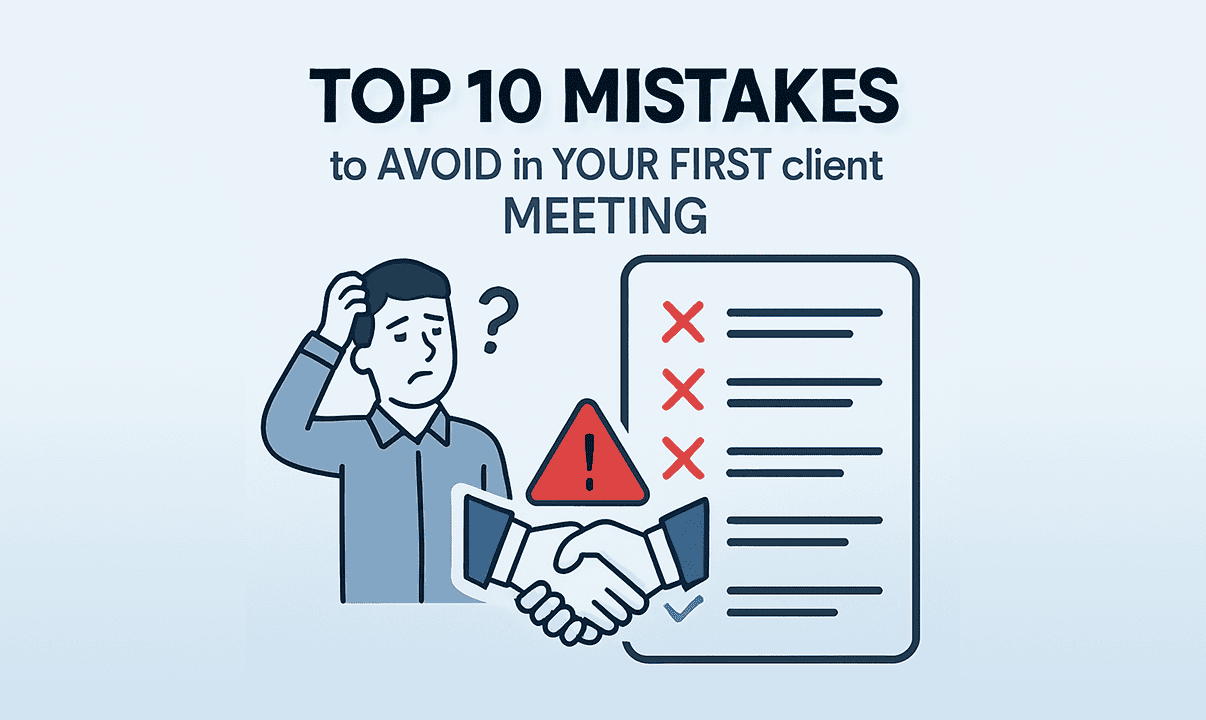
  • Top 10 Mistakes to Avoid in Your First Client Meeting

    Top 10 Mistakes to Avoid in Your First Client Meeting

    Common pitfalls and how to make a confident, credible impression.


    The first client meeting can make or break your professional relationship. It’s your chance to set the tone, build trust, and show that you’re the right person—or team—for the job. Whether you’re a freelancer, consultant, agency, or business owner, that first impression matters more than your pitch deck or pricing sheet.

    But too many professionals fumble in those early moments—not because they’re unqualified, but because of avoidable missteps.

    Top 10 Mistakes to Avoid in Your First Client Meeting

    Here are the top 10 mistakes to avoid in your first client meeting—and how to ensure you walk out leaving a confident, credible impression.


    1. Walking In Unprepared

    Mistake: Showing up without knowing the client’s business, goals, or challenges.

    Fix: Do your homework. Review their website, recent news, social media, and competitors. Understand their industry language and current pain points. Preparation reflects professionalism.


    2. Talking Too Much, Listening Too Little

    Mistake: Dominating the conversation with your pitch or services.

    Fix: Ask open-ended questions and truly listen. Your goal is to understand before you propose anything. Remember: the more the client talks, the more insight you gain.


    3. Skipping the Agenda

    Mistake: Letting the meeting run without structure.

    Fix: Start with a simple outline:

    “Just to keep us on track, I’d love to cover X, Y, and Z in the next 30 minutes. Sound good?”

    It shows leadership and time respect—two things clients love.


    4. Overselling Too Early

    Mistake: Jumping into pricing or pitching before understanding the client’s needs.

    Fix: Take time to diagnose their situation. Think like a doctor—you wouldn’t prescribe before asking questions. Build a solution with them, not at them.


    5. Using Too Much Jargon

    Mistake: Overloading the conversation with technical or industry-heavy language.

    Fix: Keep things clear and conversational. Simplicity doesn’t dilute your expertise—it amplifies it. Your client needs to feel confident they understand what they’re investing in.


    6. Being Too Casual (or Too Formal)

    Mistake: Coming across as overly relaxed or overly stiff.

    Fix: Read the room and mirror their tone. If they’re corporate, maintain professionalism. If they’re relaxed, warm up your tone—but keep it respectful and focused.


    7. Ignoring Body Language

    Mistake: Focusing only on your slides or notes, missing visual cues.

    Fix: Maintain eye contact, smile, nod when they speak, and watch their expressions for interest or hesitation. Non-verbal signals often speak louder than words.


    8. Not Taking Notes

    Mistake: Trusting memory alone for important client inputs.

    Fix: Take light, active notes—especially when they share goals, concerns, or decision-making timelines. It shows attentiveness and ensures accurate follow-ups.


    9. Ending Vaguely

    Mistake: Wrapping up with “Let’s touch base soon.”

    Fix: Be specific about next steps:

    “I’ll send a proposal by Thursday, and we can schedule a review early next week—how does Monday 11 AM sound?”

    Clear actions give confidence that you’re organized and committed.


    10. Not Following Up

    Mistake: Waiting for the client to reach out after the meeting.

    Fix: Send a thank-you email within 24 hours, recapping key discussion points, deliverables, and deadlines. It leaves a lasting, professional impression.


    ✅ Bonus Tip: Show Enthusiasm—Genuinely

    While professionalism is important, don’t forget to let your passion shine through. Clients want to work with people who want to work with them.

    Say things like:

    “I’m genuinely excited about the potential to work together.”
    “I believe we can bring real value to your vision.”

    Authenticity sells better than any pitch.


    💬 Final Thoughts

    Your first client meeting is more than a formality—it’s a chance to build trust, showcase your clarity, and plant the seeds for a strong partnership. Avoiding these ten common mistakes doesn’t require genius—just intentionality and empathy.

    So prep well, listen more than you speak, and end with clarity. Do that, and clients won’t just remember you—they’ll want to work with you again.

  • Cheque Book Request Letter – Things to Keep in Mind and Sample Letters

    A cheque book is an essential tool for many bank account holders, facilitating various financial transactions. When your cheque book is nearing its end or you need a new one, a formal request letter to your bank is necessary. This article will guide you through the process of writing a clear and effective cheque book request letter, including helpful samples.  

    Writing a Cheque Book Request Letter

    When drafting a cheque book request letter, maintain a professional tone and include the following key information:

    • Your Contact Information: Include your name, address, and contact number.
    • Date: Write the date of the letter.
    • Bank’s Contact Information: Include the bank manager’s name, the bank’s name, and the branch address.
    • Subject Line: Clearly state the purpose of the letter (e.g., “Request for New Cheque Book”).
    • Salutation: Address the bank manager respectfully (e.g., “Dear Sir/Madam”).  
    • Body of the Letter:
      • Clearly state your account number and account type.
      • Mention the reason for requesting a new cheque book (e.g., “My current cheque book is nearing its end,” or “I require a new cheque book for my transactions.”).
      • Request the issuance of a new cheque book.
      • If you have a preference for the number of leaves in the cheque book, mention it.
    • Closing: Use a polite closing (e.g., “Thank you,” “Sincerely”).  
    • Signature: Sign the letter and include your printed name.

    Sample Cheque Book Request Letter

    [Your Name]
    [Your Address]
    [Your Phone Number]
    [Date]
    
    The Branch Manager
    [Bank Name]
    [Branch Address]
    
    Subject: Request for New Cheque Book - Account Number [Your Account Number]
    
    Dear Sir/Madam,
    
    I am writing to request a new cheque book for my [Account Type] account, with account number [Your Account Number], held at your [Branch Name] branch.
    
    My current cheque book is nearing its end, and I require a new one to continue my financial transactions smoothly.
    
    I kindly request you to issue a new cheque book at your earliest convenience. I prefer a cheque book with 25 leaves.
    
    Thank you for your prompt attention to this matter.
    
    Sincerely,
    
    [Your Signature]
    [Your Printed Name]
    

    Application for Cheque Book Issue

    [Your Name]
    [Your Address]
    [Your Phone Number]
    [Date]
    
    The Branch Manager
    [Bank Name]
    [Branch Address]
    
    Subject: Application for Cheque Book Issue - Account Number [Your Account Number]
    
    Dear Sir/Madam,
    
    I am writing to apply for the issue of a new cheque book for my [Account Type] account, account number [Your Account Number], at your branch.
    
    I require a new cheque book for my day to day transactions.
    
    Please process my request and inform me when the cheque book is ready for collection.
    
    Thank you for your assistance.
    
    Sincerely,
    
    [Your Signature]
    [Your Printed Name]
    

    Cheque Book Request Letter to Bank

    [Your Name]
    [Your Address]
    [Your Phone Number]
    [Date]
    
    The Branch Manager
    [Bank Name]
    [Branch Address]
    
    Subject: Cheque Book Request - Account Number [Your Account Number]
    
    Dear Sir/Madam,
    
    This is a formal request for a new cheque book for my [Account Type] account, account number [Your Account Number], at your [Branch Name] branch.
    
    I am requesting this because I am running low on cheques in my current cheque book.
    
    Please let me know if any additional information is required from my side.
    
    Thank you for your time and cooperation.
    
    Sincerely,
    
    [Your Signature]
    [Your Printed Name]
    

    Application for New Cheque Book

    [Your Name]
    [Your Address]
    [Your Phone Number]
    [Date]
    
    The Branch Manager
    [Bank Name]
    [Branch Address]
    
    Subject: Application for New Cheque Book - Account Number [Account Number]
    
    Dear Sir/Madam,
    
    I am writing to request a new cheque book for my savings account, account number [Account Number].
    
    I require a new cheque book to manage my personal finances.
    
    I would appreciate it if you could issue a new cheque book with 50 pages at your earliest convenience.
    
    Thank you.
    
    Sincerely,
    
    [Your Signature]
    [Your Printed Name]
    

    FAQs on Cheque Book Request Letter Format

    Q: Do I need to provide a reason for requesting a new cheque book?

    A: While not always mandatory, providing a brief reason can help the bank understand your needs.

    Q: Can I request a cheque book via email or online banking?

    A: Many banks now offer online cheque book request options through their websites or mobile apps. However, a formal letter is still widely accepted.  

    Q: How long does it take to receive a new cheque book?

    A: The processing time varies depending on the bank. It usually takes a few business days.

    Q: What documents do I need to include with my request?

    A: Typically, no additional documents are required. However, always confirm with your bank for their specific requirements.

  • Salary Increment Letter – How to Write, Format and Samples

    A salary increment letter is a formal document that informs an employee of their well-deserved pay increase. This letter not only communicates the change in compensation but also acknowledges the employee’s contributions and value to the company. On the other hand, employees can also write request letters to their employers. This article will guide you through the process of writing both types of salary increment letters, including the correct format and useful samples.  

    Writing a Salary Increment Letter

    When drafting a salary increment letter, it’s essential to maintain a professional and positive tone. Here are some key points to consider:

    • Clarity and Conciseness: Clearly state the employee’s new salary, the effective date of the increase, and any other relevant details.  
    • Acknowledgement of Performance: Briefly mention the employee’s contributions and achievements that led to the increment.  
    • Positive Tone: Express appreciation for the employee’s hard work and dedication.
    • Additional Benefits (Optional): If applicable, mention any additional benefits or changes in compensation.  
    • Formal Language: Use professional language and avoid informal or ambiguous terms.

    Salary Increment Letter Format

    A standard salary increment letter should follow this format:

    • Company Letterhead: Include the company’s logo and contact information.
    • Date: The date the letter is written.
    • Employee’s Information: The employee’s name, job title, and employee ID (if applicable).  
    • Subject Line: A clear subject line, such as “Salary Increment Notification.”
    • Salutation: A formal greeting, like “Dear [Employee’s Name].”  
    • Body of the Letter:
      • State the new salary and the effective date.  
      • Briefly mention the employee’s performance and contributions.  
      • Express appreciation for their work.
      • Mention any additional benefits or changes.
    • Closing: A polite closing, such as “Sincerely” or “Best Regards.”  
    • Signature: The signature of the authorized signatory and their typed name.

    Sample Salary Increment Letters

    [Company Letterhead]
    [Date]
    
    [Employee's Name]
    [Employee's Job Title]
    [Employee ID]
    
    Subject: Salary Increment Notification
    
    Dear [Employee's Name],
    
    We are pleased to inform you that your salary has been increased to $[New Salary] per [Period], effective [Effective Date].
    
    This increment is a recognition of your consistent hard work, dedication, and valuable contributions to the company, particularly your work on the [Project Name] project. Your performance has consistently exceeded our expectations.
    
    We appreciate your commitment to [Company Name] and look forward to your continued success.
    
    [Optional: mention additional benefits]
    
    Sincerely,
    
    [Signature]
    [Authorized Signatory's Name]
    [Authorized Signatory's Title]
    

    Salary Increment Request Letter Sample

    [Your Name]
    [Your Employee ID]
    [Your Department]
    [Date]
    
    [Supervisor's Name]
    [Supervisor's Title]
    [Company Name]
    
    Subject: Request for Salary Increment
    
    Dear [Supervisor's Name],
    
    I am writing to formally request a review of my current salary. I have been with [Company Name] for [Duration], and during this time, I have consistently met and exceeded my performance goals.
    
    Specifically, I have [Mention key achievements and contributions]. I have also taken initiative in [Mention any additional responsibilities or projects].
    
    Given my contributions and the current market rates for my position, I believe a salary increment is warranted. I am confident that I will continue to be a valuable asset to the company.
    
    I would appreciate the opportunity to discuss my compensation in more detail at your convenience.
    
    Thank you for your consideration.
    
    Sincerely,
    
    [Your Signature]
    [Your Typed Name]
    

    Increment Request Letter Sample

    Subject: Increment Request
    
    Dear [Supervisor's Name],
    
    I hope this email finds you well.
    
    I am writing to respectfully request a review of my current compensation. Having worked at [Company Name] for [duration], I have consistently demonstrated a strong commitment to my role and the company's objectives.
    
    During my time here, I have achieved [list achievements]. I am confident that these contributions have positively impacted our team and the company.
    
    I am eager to continue growing with [Company Name] and believe that an increment would reflect my value and dedication.
    
    Thank you for considering my request.
    
    Best regards,
    
    [Your Name]
    [Your Employee ID]
    

    Salary Appraisal Request Mail

    Subject: Request for Salary Appraisal
    
    Dear [Supervisor's Name],
    
    I hope this email finds you well.
    
    I am writing to request a salary appraisal. As you know, I have been with [Company Name] for [duration] and have consistently performed well in my role.
    
    I would appreciate the opportunity to discuss my performance and compensation. Please let me know when it would be convenient for us to meet.
    
    Thank you for your time and consideration.
    
    Best regards,
    
    [Your Name]
    

    FAQs on Salary Increment Request Letter Format

    Q: How often should I request a salary increment?

    A: It depends on your company’s policies and your performance. Generally, annual or bi-annual reviews are common.

    Q: What information should I include in my increment request letter?

    A: Include your achievements, contributions, and any relevant market data to support your request.

    Q: Should I send my request letter via email or in person?

    A: Email is generally acceptable, but follow your company’s preferred communication method.

    Q: What if my increment request is denied?

    A: Ask for feedback on areas for improvement and discuss potential future opportunities for salary increases.Sources and related content

  • Relieving Letter – Format and How to Write

    The transition from one job to another involves several crucial documents, and among them, the relieving letter holds significant importance. It serves as formal proof that an employee has been released from their duties at a company. This article delves into the format, content, and importance of a relieving letter, providing you with templates and examples to navigate this process smoothly.

    What Is a Relieving Letter?

    A relieving letter is a formal document issued by an employer to an employee upon their resignation or termination. It confirms the employee’s release from their duties and specifies the last working day. This document is often required by new employers for verification purposes and may also be needed for various administrative processes.

    Relieving Letter Template

    Here’s a basic template that you can adapt for your needs:

    [Company Letterhead]
    
    [Date]
    
    [Employee Name]
    [Employee Address]
    
    Subject: Relieving Letter
    
    Dear [Employee Name],
    
    This letter is to confirm that [Employee Name] was employed with [Company Name] from [Start Date] to [End Date]. During their tenure, they held the position of [Employee Designation] in the [Department Name] department.
    
    [Employee Name]'s last working day was [Last Working Day]. We acknowledge their contributions to the company and wish them all the best in their future endeavors.
    
    [Optional: Briefly mention the employee’s performance or contributions.]
    
    All dues and settlements have been cleared.
    
    Sincerely,
    
    [Authorized Signatory Name]
    [Authorized Signatory Title]
    [Company Name]
    [Company Contact Information]
    

    Examples of Relieving Letter

    Relieving Letter Request from Employee

    While the employer usually provides the letter, an employee can request one. Here’s a sample request:

    [Your Name]
    [Your Address]
    [Your Contact Information]
    [Date]
    
    [HR Department/Manager Name]
    [Company Name]
    [Company Address]
    
    Subject: Request for Relieving Letter
    
    Dear [HR Department/Manager Name],
    
    I am writing to formally request a relieving letter, as my last day of employment with [Company Name] was [Last Working Day].
    
    I require this letter for my records and for submission to my new employer.
    
    Please let me know when I can expect to receive the letter or if any further information is needed from my side.
    
    Thank you for your time and assistance.
    
    Sincerely,
    
    [Your Name]
    

    Relieving Letter from Employer

    [Company Letterhead]
    
    [Date]
    
    [Employee Name]
    [Employee Address]
    
    Subject: Relieving Letter
    
    Dear [Employee Name],
    
    This letter serves to confirm that [Employee Name] was employed with [Company Name] from [Start Date] to [End Date]. They held the position of [Employee Designation] in the [Department Name] department.
    
    Their last working day was [Last Working Day]. During their time with us, [Employee Name] consistently demonstrated [Positive Qualities/Contributions].
    
    All final settlements, including salary and any outstanding dues, have been cleared.
    
    We wish [Employee Name] success in their future career.
    
    Sincerely,
    
    [Authorized Signatory Name]
    [Authorized Signatory Title]
    [Company Name]
    

    Relieving Mail

    In some cases, a relieving letter may be sent via email. Here’s a sample:

    Subject: Relieving Letter - [Employee Name]
    
    Dear [Employee Name],
    
    Please find attached your relieving letter, confirming your release from [Company Name]. As stated in the letter, your employment period was from [Start Date] to [End Date], and your last working day was [Last Working Day].
    
    We appreciate your contributions and wish you all the best in your future endeavors.
    
    Please let us know if you have any questions.
    
    Sincerely,
    
    [Authorized Signatory Name]
    [Authorized Signatory Title]
    [Company Name]
    [Attachment: Relieving Letter.pdf]
    

    FAQs on Relieving Letter

    Q: Is a relieving letter mandatory?

    A: While not legally mandatory in all jurisdictions, it is a standard practice and often required by new employers.

    Q: What information should a relieving letter include?

    A: It should include the employee’s name, employment period, designation, last working day, and confirmation of clearance of dues.

    Q: Can an employee request a relieving letter?

    A: Yes, an employee can request a relieving letter, especially if the employer does not provide it automatically.

    Q: How long does it take to receive a relieving letter?

    A: It varies by company policy, but it is typically issued within a few days to a week after the employee’s last working day.

    Q: What is the difference between a relieving letter and an experience certificate?

    A: A relieving letter confirms the release from employment, while an experience certificate details the employee’s roles and responsibilities and experience gained. They are often combined into one document.

  • Order Letter – How to Write with Samples

    An order letter is a formal document used to request goods or services from a supplier or vendor. It serves as a written record of the transaction, detailing the items ordered, quantities, specifications, and delivery instructions. A well-written order letter ensures clarity, avoids misunderstandings, and establishes a professional business relationship. This article will guide you through the process of writing an effective order letter, including formats and sample letters.

    How to Write an Order Letter?

    Writing an order letter involves several key steps to ensure accuracy and clarity:

    1. Start with your company’s information: Include your company name, address, and contact details.
    2. Add the supplier’s information: Write the supplier’s company name, address, and contact details.
    3. Include the date: Clearly state the date of the order.
    4. Use a clear subject line: For example, “Order for [Items/Services]” or “Purchase Order Number [Number].”
    5. Clearly list the items or services: Provide detailed descriptions, quantities, and specifications.
    6. Specify the unit price and total price: Include the cost of each item and the total cost of the order.
    7. Mention the delivery details: Include the delivery address, preferred delivery date, and any special instructions.
    8. State the payment terms: Specify the payment method and any applicable terms.
    9. Include your purchase order number: If applicable, provide your company’s purchase order number for reference.
    10. Close with a professional tone: Express gratitude and include your contact information for any queries.

    Order Letter Format

    Here’s the standard format for an order letter:

    [Your Company Name]
    [Your Company Address]
    [Your Phone Number]
    [Your Email Address]
    
    [Date]
    
    [Supplier's Company Name]
    [Supplier's Address]
    [Supplier's Phone Number]
    [Supplier's Email Address]
    
    Subject: Order for [Items/Services] - Purchase Order Number [Number]
    
    Dear Sir/Madam,
    
    Please process the following order:
    
    | Item Description | Quantity | Unit Price | Total Price |
    |------------------|----------|------------|-------------|
    | [Item 1]         | [Number] | $[Amount]  | $[Amount]   |
    | [Item 2]         | [Number] | $[Amount]  | $[Amount]   |
    | [Item 3]         | [Number] | $[Amount]  | $[Amount]   |
    | [Total]          |          |            | $[Total]    |
    
    Delivery Address: [Delivery Address]
    Preferred Delivery Date: [Date]
    Payment Terms: [Payment Terms]
    
    Please confirm the receipt of this order and the estimated delivery date.
    
    If you have any questions, please contact me at [Your Phone Number] or [Your Email Address].
    
    Thank you for your prompt attention to this matter.
    
    Sincerely,
    
    [Your Signature]
    [Your Typed Name]
    [Your Title]
    

    Order Letter Examples

    Here are a few sample order letters for different scenarios:

    Purchase Letter Format – Order for Books

    ABC Bookstore
    123 Main Street
    Anytown, CA 12345
    (555) 123-4567
    orders@abcbookstore.com
    
    October 26, 2023
    
    XYZ Publishing
    456 Oak Avenue
    Anytown, CA 12346
    (555) 987-6543
    sales@xyzpublishing.com
    
    Subject: Order for Books - Purchase Order Number ABC-123
    
    Dear Sir/Madam,
    
    Please process the following order for books:
    
    | Book Title  | Author        | Quantity | Unit Price | Total Price |
    |-------------|---------------|----------|------------|-------------|
    | Mathematics | John Smith    | 50       | $15.00     | $750.00     |
    | History     | Jane Doe      | 30       | $20.00     | $600.00     |
    | Science     | David Lee     | 20       | $12.00     | $240.00     |
    | Total       |               |          |            | $1590.00    |
    
    Delivery Address: 123 Main Street, Anytown, CA 12345
    Preferred Delivery Date: November 10, 2023
    Payment Terms: Net 30 days
    
    Please confirm the receipt of this order and the estimated delivery date.
    
    If you have any questions, please contact me at (555) 123-4567 or orders@abcbookstore.com.
    
    Thank you for your prompt attention to this matter.
    
    Sincerely,
    
    [Your Signature]
    [Your Typed Name]
    Purchasing Manager
    

    Business Order Letter – Purchase of Stationery Supplies

    Tech Solutions Inc.
    789 Pine Lane
    Anytown, CA 12347
    (555) 456-7890
    purchasing@techsolutions.com
    
    October 26, 2023
    
    Office Supplies Depot
    100 Maple Drive
    Anytown, CA 12348
    (555) 789-0123
    sales@officesuppliesdepot.com
    
    Subject: Order for Stationery Supplies - Purchase Order Number TS-456
    
    Dear Sir/Madam,
    
    Please process the following order for stationery supplies:
    
    | Item Description   | Quantity | Unit Price | Total Price |
    |--------------------|----------|------------|-------------|
    | A4 Paper Reams     | 10       | $5.00      | $50.00      |
    | Ballpoint Pens     | 100      | $0.50      | $50.00      |
    | Stapler Machines   | 5        | $10.00     | $50.00      |
    | Total              |          |            | $150.00     |
    
    Delivery Address: 789 Pine Lane, Anytown, CA 12347
    Preferred Delivery Date: November 5, 2023
    Payment Terms: Credit Card
    
    Please confirm the receipt of this order and the estimated delivery date.
    
    If you have any questions, please contact me at (555) 456-7890 or purchasing@techsolutions.com.
    
    Thank you for your prompt attention to this matter.
    
    Sincerely,
    
    [Your Signature]
    [Your Typed Name]
    Purchasing Officer
    

    Sample Order Letter – Response to the Order Letter from the Buyer

    This is an example of a confirmation letter from the supplier to the buyer.

    Office Supplies Depot
    100 Maple Drive
    Anytown, CA 12348
    (555) 789-0123
    sales@officesuppliesdepot.com
    
    October 27, 2023
    
    Tech Solutions Inc.
    789 Pine Lane
    Anytown, CA 12347
    
    Subject: Confirmation of Order - Purchase Order Number TS-456
    
    Dear Purchasing Officer,
    
    This letter is to confirm that we have received your order (Purchase Order Number TS-456) for stationery supplies.
    
    We have begun processing your order and anticipate that it will be ready for delivery on November 5, 2023, as requested.
    
    Thank you for your business.
    
    Sincerely,
    
    [Your Signature]
    [Your Typed Name]
    Sales Representative
    

    FAQs on Order Letter Format

    Q: Is an email order acceptable?

    A: Yes, email orders are commonly accepted, but it’s essential to maintain a formal tone and include all necessary details.

    Q: Do I need to include a purchase order number?

    A: If your company uses purchase order numbers, it’s crucial to include them for tracking purposes.

    Q: How do I specify special delivery instructions?

    A: Clearly state any special delivery instructions in the delivery details section of the letter.

    Q: What if I need to change or cancel an order?

    A: Contact the supplier immediately and provide your purchase order number. Follow up with a written confirmation of the change or cancellation.

  • Appointment Letter – How to Write, Format, and Samples

    An appointment letter is a formal document issued by an employer to a successful candidate, offering them a position within the company. It outlines the terms and conditions of employment, including the job title, salary, start date, and other essential details. This letter serves as a legal agreement and provides clarity to both the employer and the employee. A well-written appointment letter is crucial for establishing a professional relationship from the outset.

    Appointment Letter Format – Details to be Included and How to Write

    To ensure clarity and avoid future disputes, an appointment letter should include the following details:

    1. Company Letterhead: Include the company’s name, logo, address, and contact information.
    2. Date: The date the letter is issued.
    3. Employee’s Details: The employee’s full name, address, and contact information.
    4. Subject Line: A clear subject line, such as “Appointment Letter for [Job Title].”
    5. Salutation: A formal greeting, like “Dear [Employee’s Name].”
    6. Job Title and Description: The exact job title and a brief description of the responsibilities.
    7. Start Date: The date the employee is expected to begin working.
    8. Salary and Benefits: Details of the employee’s salary, including the payment frequency, and any benefits such as health insurance, retirement plans, etc.
    9. Working Hours and Location: The standard working hours and the location where the employee will be working.
    10. Terms and Conditions: Any specific terms and conditions of employment, such as probationary period, leave policy, and termination clauses.
    11. Reporting Structure: Who the employee will report to.
    12. Company Policies: A statement that the employee is expected to adhere to the company’s policies and procedures.
    13. Acceptance Clause: A section for the employee to sign and return, indicating their acceptance of the offer.
    14. Signature and Company Stamp: The signature of the authorized signatory and the company stamp.

    Appointment Letter Samples

    Here are a few sample appointment letters for different scenarios:

    Appointment Letter for Employee

    [Company Letterhead]
    
    [Date]
    
    [Employee's Name]
    [Employee's Address]
    [Employee's Contact Information]
    
    Subject: Appointment Letter for Software Developer
    
    Dear [Employee's Name],
    
    We are pleased to offer you the position of Software Developer at [Company Name]. We were impressed with your skills and experience during the interview process.
    
    Your start date will be [Start Date]. Your responsibilities will include [Brief Description of Responsibilities].
    
    Your annual salary will be $[Salary], paid [Payment Frequency]. You will also be eligible for [Benefits].
    
    Your working hours will be [Working Hours] at our [Location] office. You will report to [Reporting Manager's Name].
    
    This appointment is subject to a probationary period of [Probation Period]. You are expected to adhere to all company policies and procedures.
    
    Please sign and return a copy of this letter to indicate your acceptance of this offer.
    
    Sincerely,
    
    [Authorized Signatory's Name]
    [Authorized Signatory's Title]
    [Company Stamp]
    
    Acceptance:
    
    I, [Employee's Name], accept the terms and conditions of this appointment.
    
    Signature: _________________________
    
    Date: _________________________
    

    Job Appointment Letter

    [Company Letterhead]
    
    [Date]
    
    [Employee's Name]
    [Employee's Address]
    [Employee's Contact Information]
    
    Subject: Job Appointment Offer - Marketing Associate
    
    Dear [Employee's Name],
    
    Following your successful interview, we are delighted to offer you the position of Marketing Associate at [Company Name].
    
    Your employment will commence on [Start Date]. Your main duties will involve [Briefly describe duties].
    
    Your compensation will be $[Salary] per [Payment Frequency], along with benefits that include [Benefits].
    
    Your regular work schedule will be [Work Schedule], performed at our [Location] facility.
    
    This position is subject to [Terms].
    
    Please confirm your acceptance of this offer by signing and returning this letter by [Date].
    
    We look forward to welcoming you to our team.
    
    Regards,
    
    [Hiring Manager Name]
    [Hiring Manager Title]
    [Company Stamp]
    

    Appointment Order by Mail

    [Company Letterhead]
    
    [Date]
    
    [Employee's Name]
    [Employee's Address]
    
    Subject: Appointment Order - [Job Title]
    
    Dear [Employee's Name],
    
    This letter serves as formal notification of your appointment as [Job Title] at [Company Name], effective [Start Date].
    
    Your responsibilities will include [Brief Description]. Your salary will be $[Salary] per [Payment Frequency].
    
    Your working hours will be from [Start Time] to [End Time], and you will be based at our [Location] office.
    
    Please review the attached employee handbook for company policies.
    
    Kindly sign and return a copy of this letter within [Number] days to confirm your acceptance.
    
    Sincerely,
    
    [Authorized Signatory Name]
    [Title]
    [Company Stamp]
    

    FAQs on Appointment Letter Format

    Q: Is an appointment letter legally binding?

    A: Yes, an appointment letter is a legally binding document once it is signed and accepted by the employee.

    Q: Can the employer change the terms of the appointment letter?

    A: Any changes to the terms of the appointment letter should be mutually agreed upon and documented in writing.

    Q: What should I do if I find errors in my appointment letter?

    A: Immediately notify the employer and request a corrected version of the letter.

    Q: Should the appointment letter include a confidentiality clause?

    A: Yes, it is common to include a confidentiality clause to protect the company’s sensitive information.

  • Apology Letter Format – How to Write and Apology Letter Samples

    An apology letter is a powerful tool for repairing relationships and restoring trust. Whether in personal or professional settings, a sincere apology can mitigate the impact of mistakes and demonstrate accountability. This article will guide you through the essential components of an effective apology letter and provide practical samples for various situations.

    How to Write an Apology Letter?

    A well-crafted apology letter should be sincere, concise, and focused on taking responsibility. Here’s a step-by-step guide:

    1. Start with a Clear Apology:
      • Begin by explicitly stating your apology. Use phrases like “I sincerely apologize” or “Please accept my apologies.”
    2. Acknowledge the Mistake:
      • Clearly state what you did wrong. Avoid making excuses or shifting blame.
    3. Take Responsibility:
      • Use “I” statements to show that you are taking ownership of your actions.
    4. Express Remorse:
      • Show genuine regret for the impact of your mistake.
    5. Offer an Explanation (If Necessary):
      • If appropriate, provide a brief explanation without making excuses.
    6. Offer to Make Amends:
      • If possible, suggest ways to rectify the situation.
    7. Promise to Prevent Recurrence:
      • Assure the recipient that you will take steps to prevent the mistake from happening again.
    8. End on a Positive Note:
      • Reiterate your apology and express hope for reconciliation.
    9. Format Appropriately:
      • For formal Letters include your contact information, the date, and the recipients information.
      • For emails, a clear subject line is important.
      • Maintain a professional tone.

    Apology Letter Samples

    Here are some sample apology letters for different scenarios:

    Formal Apology Letter for Delivery of Damaged Products

    [Your Name/Company Name]
    [Your Address]
    [Your Phone Number]
    [Your Email Address]
    
    [Date]
    
    [Recipient's Name/Company Name]
    [Recipient's Address]
    
    Subject: Apology for Delivery of Damaged Products
    
    Dear [Recipient's Name],
    
    Please accept our sincerest apologies for the delivery of damaged products in your recent order [Order Number]. We deeply regret the inconvenience and frustration this has caused you.
    
    Upon investigation, we have determined that the damage occurred during [Brief Explanation, e.g., transit/packaging]. We take full responsibility for this error.
    
    We are committed to rectifying this situation immediately. We will arrange for a replacement shipment of your order, free of charge, to be delivered within [Number] business days. Additionally, we would like to offer [Offer, e.g., a discount on your next purchase] as a gesture of our apology.
    
    We are implementing stricter quality control measures to prevent such incidents from occurring in the future.
    
    Thank you for your understanding. We value your business and hope to restore your confidence in our company.
    
    Sincerely,
    
    [Your Signature]
    [Your Typed Name/Company Name]
    

    Official Apology Letter for Delay in Supply of Garments

    [Your Name/Company Name]
    [Your Address]
    [Your Phone Number]
    [Your Email Address]
    
    [Date]
    
    [Recipient's Name/Company Name]
    [Recipient's Address]
    
    Subject: Apology for Delay in Supply of Garments
    
    Dear [Recipient's Name],
    
    We sincerely apologize for the delay in the supply of garments, as per our agreement dated [Date of Agreement]. We understand the impact this delay has had on your operations.
    
    The delay was due to [Brief Explanation, e.g., unforeseen production issues/supplier delays]. We acknowledge our failure to meet the agreed-upon delivery schedule and take full responsibility.
    
    We are working diligently to expedite the process and anticipate the delivery of the garments by [New Delivery Date]. We are also implementing [Steps taken to prevent future delays].
    
    We value your partnership and deeply regret any inconvenience caused.
    
    Sincerely,
    
    [Your Signature]
    [Your Typed Name/Company Name]
    

    Apology Mail Format for Missing to Mark Attendance

    Subject: Apology for Missing to Mark Attendance - [Your Name]
    
    Dear [Supervisor's Name],
    
    Please accept my sincere apologies for missing to mark my attendance on [Date]. I understand the importance of accurate attendance records and regret my oversight.
    
    [Brief Explanation, e.g., I was dealing with an urgent matter and forgot to log in/My system had a technical issue].
    
    I will ensure that I am more diligent in marking my attendance in the future.
    
    Thank you for your understanding.
    
    Sincerely,
    
    [Your Name]
    [Your Employee ID]
    

    FAQs on Apology Letter Format

    Q: Should I always provide a reason for my mistake?

    A: Providing a brief explanation can help the recipient understand the situation, but avoid making excuses.

    Q: How soon should I send an apology letter?

    A: Send the apology as soon as possible after the incident. Promptness demonstrates sincerity.

    Q: Should I apologize in person or in writing?

    A: It depends on the situation. For formal or serious matters, a written apology is often preferred. For minor issues, a verbal apology may suffice.

    Q: What should I avoid in an apology letter?

    A: Avoid blaming others, making excuses, minimizing the impact of your mistake, or being defensive.

  • Writing a Leave Application for Personal Work – Format and Samples

    Taking leave for personal reasons is a common practice in any workplace. Whether it’s for medical appointments, family obligations, or essential personal tasks, it’s crucial to communicate your absence to your employer or supervisor in a professional and clear manner. A well-written leave application ensures that your request is understood and processed efficiently. This article provides a guide on how to write a leave application for personal work, including the correct format and useful samples.

    Personal Leave Application Format

    A standard personal leave application should include the following elements:

    • Your Contact Information: Your name, employee ID (if applicable), and department.
    • Date: The date you are writing the application.
    • Recipient’s Information: The name and title of your supervisor or HR department.
    • Subject Line: A clear subject line, such as “Leave Application – Personal Work.”
    • Salutation: A professional greeting, like “Dear [Supervisor’s Name].”
    • Body of the Letter:
      • Clearly state the dates of your requested leave.
      • Briefly mention the reason for your leave (you don’t always need to go into great detail, but be clear).
      • Assure your supervisor that you will complete any urgent tasks or delegate them appropriately.
      • Provide contact information if you need to be reached during your leave.
    • Closing: A polite closing, such as “Thank you” or “Sincerely.”
    • Signature: Your signature and typed name.

    Leave Application Samples for You

    Here are some sample leave applications for various personal reasons:

    Sample Leave Request for Personal Reasons – Eye Checkup

    [Your Name]
    [Your Employee ID]
    [Your Department]
    [Date]
    
    [Supervisor's Name]
    [Supervisor's Title]
    [Company Name]
    
    Subject: Leave Application - Personal Eye Checkup
    
    Dear [Supervisor's Name],
    
    I am writing to request a leave of absence for one day, on [Date], for a scheduled eye checkup appointment.
    
    I have scheduled this appointment for [Time] and will need to be away from the office for the day. I have completed [Urgent Task] and will ensure that [Colleague's Name] is briefed on any pending matters.
    
    I can be reached at [Your Phone Number] if necessary.
    
    Thank you for your consideration.
    
    Sincerely,
    
    [Your Signature]
    [Your Typed Name]
    

    Sample Leave Application for Personal Work – Child’s Parent-Teacher Meeting

    [Your Name]
    [Your Employee ID]
    [Your Department]
    [Date]
    
    [Supervisor's Name]
    [Supervisor's Title]
    [Company Name]
    
    Subject: Leave Application - Child's Parent-Teacher Meeting
    
    Dear [Supervisor's Name],
    
    I am writing to request a half-day leave on [Date] to attend my child’s parent-teacher meeting at [School Name].
    
    The meeting is scheduled for [Time]. I plan to be back in the office by [Return Time]. I will complete any urgent tasks before leaving and will check my email periodically.
    
    Thank you for your understanding.
    
    Sincerely,
    
    [Your Signature]
    [Your Typed Name]
    

    Sample Personal Leave Application Mail – Renewal of Driving Licence

    Subject: Leave Application - Renewal of Driving Licence
    
    Dear [Supervisor's Name],
    
    I am writing to request a leave of absence for one day, [Date], to renew my driving licence.
    
    This is a necessary personal task that requires my presence at the [Licensing Authority Name] office. I will complete any urgent tasks before I leave.
    
    I can be reached on my mobile phone at [Your Phone Number] if required.
    
    Thank you for your consideration.
    
    Regards,
    
    [Your Name]
    [Your Employee ID]
    

    Frequently Asked Questions on Personal Leave Application Format

    Q: How much detail should I provide about my personal reason?

    A: It’s usually sufficient to provide a brief and general reason. You don’t need to disclose highly personal details unless you feel comfortable doing so.

    Q: Should I submit a leave application via email or in person?

    A: It depends on your company’s policy. Email is commonly accepted, but if you’re unsure, ask your supervisor or HR department.

    Q: How far in advance should I submit my leave application?

    A: As early as possible. Ideally, at least a few days in advance, especially for planned leaves. However, for urgent personal matters, inform your supervisor as soon as you can.

    Q: What if my leave request is denied?

    A: Discuss the reasons for the denial with your supervisor and try to find a mutually agreeable solution. Be prepared to provide additional information or adjust your leave dates if possible.

  • Job Application Letter Format – How to Write and Sample Letters

    A job application letter, also known as a cover letter, is a crucial part of your job application. It serves as an introduction to your resume, highlighting your qualifications and expressing your interest in the position. A well-written application letter can significantly increase your chances of securing an interview. This article will guide you through the essential components of a job application letter and provide sample letters to help you create a compelling application.

    Writing a Job Application Letter – What Recruiters Expect?

    Recruiters look for specific qualities in a job application letter. Here’s what they expect:

    • Clarity and Conciseness: The letter should be easy to read and get straight to the point.
    • Relevance: It should highlight skills and experiences relevant to the job description.
    • Professionalism: The tone should be formal and respectful.
    • Personalization: It should demonstrate that you’ve researched the company and the position.
    • Enthusiasm: It should convey your genuine interest in the role.
    • Proofreading: Error-free writing is essential.

    Key Components of a Job Application Letter

    1. Your Contact Information: Include your name, address, phone number, and email address.
    2. Date: Write the date you’re sending the letter.
    3. Employer’s Contact Information: Include the recipient’s name (if known), company name, and address.
    4. Salutation: Address the recipient formally (e.g., “Dear Mr./Ms. [Last Name]”).
    5. Introduction: Briefly state the position you’re applying for and how you learned about it.
    6. Body Paragraphs:
      • Highlight your relevant skills and experiences.
      • Explain why you’re a good fit for the company.
      • Connect your qualifications to the job requirements.
    7. Closing Paragraph: Express your interest in an interview and thank the recipient.
    8. Closing: Use a professional closing (e.g., “Sincerely,” “Respectfully”).
    9. Signature: Sign the letter and include your typed name.

    Sample Job Application Letters for You

    Formal Letter for Job Application for the Position of Cryptographer

    [Your Name]
    [Your Address]
    [Your Phone Number]
    [Your Email Address]
    
    [Date]
    
    [Hiring Manager Name] (If known, otherwise use title)
    [Company Name]
    [Company Address]
    
    Dear [Mr./Ms./Mx. Last Name],
    
    I am writing to express my keen interest in the Cryptographer position at [Company Name], as advertised on [Platform where you saw the advertisement]. With my extensive background in cryptography and my proven ability to develop and implement secure algorithms, I am confident I possess the skills and experience necessary to excel in this role.
    
    In my previous role at [Previous Company], I was responsible for [Specific responsibilities related to cryptography]. I have a strong foundation in [Relevant technical skills, e.g., encryption techniques, security protocols]. My academic background, including a [Your Degree] in [Your Field] from [University Name], has further equipped me with the theoretical and practical knowledge required for this position.
    
    I am particularly drawn to [Company Name]'s commitment to [Company's mission or values]. I am eager to contribute my expertise to your team and help ensure the security of your data.
    
    Thank you for considering my application. I have attached my resume for your review and welcome the opportunity to discuss my qualifications further in an interview.
    
    Sincerely,
    
    [Your Signature]
    [Your Typed Name]
    

    Sample Job Application Letter for the Post of High School English Teacher

    [Your Name]
    [Your Address]
    [Your Phone Number]
    [Your Email Address]
    
    [Date]
    
    [Hiring Manager Name] (If known, otherwise use title)
    [School Name]
    [School Address]
    
    Dear [Mr./Ms./Mx. Last Name],
    
    I am writing to apply for the High School English Teacher position at [School Name], as advertised on [Platform where you saw the advertisement]. As a passionate educator with [Number] years of experience in teaching English literature and language arts, I am excited about the opportunity to inspire and guide students at your esteemed institution.
    
    During my tenure at [Previous School], I developed and implemented engaging lesson plans that fostered critical thinking and effective communication skills. I am proficient in [Relevant teaching methods, e.g., differentiated instruction, project-based learning]. My commitment to creating a positive and inclusive learning environment has consistently resulted in improved student performance.
    
    I am particularly impressed by [School Name]'s dedication to [School's values or programs]. I believe my teaching philosophy aligns with your school's mission, and I am confident that I can make a significant contribution to your English department.
    
    Thank you for your time and consideration. I have attached my resume for your review and look forward to the possibility of an interview.
    
    Sincerely,
    
    [Your Signature]
    [Your Typed Name]
    

    Sample Job Application Mail Template

    Subject: Application for [Job Title] - [Your Name]
    
    Dear [Mr./Ms./Mx. Last Name],
    
    Please find attached my resume and cover letter for the [Job Title] position at [Company Name], as advertised on [Platform where you saw the advertisement].
    
    I am very interested in this opportunity and believe my skills and experience align well with your requirements.
    
    Thank you for your time and consideration.
    
    Sincerely,
    
    [Your Name] [Your Phone Number] [Your Email Address]

    FAQs on Job Application Letter Format

    Q: Should I address the letter to a specific person?

    A: Yes, if possible. Addressing the letter to the hiring manager shows that you’ve done your research.

    Q: How long should my application letter be?

    A: Ideally, it should be one page.

    Q: Should I mention my salary expectations in the letter?

    A: It’s generally best to avoid mentioning salary expectations in the application letter.

    Q: Do I need to rephrase my resume in the cover letter?

    A: No, the cover letter should complement your resume, not repeat it. Focus on highlighting specific achievements and experiences relevant to the job.