Effective teamwork creates its own set of characteristics that makes it possible to see the cohesion in a group. When an efficient team gets to work, the structure that has been put into place helps the group obtain productive results. In order to create a productive team, you first need to be able to identify the characteristics of effective teamwork.
Pillars of Effective Teamwork
Pillars of Effective Teamwork are as follows
Unified Commitment to a Goal
Participation
Open Communication
Decision Making
Efficient use of Ideas
Unified Commitment to a Goal
A team is created to complete the goals it is given. An effective team is committed to completing its goal by using the team’s resources. It does not mean that as individuals the people that make up the team share the same point of view or are all in agreement on what is best for the group. It means that when the team is presented with a goal, they can come together and work as a single unit to complete the task.
Participation
In order for a team to act as a team everyone must be participating in the creation of a solution. A team does not have extra members. Each member of a team is essential to the team’s success, and when the group is given a task, each member knows what their job is and sets out to put in their fair share of the effort.
Open Communication
A team is able to communicate effectively and there is a feeling of open communication between all members of the group. Issues within a team are handled by face-to-face communication. Team members do not talk behind each other’s back as there is a respect developed among team members that necessitates direct and open communication on all issues.
Decision-Making
A team has a hierarchy and a built-in decision-making system that helps it to react quickly and effectively to all situations. The members of the group are respected for their various areas of expertise, and the leader of the group has developed the ability to obtain the group members’ opinions to formulate the group’s response. This applies to decisions made within the group ranging from resolving internal conflict to a potential change in group leadership.
Efficient Use of Ideas
Brainstorming is one way that groups come up with the solution to a problem. An effective team is able to gather information from each member and formulate that information into a response. The team becomes adept at dismissing ideas that will not work, and including effective ideas into what would become the team’s solution to an issue.
In this article, you’ll learn about Traits of an Effective Leader and more.
The traits of an effective leader
Emotional stability. Good leaders must be able to tolerate frustration and stress. Overall, they must be well-adjusted and have the psychological maturity to deal with anything they are required to face.
Dominance. Leaders are often times competitive and decisive and usually enjoy overcoming obstacles. Overall, they are assertive in their thinking style as well as their attitude in dealing with others.
Enthusiasm. Leaders are usually seen as active, expressive, and energetic. They are often very optimistic and open to change. Overall, they are generally quick and alert and tend to be uninhibited.
Conscientiousness. Leaders are often dominated by a sense of duty and tend to be very exacting in character. They usually have a very high standard of excellence and an inward desire to do one’s best. They also have a need for order and tend to be very self-disciplined.
Social boldness. Leaders tend to be spontaneous risk-takers. They are usually socially aggressive and generally thick-skinned. Overall, they are responsive to others and tend to be high in emotional stamina.
Tough-mindedness. Good leaders are practical, logical, and to-the-point. They tend to be low in sentimental attachments and comfortable with criticism. They are usually insensitive to hardship and overall, are very poised.
Self-assurance. Self-confidence and resiliency are common traits among leaders. They tend to be free of guilt and have little or no need for approval. They are generally secure and free from guilt and are usually unaffected by prior mistakes or failures.
Compulsiveness. Leaders were found to be controlled and very precise in their social interactions. Overall, they were very protective of their integrity and reputation and consequently tended to be socially aware and careful, abundant in foresight, and very careful when making decisions or determining specific actions.
Beyond these basic traits, leaders of today must also possess traits which will help them motivate others and lead them in new directions. Leaders of the future must be able to envision the future and convince others that their vision is worth following. To do this, they must have the following personality traits:
High energy. Long hours and some travel are usually a prerequisite for leadership positions, especially as your company grows. Remaining alert and staying focused are two of the greatest obstacles you will have to face as a leader.
Intuitiveness. Rapid changes in the world today combined with information overload result in an inability to “know” everything. In other words, reasoning and logic will not get you through all situations. In fact, more and more leaders are learning to the value of using their intuition and trusting their “gut” when making decisions.
Maturity. To be a good leader, personal power and recognition must be secondary to the development of your employees. In other words, maturity is based on recognizing that more can be accomplished by empowering others than can be by ruling others.
Team orientation. Business leaders today put a strong emphasis on team work. Instead of promoting an adult/child relationship with their employees, leaders create an adult/adult relationship which fosters team cohesiveness.
Empathy. Being able to “put yourself in the other person’s shoes” is a key trait of leaders today. Without empathy, you can’t build trust. And without trust, you will never be able to get the best effort from your employees.
Charisma. People usually perceive leaders as larger than life. Charisma plays a large part in this perception. Leaders who have charisma are able to arouse strong emotions in their employees by defining a vision which unites and captivates them. Using this vision, leaders motivate employees to reach toward a future goal by tying the goal to substantial personal rewards and values.
Overall, leaders are larger than life in many ways. Personal traits play a major role in determining who will and who will not be comfortable leading others. However, it’s important to remember that people are forever learning and changing.
“I like her attitude,” “He has a good attitude,” etc. Actually, it is characterized by the tendency to feel and behave in a particular way toward some object.
What is Attitude?
A predisposition or a tendency to respond positively or negatively towards a certain idea, object, person, or situation.
Attitude influences an individual’s choice of action, and responses to challenges, incentives, and rewards (together called stimuli). An attitude can be a positive or negative evaluation of people, objects, events, activities, and ideas. It could be concrete, abstract or just about anything in your environment.
Attitude Definition
Attitudes are evaluation statements either favourable or unfavourable or unfavourable concerning objects, people or events. They reflect how one feels about something.
Robbins
Attitude as an enduring organization of motivational, emotional, perceptual and cognitive processes with respect to some aspect of the individual’s world.
Krech and Crutchfield
Attitude is a tendency or predisposition to evaluate an object or symbol of that object in a certain way.
Katz and Scotland
Attitude is a mental and neutral state of readiness organized through experience, exerting a directive or dynamic influence upon individual’s response to all objects and situations with which it is related.
G.W. Allport
ABC Model of attitude
Every attitude has three components that are represented in what is called the ABC model of attitudes:
A for affective,
B for behavioral, and
C for cognitive.
ABC Model of attitude
ABC Model of attitude formation
1.Affective Component
First, the affective component refers to the emotional reaction one has toward an attitude object. Think of someone – we’ll name her Alice – who has ophidiophobia (a phobia of snakes). A snake is an attitude object. Whenever Alice is exposed to a snake – whether she sees one or thinks about one – she feels extreme anxiety and fear. This is only one component of this specific attitude, though; we will discuss the other two components a little later in this lesson.
Now, an attitude that is stemmed from or originally created by an emotion is called an affectively-based attitude. Attitudes about hot-button issues – such as politics, sex, and
religion – tend to be affectively-based, as they usually come from a person’s values. This type of attitude is used to express and validate our moral belief or value systems.
2.Behavioral Component
The next component of an attitude is the behavioral component, and it refers to the way one behaves when exposed to an attitude object. Think about Alice and her snake phobia again. We already identified the affective component of her attitude towards snakes – fear and anxiety. How do you think she behaves when it comes to snakes? Most likely, she avoids them whenever possible. If she does see one, she probably screams or cries. This behavior is the second component of that particular attitude.
3.Cognitive Component
The third and final component of an attitude is the cognitive component, and it refers to the thoughts and beliefs one has about an attitude object. We’ve already determined that Alice avoids snakes and is scared when she is exposed to them. But, what does she think about snakes? It’s likely she believes that all snakes are dangerous and gross. Beyond the physical and emotional reactions of her phobia, there is also this cognitive component of her attitude.
Characteristics of Attitude
Attitudes are the complex combination of things we call personality, beliefs, values, behaviors, and motivations.
It can fall anywhere along a continuum from very favorable to very unfavorable.
All people, irrespective of their status or intelligence, hold attitudes.
An attitude exists in every person’s mind. It helps to define our identity, guide our actions, and influence how we judge people.
Although the feeling and belief components of attitude are internal to a person, we can view a person’s attitude from their resulting behavior.
Attitude helps us define how we see situations and define how we behave toward the situation or object.
It provides us with internal cognitions or beliefs and thoughts about people and objects.
It can also be explicit and implicit. Explicit attitude is those that we are consciously aware of an implicit attitude is unconscious, but still, affect our behaviors.
Attitudes cause us to behave in a particular way toward an object or person.
An attitude is a summary of a person’s experience; thus, an attitude is grounded in direct experience predicts future behavior more accurately.
It includes certain aspects of personality as interests, appreciation, and social conduct.
It indicates the total of a man’s inclinations and feelings.
An attitude is a point of view, substantiated or otherwise, true or false, which one holds towards an idea, object, or person.
It has aspects such as direction, intensity, generality, or specificity.
It refers to one’s readiness for doing Work.
It may be positive or negative and may be affected by age, position, and education.
A psychological process resulting from work stress that results in
Emotional exhaustion, depersonalization and feelings of decreased accomplishment.
Burnout is a type of psychological stress. Occupational burnout or job burnout is characterized by exhaustion, lack of enthusiasm and motivation, feelings of ineffectiveness.
The term burnout in psychology was coined by Herbert Freudenberger.
More recently the term brownout has been used in the business world to describe a less serious version of burnout. It refers to staff that are disengaged and de-motivated in their job role.
Occupational burnout is typically and particularly found within human service professions. One reason why burnout is so prevalent within the human services field is due to the high-stress work environment and emotional demands of the job.
Professions with high levels of burnout include social workers, nurses, teachers, lawyers, engineers, physicians, customer service representatives, and police officers.
Types of Burnout
Three types of burnout have been identified, each with their own cause:
Overload Burnout
This happens when you work harder and harder, becoming frantic in your pursuit of success. If you experience this, you may be willing to risk your health and personal life to feel successful in your job.
Under-Challenged Burnout
This happens when you feel underappreciated and bored in your job. Maybe your job doesn’t provide learning opportunities or have room for professional growth. If you feel under-challenged, you may distance yourself from your job, become cynical, and avoid responsibilities.
Neglect Burnout
This happens when you feel helpless at work. If things aren’t going right, you may believe you’re incompetent or unable to keep up with your responsibilities. Such burnout can be closely connected to imposter syndrome, a psychological pattern in which you doubt your skills, talents, or accomplishments.
Indicators of Burnout
Emotional Exhaustion
Depersonalization
Low Personal Accomplishment
Feel drained by work
Have become calloused by job
Cannot deal with problems effectively
Feel fatigued in the morning
Treat others like objects
Do not have a positive influence on others
Frustrated
Do not care what happens to other people
Cannot understand others’ problems or identify with them
Do not want to work with other people
Feel other people blame you
No longer feel exhilarated by your job
Major reasons for burnout
Major reasons for burnout are as follows:
Unmanageable workloads
Unfair treatment at work
Confusing work responsibilities
Lack of communication or support from managers
Immense deadline pressure
Dealing with burnout
Whether you recognize the warning signs of impending burnout or you’re already past the breaking point, trying to push through the exhaustion and continuing as you have been will only cause further emotional and physical damage. Now is the time to pause and change direction by learning how you can help yourself overcome burnout and feel healthy and positive again.
Dealing with burnout requires the “Three R” approach:
Recognize. Watch for the warning signs of burnout.
Reverse. Undo the damage by seeking support and managing stress.
Resilience. Build your resilience to stress by taking care of your physical and emotional health.
Ways to avoid a burnout
Burnout builds over time. It’s caused by stress at work or in other parts of your life, making it difficult to manage your job and other responsibilities. Once you’ve identified your burnout signs, there are ways to avoid a breakdown:
Talk with your Supervisor
If you are in an environment where this is possible, try to explain how you’re feeling and discuss a more manageable workload. Communication is important for creating a healthy work environment.
Get Enough Sleep
Sleep is vital for good physical and mental health. If you aren’t getting enough because of anxiety over your job, it’s likely to lead to burnout. Prioritize getting enough sleep.
Try a Relaxing Activity
Yoga, meditation, or tai chi can be great ways to release stress. Burnout symptoms can appear physically; you can hold onto stress in your body. Practicing these activities can help you release the tension.
Exercise Mindfulness
This gets you to focus on yourself internally, and know how you’re feeling in the moment. Mindfulness can help you identify when you’re feeling overwhelmed and let you take stock of your emotional well-being. It can also help you cope with challenges of life and work.
Find Support
Talking with trusted coworkers, friends, and family is an important way to share how you’re feeling and seek help. Their support can help you cope with the stressors of your job. Finding a therapist is also a great way to discuss your feelings and get support.
Get Moving
Taking at least 30 minutes of exercise is proven to have a multitude of health benefits. Not only is it good for you physically, but it can improve your sleep quality and mental health as well.
Organizational Behaviour is concerned with the understanding, prediction and control of human behaviour in organizations. It focuses on the individuals, the groups and the organization and also on their interactional relationships. It is the study and application of knowledge about how people act with organizations.
What is Organizational Behaviour ?
Organizational Behaviour is a human tool for human benefit. It applies broadly to the behaviour of people in all types of organizations. Wherever organizations are, there is a need to understand organizational behaviour.
Definitions on Organizational Behaviour
Organizational behavior can be defined as the understanding, prediction, and management of human behavior in organizations.
Fred Luthans, Organizational behavior. New Delhi; Mc Graw—Hill; 2002.p.23
Organizational behavior represents the human side of management, not the whole of management.‖
Fred Luthans, Organizational Behavior. P-24.
Organizational Behavior is the study and application of knowledge about how people act within organizations. It is a human tool for the human benefit. It applies broadly to the behavior of people in all types of organizations such as business, government, schools, etc. It helps people, structure, technology, and the external environment blend together into an effective operative system.
Keith Davis in Human Behavior at Work
Organizational behavior can be regarded as a systematic attempt to understand the behavior of people in organizations of which they are an integral part.
R.A. Sharma, Organizational Theory and behavior. New Delhi: Tata Mc Graw — Hill. P.9.
Features Of Organizational Behaviour
OB is a part of general management and not the whole of management. It represents behavioural approach to management.
OB is a human tool for human benefit. It helps in predicting the behaviour of individuals.
OB is inter-disciplinary field of study. It tries to synthesize knowledge drawn from various behavioural and social sciences such as Psychology, Sociology, Anthropology, Political-science, Economics, etc. In fact, OB is an applied behavioural sciences.
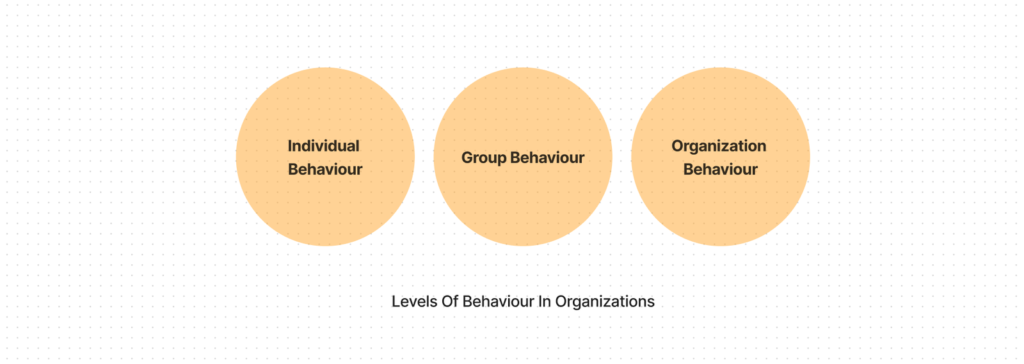
OB involves three levels of analysis of behaviour-individual behaviour, group behaviour and behaviour of the organization itself.
OB is an action-oriented and goal-directed discipline. It provides a rational thinking about people and their behaviour
OB is both a science and an art. The systematic knowledge about human behaviour is a science. The application of behvioural knowledge and skills clearly leans towards being an art.
OB seeks to fulfil both employees’ needs and organizational objectives.
Scope Of Organizational Behaviour
The scope of OB may be summed up in the words of S.P.Robbins as follows:
OB is a field of study that investigates the impact that individuals, groups, and structure have on behaviour within organizations, for the purpose of applying such knowledge towards improving an organisation’s effectiveness‖.
The scope of OB involves three levels of behaviour in organizations: Individuals, groups and structure.
In this article, you’ll learn about What is Stress, What stress is not, Hans Selye’s Model of Stress, Levels of Stress and more.
What is Stress?
Stress may be defined as “a state of psychological and/or physiological imbalance resulting from the disparity between situational demand and the individual’s ability and/or motivation to meet those demands.”
Stress is the body’s reaction to a change that requires a physical, mental or emotional adjustment or response. It can be caused by both good and bad experiences. When people feel stressed by something going on around them, their bodies react by releasing chemicals into the blood. These chemicals give people more energy and strength, which can be a good thing if their stress is caused by physical danger. But this can also be a bad thing if their stress is in response to something emotional and there is no outlet for this extra energy and strength. Stress can be positive or negative. Stress can be positive when the situation offers an opportunity for a person to gain something. It acts as a motivator for peak performance. Stress can be negative when a person faces social, physical, organizational, and emotional problems. Stress can cause headaches, eating disorders, allergies, insomnia, backaches, frequent cold, and fatigue to diseases such as hypertension, asthma, diabetes, heart ailments, and even cancer.
What stress is not?
The word stress has been used so loosely, and so many confusing definitions of it have been formulated, it is useful to state what does not constitute stress. Each of the following does not amount to stress:
Stress is not nervous tension: People exhibiting these behaviors may not be under stress.
Stress is not the nonspecific result of damage on: Normal and even pleasant activities can produce considerable stress without causing conspicuous damage.
Stress is not that which causes an alarm reaction: The stressor does that, not stress itself.
Stress itself is not a nonspecific reaction: The pattern of the stress reaction is very specific. it affects certain organs in a highly selective manner.
Stress is not a reaction to a specific thing: The stress response can be produced by virtually any agent.
Stress is not necessarily undesirable: It all depends on how you take it. The stress of failure, humiliation, is detrimental; but that of exhilarating, creative, successful work is beneficial. The stress reaction, like energy consumption, may have good or bad effects.
Stress cannot and should not be avoided: Everybody is always under some degree of stress. The statement “He is under stress” is just as meaningless as “He is running a temperature.” What we actually refer to by means of such phrases is an excess of stress or of body temperature.
If we consider these points, we may easily be led to conclude that stress cannot be defined and that perhaps the concept itself is just not sufficiently clear to serve as the object of scientific study. Nevertheless, stress has a very clear, tangible form. Countless people have actually suffered or benefited from it. Stress is very real and concrete indeed and is manifested in precisely measurable changes within the body.
Hans Selye’s Model of Stress
Stressors like heat, pain, toxins, viruses, cause the body to respond with a fight-or-flight response.
Stress consists of physiological reactions that occur in three stages:
Alarm Phase
Upon encountering a stressor, the body reacts with a “fight-or-flight” response, and the sympathetic nervous system is activated. Hormones such as cortisol and adrenalin are released into the bloodstream to meet the threat or danger. The body’s resources are now mobilized.
Resistance Phase
Parasympathetic nervous system returns many physiological functions to normal levels while the body focuses resources against the stressor. Blood glucose levels remain high, cortisol and adrenalin continue to circulate at elevated levels, but the outward appearance of the organism seems normal. Increase Heart Rate, BP, breathing Body remains on red alert.
Exhaustion Phase
If the stressor continues beyond the body’s capacity, the organism exhausts resources and becomes susceptible to disease and death.
Levels of Stress
Stress can be both positive and negative. It is our response to stress—how we manage stress—that makes a difference in terms of how it affects us.
There are two types of levels are as follows
Eustress
Stress resulting from pleasant events or conditions is called eustress. Eustress can be defined as pleasant or curative stress. We can’t always avoid stress, in fact, sometimes we don’t want to. Often, it is controlled stress that gives us our competitive edge in performance-related activities like athletics, giving a speech, or acting.
Distress
Stress resulting from unpleasant events or conditions is called distress.
Acute stress: Acute stress is usually for short time and may be due to work pressure, meeting deadlines pressure or minor accident, overexertion, increased physical activity, searching for something but you misplaced it, or similar things.
Chronic stress: Chronic stress is prolonged stress that exists for weeks, months, or even years. This stress is due to poverty, broken or stressed families and marriages, chronic illness, and successive failures in life. People suffering from this type of stress get used to it and may even not realize that they are under chronic stress. It is very harmful to their health.
Both distress and eustress elicit the same physiological responses in the body. While stress may not always be negative, our responses to it can be problematic or unhealthy.
Both positive and negative stressful situations place extra demands on the body—your body reacts to an unexpected change or a highly emotional experience, regardless of whether this change is good or bad. If the duration of stress is relatively short, the overall effect is minimal and your body will rest, renew itself, and return to normal.
Potential Stressors
Factors that cause stress are called “Stressors.” The following are the sources or causes of organizational and non-organizational stress.
Individual-level Stressors
Career Changes: When a person suddenly switches over a new job, he is under stress to shoulder new responsibilities properly. Under promotion, over promotion, demotion and transfers can also cause stress.
Career Concern : If an employee feels that he is very much behind in corporate ladder, then he may experience stress and if he feels that there are no opportunities for self-growth he may experience stress. Hence unfulfilled career expectations are a major source of stress.
Role Ambiguity: It occurs when the person does not known what he is supposed to do on the job. His tasks and responsibilities are not clear. The employee is not sure what he is expected to do. This creates confusion in the minds of the worker and results in stress.
Role Conflict: It takes place when different people have different expectations from a person performing a particular role. It can also occur if the job is not as per the expectation or when a job demands a certain type of behaviour that is against the person’s moral values.
Role Overload: Stress may occur to those individuals who work in different shifts. Employees may be expected to work in day shift for some days and then in the night shift. This may create problems in adjusting to the shift timings, and it can affect not only personal life but also family life of the employee.
Frustration:Frustrationis another cause of stress. Frustration arises when goal directed behaviour is blocked. Management should attempt to remove barriers and help the employees to reach their goals.
Life Changes: Life changes can bring stress to a person. Life changes can be slow or sudden. Slow life changes include getting older and sudden life changes include death or accident of a loved one. Sudden life changes are highly stressful and very difficult to cope.
Personality: People are broadly classified as ‘Type A‘ and ‘Type B‘.
Feels guilty while relaxing.
Gets irritated by minor mistakes of self and others.
Feels impatient and dislikes waiting.
Does several things at one time.
While the ‘Type B’ people are exactly opposite and hence are less affected by stress due to the above-mentioned factors.
Group Level Stressors
Managerial Behaviour : Some managers creates stress for employees by
Exhibiting inconsistent behaviour
Failing to provide necessary support
Providing inadequate direction
Showing lack of concern and
Creating high productivity environment.
Lack of Group Cohesiveness: Every group is characterised by its cohesiveness although they differ widely in degree of cohesiveness. Individuals experience stress when there is no unity among the members of work group. There is mistrust, jealously, frequent quarrels, etc., in groups and this lead to stress to employees.
Lack of Participation in Decision Making: Many experienced employees feel that management should consult them on matters affecting their jobs. In reality, the superiors hardly consult the concerned employees before taking a decision. This develops a feeling of being neglected, which may lead to stress.
Interpersonal and Intergroup Conflict : Interpersonal and intergroup conflict takes place due to differences in perceptions, attitudes, values and beliefs between two or more individuals and groups. Such conflicts can be a source of stress to group members.
Lack of Social Support: When individuals believe that they have the friendship and support of others at work, their ability to cope with the effects of stress increases. If this kind of social support is not available then an employee experiences more stress.
Workplace violence: Workplace violence is a very serious interpersonal stressor. Individuals who experience violence have symptoms of severe distress after the violent event. Workplace violence is also stressor for those who observe the violence.
Sexual Harassment: This refers to un-welcome conduct of a sexual nature that affects the job related performance of an employee adversely.
Organisational level Stressors
Organisational Climate: A high pressure environment that places chronic work demands on employees fuels the stress response.
Organisational Structure: It defines the level of differentiation, the degree of rules and regulations and where decisions are made. Excessive rules and lack of participation in decisions that affect an employee are examples of structural variables that might be potential stressors.
Organisational Leadership: Represents the managerial style of the organisation’s senior executives. Some chief executive officers create a culture characterised by tension, fear and anxiety.
Organisational Changes: When changes occur, people have to adapt to those changes and this may cause stress. Stress is higher when changes are major or unusual like transfer or adaption of new technology.
Occupational Demands: Some jobs are more stressful than others. Jobs that involve risk and danger are more stressful. Research findings indicate that jobs that are more stressful usually requires constant monitoring of equipments and devices, unpleasant physical conditions, making decisions, etc.
Work Overload: Excessive work load leads to stress as it puts a person under tremendous pressure. Work overload may take two different forms :-
Qualitative work overload implies performing a job that is complicated or beyond the employee’s capacity.
Quantitative work overload arises when number of activities to be performed in the prescribed time is many.
Work Under load: In this case, very little work or too simple work is expected on the part of the employee. Doing less work or jobs of routine and simple nature would lead to monotony and boredom, which can lead to stress.
Working Conditions: Employees may be subject to poor working conditions. It would include poor lighting and ventilations, unhygienic sanitation facilities, excessive noise and dust, presence of toxic gases and fumes, inadequate safety measures, etc. All these unpleasant conditions create physiological and psychological imbalance in humans thereby causing stress.
Extra-Organisational Stressors
Technological Changes: When there are any changes in technological field, employees are under the constant stress of fear of losing jobs, or need to adjust to new technologies. This can be a source of stress.
Civic Amenities: Poor civic amenities in the area in which one lives can be a cause of stress. Inadequate or lack of civic facilities like improper water supply, excessive noise or air pollution, lack of proper transport facility can be quite stressful.
Caste and Religion Conflicts: Employees living in areas which are subject to caste and religious conflicts do suffer from stress. In case of religion, the minorities and lower-caste people (seen especially in India) are subject to more stress.
Economic Factors: Changes in business cycle create economic uncertainties. When the economy contracts, people get worried about their own security. Minor stress also cause stress in work force.
Moderators
Variables that cause the relationship between stressors, perceived stress, and outcomes to be weaker for some and stronger for others are called moderators. An awareness of moderators helps managers identify those who are more likely to experience stress and negative outcomes.
Cognitive Appraisal of Stressors
Cognitive appraisal of stressors reflects an individual’s overall perception or evaluation of a stressor.
Primary Appraisal determines whether a stressor is irrelevant, positive, or stressful.
Secondary Appraisal assessing what might and can be done to reduce stress.
Outcomes
Physiological consequences
50%-75% of all illnesses
Cardiovascular diseases
Ulcers, sexual dysfunction, headaches
Burnout
Behavioral consequences
work performance, accidents, decisions
absenteeism — due to sickness and flight
workplace aggression
Cognitive Consequences
Poor concentration
Inability to make sound decisions or any decisions at all