Category: Principles of management

  • Evolution of Management

    Evolution of Management

    In this article, you’ll learn about Evolution of Management like Classical theory of management, Neoclassical theory of management, Modern theory of management and more.

    Peter Ferdinand Drucker, one of the leading management gurus, said it best—“Management is doing things right; leadership is doing the right things

    Management theories help you study an organization, its corporate designs, structures and behavior of individuals or groups. By studying the impact of internal and external business environments, these theories provide a lens to address critical questions about how a business works or operates. Management theories can be grouped under three categories—classical theory, neoclassical theory and modern management theory. Let’s take a look at the individual theories in detail:

    1. Classical theory of management

    The theories that emerged under the classical evolution of management thought are:

    • Scientific Management

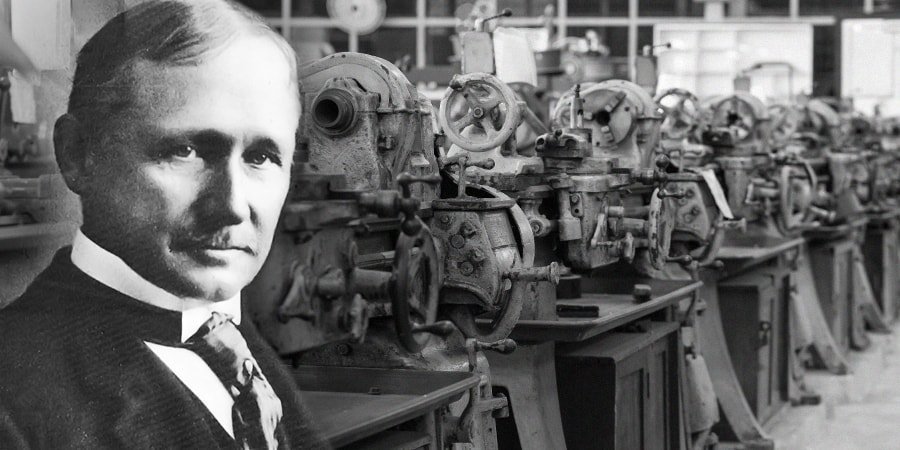
    Fredrick Winslow Taylor, an engineer, proposed and developed the Scientific Management Theory. He is also known as the Father of Scientific Management and his school of thought came to be known as Taylorism. He introduced a scientific approach to productivity, which meant that an increase in efficiency can lead to higher productivity and profits. He believed that research-backed and standardized procedures were necessary for effective management.

    • Administrative Management

    Henry Fayol, a French mining engineer, laid down five functions and 14 principles of management under the theory of Fayolism. This gave way to the school of administrative management. He believed that these functions and principles can guide managers to fulfill their responsibilities effectively and they should have the liberty to determine how to use them.

    2. Neoclassical theory of management

    The theories that emerged under the neoclassical evolution of management practices are:

    • Human Relations Management

    Developed by Elton Mayo, an Australian psychologist, the Human Relations Theory of Management was proposed after a series of experiments, also known as Hawthorne Studies or Hawthorne Experiments. This theory emerged as a response to the criticism faced by the classical management theories, where social factors such as human behavior and attitudes weren’t considered important.

    • Behavioral Management

    Behavioral approaches to management set the pace for how modern workplaces build an employee-friendly culture. Abraham Maslow, an American psychologist, proposed the hierarchy of need, where employee need and expectations were prioritized. The theory suggests that human relations and behavior are essential in driving efficiency in teams and managing the workforce successfully.

    3. Modern theory of management

    The theories that emerged with the modern evolution of management needs are:

    • Systems Approach

    The Systems Theory of organization has its roots in biology and systems science. This concept broke away from classical management theory that viewed organizations as machines and moved toward a more holistic view that sees them as networks of people, procedures, and activities. Systems Theory allows for an understanding of the connections between various parts of the organization and how they interact with one another.

    • Contingency Approach

    The Contingency Management Theory suggests that there isn’t any perfect way to organize a business or corporation. The optimal solution lies in the situation that an organization operates in. A business is a contingent (depends) upon internal or external environments.

    Administrative Management

    Father of Management — Henry Fayol (1841 — 1925)

    Henry Fayol contributed 14 principles to Management which is widely applied in all the Organization

    1. Division of Work
    2. Authority and Responsibility
    3. Discipline
    4. Unity of Command
    5. Unity of Direction
    6. Subordination of individual interest to general interest
    7. Remuneration of personnel
    8. Centralization
    9. Scalar Chain
    10. Order
    11. Equity
    12. Stability of Tenure of Personnel
    13. Initiative
    14. Esprit-de-corps

    Critical Evaluation

    • Too formal
    • Not pay adequate attention to workers
    • Vagueness
    • His principle hinted but did not elaborate that mgt can and should be taught.

    – Despite these limitations, Fayol made a unique and outstanding contribution to Mgt theory.

    Scientific Management

    Father of Scientific Management F. W. Taylor (1856 —1915)

    “The art of knowing exactly what you want men to do and see that they do it in the best and cheapest way.”

    Management is Science-based upon certain clearly defined principles.

    Principles of Scientific Management

    • Science not the rule of thumb
    • Harmony not discord
    • Corporation, not individualism
    • Maximum output in place of restricted output
    • Development of each individual to his greatest efficiency and prosperity

    Mental Revolution — Workers and Management, Workmen towards their work, their fellowmen, and towards their employees. The mental attitude of the two parties.

    Techniques of Scientific Management

    1. Time Study
    2. Motion Study
    3. Scientific task Planning
    4. Standardization and simplification
    5. Differential piece rate system
    6. Functional foremanship

    According to Taylor, one supervisor cannot be an expert in all aspects of work supervision. In the system of Functional Foremanship in which eight supervisors supervise a worker’s job.

    1. Route Clerk
    2. instruction card clerk
    3. Time and cost clerk
    4. Shop disciplinarian
    5. Gang boss
    6. Speed boss
    7. Repair boss
    8. Inspector

    Critical Evaluation

    • Mechanistic Approach
    • Umealistic Assumptions
    • Narrow View
    • Impracticable
    • Exploitation of Labour

    Human Relations Management

    George Elton Mayo (1880— 1949) Hawthrone Experiments

    1. Illumination Experiments ( illumination affected Productivity)
    2. Relay assembly Test room Experiments ( Working conditions and Productivity). piece work, rest pauses, shorter working hours,
    3. Mass interviewing Programme ( Direct Questions), Grievances, deep rooted disturbance, satifactory level

    Outcomes

    • Workers working in a group develop bond of relationships
    • Behaviour at workplace depens on their mental state, emotions and prejudices
    • Emotional factors play an important role in determining
    • Human and liberal attitude of supervisor helps in improving performance.
    • Managerial skills and technical skills are not necessary to be a successful leader.

    HENRY LAURENCE GANTT (1861 -1919)

    • Contribution was famous, Gantt Chart, used for scheduling and control of work.
    • Task and Bonus plan ( Minimum wages is guaranteed to all workers irrespective of output, Extra wages are paid for extra work)

    FRANK BUNKER G1LBRETH (1868 —1924)

    • Motion study, time study
    • Fatigue Study
    • Work Simplification — 3 positional promotion plan ( present position, the position to be held before promotion to his present position and the next higher position)

  • The Roles of a Managers

    The Roles of a Managers

    Managers are the people in the organization responsible for developing and carrying out this management process. The four primary functions of managers are planning, organizing, leading, and controlling. By using the four functions, managers work to increase the efficiency and effectiveness of their employees, processes, projects, and organizations as a whole.

    The roles played by the managers are as follows

    1. Interpersonal Role

    Interacting with people inside and outside the Organisation.

    • Figurehead — as a symbolic head of an organisation, the manager performs routine duties of a legal nature
    • Leader — Hiring, Training, motivating and guiding subordinates
    • Mason – Interacting with other managers outside the orgn to obtain favours and information

    2. Informational Role

    Serving as a focal point for the exchange of Information

    • Monitor — Seeks and receive information concerning internal and external events so as to gain understanding of the Orgn and its environment.
    • Disseminator — Transmits information to subordinates, peers and superiors within the Organisation
    • Spokesperson — Speaking on behalf of the Orgn and transmitting information on Orgn plans, policies and actions to outsiders.

    3. Decisional Role

    Makes important decision

    • Entrepreneur — Initiating changes or improvements in the activities of the Orgn
    • Disturbance handler- Taking charge and corrective action when Orgn faces unexpected crises
    • Resource allocator — Distributing Orgn’s resources like money, time, equipment and labour
    • Negotiator — Representing the Orgn in bargaining and negotiations with outsiders and insiders
  • Management as an Art, Science, and Profession

    Management as an Art, Science, and Profession

    Management as an Art

    The main elements of art are —

    • Personal Skills
    • Practical know-how
    • Application of knowledge
    • Result orientation
    • Creativity
    • Constant practice aimed at perfection

    Management is basically an art because of the following reasons —

    • A manager applies his knowledge and skills to coordinate the efforts of his people
    • Mgt seeks to achieve concrete practical results
    • Mgt is creative. It brings out new situation and converts into output
    • Effective Management lead to realization of Organizational and other goals.
    • Mastery in Management requires a sufficiently long period of experience in, managing.

    Management as Science

    The essential elements of Science

    • Systematised body of Knowledge
    • Underlying principles and theories developed through continuous observation, inquiry,  experimentation and research.
    • Universal truth and applicability.
    • Organised body of knowledge can be taught and learnt in class room and outside.
    • Mgt is a social science. It contains all the essentials of science. It is an inexact science.
    • PERT, CPM, Cost MC, Finance, MB O etc

    Thus, the theory (Science) and practice (art) of Mgt go side by side for the efficient functioning of an organization.

    Management as a Profession

    The essential attribute of a profession

    • A well-defined and organised body of knowledge
    • Learning and Experience
    • Entry restricted by qualification
    • Recognised national body
    • Ethical code of conduct
    • Dominance of service motive

    Management is not a full-fledged profession now due to the following shortcomings.

    • Skills not fully developed
    • No uniform method of entry and Objective is monetary rather than service.
    • Ethical code is not strict
    • Associations are not statutory bodies

    But in India, it is developing into a profession and it will be achieved in due course.

  • Scientific Management by Frederick Taylor

    Scientific Management by Frederick Taylor

    Scientific Management, developed by Frederick Winslow Taylor in the late 19th century, is a management theory that focuses on optimizing productivity and efficiency in the workplace. Taylor’s approach revolutionized industrial practices by introducing scientific principles and methods to improve worker productivity and overall organizational efficiency. This article explores the key principles and contributions of Scientific Management, its impact on modern management practices, and the ongoing debate surrounding its application.

    Principles of Scientific Management

    1. Time and Motion Studies: Taylor emphasized the importance of analyzing and measuring every task to identify the most efficient way of performing it. Through time and motion studies, he aimed to eliminate unnecessary movements, reduce fatigue, and streamline processes.
    2. Division of Labor: Taylor advocated for breaking down complex tasks into smaller, specialized components, enabling workers to become experts in their specific roles. This division of labor allowed for increased efficiency and improved overall productivity.
    3. Standardized Work Methods: Taylor stressed the need to establish standardized work methods that were scientifically determined as the most efficient way to perform tasks. By eliminating variations and using best practices, organizations could achieve consistency and improve output quality.
    4. Scientific Selection and Training: Taylor believed in carefully selecting and training workers to ensure the right fit between employees and job requirements. He emphasized the need for scientific methods in hiring, training, and developing workers to enhance their skills and maximize their potential.
    5. Incentives and Fair Compensation: Taylor recognized the importance of providing appropriate incentives and fair compensation to motivate workers. He suggested a system of differential piece-rate wages, where higher productivity would lead to higher pay, thus encouraging employees to increase their output.

    Impact on Modern Management Practices

    1. Efficiency and Productivity: Scientific Management revolutionized the way organizations approached productivity and efficiency. By focusing on scientific analysis, process optimization, and workforce development, Taylor’s principles helped organizations achieve higher levels of output with fewer resources.
    2. Standardization and Quality Control: The emphasis on standardized work methods and the elimination of variations laid the foundation for quality control practices in modern organizations. Standardization ensures consistent output and enables organizations to maintain quality levels while reducing waste and defects.
    3. Worker-Management Relationship: Taylor’s ideas initiated a shift in the worker-management relationship, highlighting the importance of fair compensation, employee development, and worker involvement in decision-making processes. These principles influenced later management theories that emphasized employee engagement and empowerment.
    4. Scientific Approach to Problem-Solving: Scientific Management introduced a systematic and analytical approach to problem-solving in the workplace. By collecting data, conducting experiments, and applying scientific principles, organizations could make informed decisions to improve processes, optimize resources, and resolve operational challenges.

    Criticisms and Limitations

    1. Oversimplification of Work: Critics argue that Scientific Management oversimplifies work by reducing it to repetitive tasks, ignoring the complexity and creativity required in many modern jobs. This approach may lead to job dissatisfaction and demotivation among employees.
    2. Lack of Worker Participation: Taylor’s emphasis on management control and decision-making resulted in limited worker participation. Critics argue that involving employees in decision-making processes can lead to better outcomes and increased job satisfaction.
    3. Neglect of Human Factors: Scientific Management often overlooked the psychological and social aspects of work. Human factors, such as individual differences, motivation, and teamwork, play a crucial role in organizational success but received less attention in Taylor’s approach.
    4. Exploitation of Labor: Some critics argue that Scientific Management created an environment that prioritized efficiency and productivity at the expense of worker well-being. Concerns about excessive workload, stress, and inadequate compensation arose due to the intense focus on output maximization without sufficient consideration for employee welfare.

    Modern Applications and Adaptations

    Despite its criticisms, elements of Scientific Management remain influential in modern management practices. Contemporary approaches, such as Lean Management and Six Sigma, draw inspiration from Taylor’s principles to improve operational efficiency, eliminate waste, and enhance quality.

    Organizations have also recognized the importance of incorporating human factors into management practices. Employee engagement, empowerment, and work-life balance are now key considerations in creating a productive and sustainable work environment.

    Moreover, advancements in technology have facilitated the implementation of Taylor’s principles on a larger scale. Automation, robotics, and data analytics enable organizations to gather real-time data, analyze work processes, and make data-driven decisions to optimize productivity and efficiency.

    Conclusion

    Frederick Taylor’s Scientific Management theory played a significant role in transforming workplace practices and shaping modern management approaches. By introducing scientific principles, time and motion studies, and standardized work methods, Taylor sought to maximize productivity and efficiency. While his ideas faced criticism for oversimplifying work and neglecting human factors, they sparked important discussions on worker participation, employee well-being, and the balance between efficiency and employee satisfaction.

    Today, organizations continue to draw inspiration from Scientific Management while adapting its principles to fit the evolving workplace landscape. By incorporating human-centric approaches, leveraging technology, and valuing employee well-being, organizations strive to achieve optimal performance while ensuring a positive work environment.

    While Scientific Management may not provide all the answers to the complexities of modern management, it remains a foundational theory that has shaped management practices and paved the way for further advancements in workplace efficiency and productivity.

  • Henry Fayol’s 14 Principles of Management

    Henry Fayol’s 14 Principles of Management

    Any organization that wishes to be efficient and achieve its goals needs good management. Management has four basic functions – planning, organizing, leading, and controlling, also called the POLC framework in management. Without these in place, there would be little to no structure and focus in an organization.

    Henri Fayol (1841-1925), a French Industrialist offered 14 principles of management for the first time in 1916. His fourteen principles of management serve as a guide in helping managers to manage their organizations. The principles propounded by Fayol can be represented by an acronym called “DAD SEE U USSR CIO”.

    By placing the focus on managerial skills over technical skills, these principles give us a foundation for what we call “good management”.

    Henry Fayol’s 14 Principles of Management

    Henry Fayol’s 14 Principles of Management are as follows

    1. Division of Labour: This principle states that there must be job specialization so as to enhance work performance and productivity.
    2. Authority and Responsibility: According to Fayol if an authority is given to a person, he or she must be made responsible for that duty i.e. employee authority must be in-line with their responsibility.
    3. Discipline: This implies that every employee must obey orders.
    4. Scalar Chain: This principle states that there must be a clear line of formal authority and communication from the top hierarchy to the bottom level of the organization.
    5. Equity: This implies that there must be kindness, fairness, and justice in the treatment of employees if management wants their loyalty and commitments towards given job.
    6. Espirit de corps: This principle emphasizes that team spirit and cooperation should be encouraged in order to bring about harmony and unity within the organization.
    7. Unity of Command: This principle obliged all employees to receive orders and be made accountable to one superior at a time so that conflict can be avoided.
    8. Unity of Direction: This implies that all employees must be geared towards the same direction so as to achieve the common goals of the organization.
    9. Stability of Tenure: This principle states that the employee period on a given job must be stable and he or she must not be moved or transfer without clearing notification for doing so.
    10. Subordination of Individual to General Interest: This principle states that the interest of one person should not overshadow the interest of the organization as a whole.
    11. Remuneration: This means that employees are entitled to fixed wages and salaries and they must be well motivated to ensure higher productivity, thereby boosting organizational profitability.
    12. Centralization: This implies that all major decisions are concentrated in the hand of one single superior, while decentralization means allowing the subordinates to partake in the decision relating to their respective departments. The degree in which centralization should be adopted depends upon the nature of the organization that the manager is working.
    13. Initiative: Management should encourage workers to use their initiative and creativity on the given job even though it may lead to wastage or loss on the part of the organization.
    14. Order: There should be an orderly arrangement of people and materials in the right place, at the right time, doing the right job, in which they are best suited.

    Henry Fayol’s 14 principles of management are universally accepted and continually used as a guideline for managers across the world. Though these principles of management are more than 100 years old, without them, it would push us back hundreds of years back when technical skills reigned supreme and people lacked managerial responsibility.

  • Levels of Management

    Levels of Management

    In this article, you’ll learn about Levels of Management and the different role occupied by the levels of management in the organization.

    “Levels of Management’ refers to a line of demarcation between various managerial positions in an organization. The number of levels in management increases when the size of the business and workforce increases and vice versa.

    The levels of Management are as follows:

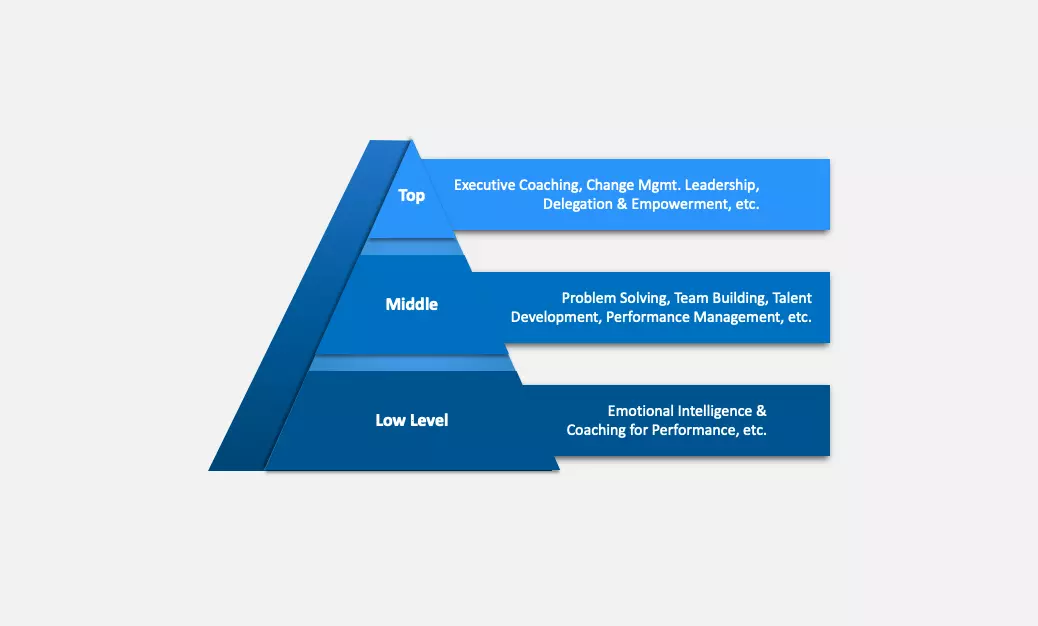
    1.Top Level Management

    Board of Directors, MD, Owners, Chief Executives

    • To analyse, evaluate and deal with th environmental forces
    • To establish overall long term goals and broad policies of the company including the master budget
    • To appoint departmental and other key executives
    • To represent the company to the outside world
    • To coordinate the activities and efforts of different department

    2. Middle Level Management

    Sales Executives, Production Executives, Production executives, etc.

    • To interpret and explain the policies framed by top management
    • To compile and issue detailed instruction regarding operations
    • To Cooperate among themselves so as to integrate various parts of the division or a department
    • To motivate supervisory personnel to work for Orgn goals
    • To develop and train supervisory and operative personnel.

    3. Supervisor / Operating / Lower Level Management

    Superintendents, Branch managers, General Foremen

    • To plan day to day production within the goals lay down by higher authority
    • To assign jobs to workers and to make arrangement for their training and development
    • To supervise and control workers and to maintain personal contact with them.
  • What is Management ? Definition, Characteristics,Skills and Need

    What is Management ? Definition, Characteristics,Skills and Need

    Management as how the mind controls the human body and its function similar management (mind) controls the various activities human body) in the Organisation

    Collection of physical equipments. 4 Nil’s in Organisation — Men, Machine,Materials, Money, and leads to nothing. For efficient and profitable functioning it is necessary that all these factors are put to work in a co­ordinated manner.

    Management Definition

    Management is the art of getting things done through others.

    Management is the process of designing and maintaining an environment in which individuals, working together in groups efficiently to accomplish selected aims

    Harold Koontz
    • Managers carry out their managerial function
    • Applies to any kind of Organisation
    • Applies to managers at all Organisational levels
    • Aim is to create a surplus
    • Concerned with productivity, implies effectiveness and efficiency.
    • Mgt of 4 M’s in the Orgn — Men, Machine, Materials & money.

    Characteristics of Management

    • Management is Universal
    • Management is dynamic
    • Management is a group of managers
    • Management is Purposeful
    • Management is goal oriented
    • Management is integrative Function
    • Management is a Social process
    • Management is a Multi-faceted discipline
    • Management is a continuous process
    • Management is a system of authority
    • Management is a resource
    • Management is intangible

    Managerial Skills

    • Conceptual skills
    • Human Skills
    • Technical Skills
    • Design Skills — Decision making

    Need for Management

    1. To increase efficiency
    2. To crystallize the nature of Management job
    3. To improve research in Management
    4. To attain social goals

  • What is Motivation? Definition, Types, Importance, Characteristics

    What is Motivation? Definition, Types, Importance, Characteristics

    What is Motivation?

    Motivation is defined as inner burning passion caused by need, wants, and desire which propels an individual to exert his physical and mental energy to achieve desired objectives.

    Motivation is goal-directed behavior. People are motivated when they expect that a course of action is likely to lead to the attainment of a goal and a valued reward – one that satisfies their needs and wants.

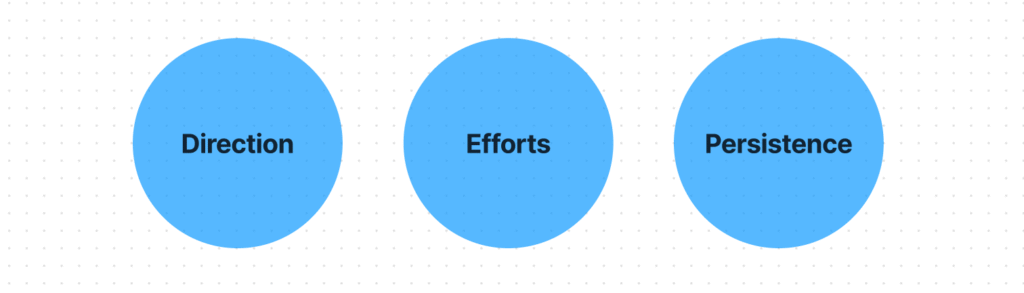
    Three Components of Motivation

    1. Direction: what a person is trying to do.
    2. Effort: how hard a person is trying.
    3. Persistence: how long a person keeps on trying.

    Dynamics of Motivation

    Motivation is triggered by the psychological tension comes due to the unfulfilled need and drives consumers to buy. Consumers strive consciously and unconsciously to bring down their tension by selecting goals in anticipation of fulfilling their needs.

    Basic idea of marketing is to identify and fulfill the needs. Marketers tend to fulfill unfelt or dormant needs. Basic needs of consumer do not change but the product fulfilling the need may change.

    A product-focused towards the consumer need ensures that companies remain in forefront of the search for new and effective solutions. This helps companies to survive and grow even in tough competition.

    Level of motivation

    The level of motivation would depend on the intensity and urgency of need. Consumer motivational levels may vary from low to high depending on how important is that purchase. Besides, various Influences affecting consumers’ buying include familiarity with the purchase, status factors and overall expense & value.

    Where fulfillment rewards are low, as with routine purchases like salt, sugar, tea, shampoo etc., motivation levels are also relatively low and involve little decision-making behavior.

    On the other hand, with a complex, risky and emotionally-charged process such as buying a new car, the drive to achieve the best result is high.

    Motivational behavior

    The behavioral aspect of consumer motivation concerns the actions we take before purchasing and consuming goods or services. We might do a lot of research-evaluating alternatives, testing, and sampling before making a purchase decision.

    Marketers aim to gain the most impact and eventual sales by linking their products and services to clearly defined consumer needs and by understanding what motivates people to buy.

    Motivation Definition

    Motivation is the willingness to exert high levels of effort toward organisational goals, conditioned by the effort’s ability to satisfy some individual needs.

    Stephen P Robbins

    It is the way in which urges, drives, desires, aspirations, strivings or needs direct, control or explains the behaviour of human beings.

    D.E. McFarland

    It is the desire within an individual that stimulates him or her to action.

    George R. Terry

    It is a process of stimulating people to action to accomplish desired goals.

    Scot

    It is the way in which urges, drives, desires, aspirations, strivings need direct, control or explain the behaviour of human beings.

    Mc Farland

    It is a willingness to expand energy to achieve a goal or reward. It is a force that activates dormant energies and sets in motion the action of the people. It is the function that kindles a burning passion for action among the human beings of an organisation.

    C.B. Mamoria

    It is steering one’s actions toward certain goals and committing a certain part of one’s energies to reach them.

    S.W Gellerman

    Concept of Motivation

    Need: A need is a condition of lack or deficit of something required by the organism/person.


    Motives: Motive is defined as an inner state that energises, activates (or moves) and directs (or chanalises) the behaviour towards certain goals.

    Types of Motivation

    The two types of motivation are:

    1. Intrinsic motivation
    2. Extrinsic motivation

    Intrinsic motivation

    Intrinsic motivation can arise from self-generated factors that influence people’s behaviour. It is not created by external incentives.

    It can take the form of motivation by the work itself when individuals feel that their work is important, interesting and challenging and provides them with a reasonable degree of autonomy (freedom to act), opportunities to achieve and advance, and scope to use and develop their skills and abilities.

    Extrinsic motivation

    Extrinsic motivation occurs when things are done to or for people to motivate them.

    These include rewards, such as incentives, increased pay, praise, or promotion; and punishments, such as disciplinary action, withholding pay, or criticism. Extrinsic motivators can have an immediate and powerful effect, but will not necessarily last long.

    Characteristics of Motivation

    Characteristics of motivation are :

    1. Motivation is a psychological phenomenon
    2. Motivation is a continuous process
    3. Motivation is caused due to anticipated perceived value from an action
    4. Motivation varies from person to person and time to time
    5. An individual is motivated by positive or negative motivation

    Motivation is a psychological phenomenon

    It is the inner desire of an individual to achieve something more. More is the individual motivated better performance and organization relations.

    Motivation is a continuous process

    Since need and desire are endless so the need is a continuous phenomenon if one need is satisfied the other need emerges.

    Motivation is caused due to anticipated perceived value from an action

    Perceived value is the probability or expectancy. motivation= value × expectancy.

    Motivation varies from person to person and time to time

    Motivation is different for different persons and it also varied according to time and place because wants are different for different people, according to time and places.

    An individual is motivated by positive or negative motivation

    Positive motivation is based on incentives or rewards. Incentives can be monetary and non-monetary.
    Negative motivation is based on penalties, calling for explanation, threats, fear, etc. Fear of losing the job or promotion

    Importance of Motivation

    Broadly, the importance of motivation is as follow:

    1. High level of performance
    2. Low employee turn over and absenteeism
    3. Acceptance of organization change
    4. Organizational image

    High level of performance

    Organizations must ensure that the employees have a high degree of motivation. A highly motivated employee puts extra effort into work and has a sense of belonging to the organization.

    The efficiency of work will be improved, wastage will be minimum which will result in increased productivity, and performance level will be high.

    Low employee turn over and absenteeism

    Low level of motivation is a root cause of low turnover and absenteeism. High level of absenteeism causes a low level of production, poor quality, wastages, and disruption in production schedules.

    Increased turnover is disastrous for any organization as it puts a strain on the financial position of the organization due to additional recruitment, selection, training and development.

    Acceptance of organization change

    Social change and technological evolution that happen in the external environment have a greater impact on the motivation of the employee. Management must ensure that the changes are introduced in the organization and their benefits explained to the employees so that there is no resistance to change and organizational growth is achieved.

    Re-engineering, empowerment, job enrichment, job rotation, the introduction of new technology and processes will go a long way to boost employee morale and achieve a high degree of motivation.

    Organizational image

    Employees are the mirrors of any organization. Regular training & development programs should be organized to keep employees updated with the latest skills. It will have a positive impact on the employees and the image of the organization will be improved.

    The high organizational image will contribute towards the brand image of the product and services the organization is marketing.

    Tools of Motivation to Boost Employee Morale

    It is very important for an organization to have a happy and satisfied workforce. A discontented and unmotivated staff may drastically impact the productivity and work relationship of the organization. Hence organizations use different motivational tools to boost the morale of their employees.

    These can be physical or monetary rewards, or internal and intrinsic that uses psychological measures to enhance the self-esteem of the employees.

    Some of the motivational tools applied by the organizations are discussed below:

    • Job Characteristic Model
    • Job Redesign
    • Alternative Work Arrangements
    • Empowerment
    • Participative Management
    • Quality of Work Life (QWL)
    • Motivation Through Variable Pay Programs
    • Mentoring
    • Employee Counseling

    Motivation Theories

    Motivation theories are categories into two: content and process theories.

    Content theory

    Content theories try to figure “what” motivates people. Following are the motivation theories in content theory perspective.

    • Maslow’s need Hierarchy
    • Herzberg’s Motivation-Hygiene Theory
    • McClelland’s Needs Theory
    • Alderfer’s ERG Theory

    Process theory

    Process theories try to figure “How” the motivation occurs. Following are the motivation theories in process theory perspective.

    • Vroom’s Expectancy Theory
    • Adam’s Equity Theory
    • Reinforcement Theory
    • Carrot and Stick Approach to Motivation
  • Difference between Management and Administration

    Difference between Management and Administration

    In this article, we’ll learn about Difference between Management and Administration.

    Management is an act of managing people. Their work is to achieve a common goal by using the resources. For better workflow needs a suitable environment.  It creates that’s an opportunity. As a result, subordinates and their manager do the work together to reach the objective. Management is a group of people. They use their talent and skills to complete organizational tasks. So, we can say that it consists of the following features. Such as:-

    1. Functional initiative
    2. Activity
    3. Documental discipline,
    4. Systematic process,
    5. And much more.

    5M’s Model of management

    5M’s Model of management
    5M’s Model of management

    Management performs organizing, planning, coordination, motivating, controlling, decision making, and leading. It contains the 5M features of the organization. It is also called the 5M’s Model of management. There are mentioned the 5M’s full form. Such as:-

    1st M = Men (Peoples)

    2nd M = Machines (Tools or equipments)

    3th M = Medium or Measurementals (Inspection & environment)

    4th M = Mission (Purpose)

    5th M = Management (Leadership)

    According to Theo Haimann, Administration means overall determination of policies, setting of major objectives, the identification of general purposes and laying down of broad programmers and projects. It refers to the activities of higher level. It lays down basic principles of the enterprise. According to Newman, “Administration means guidance, leadership & control of the efforts of the groups towards some common goals.”

    Administration vs Management

    Basis of DistinctionAdministrationManagement
    Policy and objectivesDetermination of objectives & policiesImplementation of Policies
    Main FunctionsLegislative & determination functionExecutive Function
    Planning, Organising staffingDirecting, Motivating, Coordinating Controlling Provides a sketch    of the enterpriseProvides the entire body
    InfluenceInfluenced mainly by public opinion & other outside forceInfluenced mainly by administrative function
    Levels of ManagementThe mainly top-level function involves thinking & planningThe mainly middle-level function involves doing and acting
    Level of ExecutivesOwners/ Board of DirectorsMD, GM & Managers
    PositionActs as a principalActs as an agency
    KnowledgeRequires more admin ability than technical abilityRequires more technical ability than admin ability
  • What is Planning, Definition, Characteristics, and Objective

    What is Planning, Definition, Characteristics, and Objective

    In this article, we learn about What is Planning, Definition, Characteristics, and Objective.

    Planning may be defined as deciding in advance what to be done in the future. It is the process of thinking before doing. It involves the determination of goals as well as the activities required to be undertaken to achieve the goals.

    In the planning, process managers anticipate the future and accordingly decide what activities must be undertaken. Planning deciding in advance – What to do, How to do, When, and by whom.

    What is Planning, Definition, Characteristics, and Objective

    Definition of Planning

    “Planning means the determination of what is to be done, how it is to be done, who is to do it, and how results are evaluated.”

    James Lundy

    “Planning is deciding the best alternatives among others to perform different managerial operation in order to achieve the predetermined goals.”

    Henry Feyol

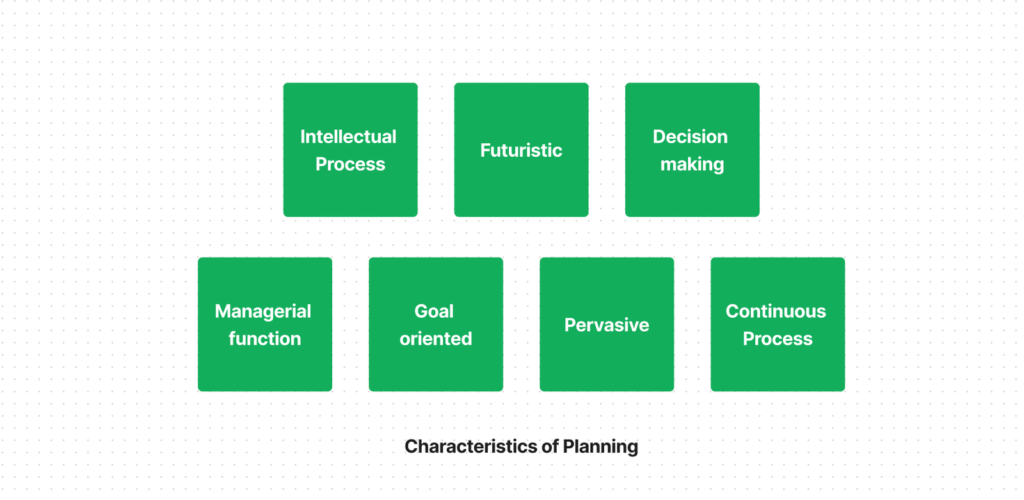
    Characteristics of Planning

    Characteristics of Planning
    1. Managerial function: Planning is a first and foremost managerial function provides the base for other functions of the management, i.e. organising, staffing, directing and controlling, as they are performed within the periphery of the plans made.
    2. Goal oriented: It focuses on defining the goals of the organisation, identifying alternative courses of action and deciding the appropriate action plan, which is to be undertaken for reaching the goals.
    3. Pervasive: It is pervasive in the sense that it is present in all the segments and is required at all the levels of the organisation. Although the scope of planning varies at different levels and departments.
    4. Continuous Process: Plans are made for a specific term, say for a month, quarter, year and so on. Once that period is over, new plans are drawn, considering the organisation’s present and future requirements and conditions. Therefore, it is an ongoing process, as the plans are framed, executed and followed by another plan.
    5. Intellectual Process: It is a mental exercise at it involves the application of mind, to think, forecast, imagine intelligently and innovate etc.
    6. Futuristic: In the process of planning we take a sneak peek of the future. It encompasses looking into the future, to analyse and predict it so that the organisation can face future challenges effectively.
    7. Decision making: Decisions are made regarding the choice of alternative courses of action that can be undertaken to reach the goal. The alternative chosen should be best among all, with the least number of the negative and highest number of positive outcomes.

    Planning is concerned with setting objectives, targets, and formulating plans to accomplish them. The activity helps managers analyze the present condition to identify the ways of attaining the desired position in the future. It is both, the need of the organization and the responsibility of managers.

    Objective of planning

    1. Reduce uncertainty: Future is uncertain. Planning may convert the uncertainty into certainty. This is possible to some extent by, planning which is reducing uncertainty.
    2. Bring cooperation and co-ordination: Planning can bring co-operation and co-ordination among various sectors of the organization. The rivalries and conflicts among departments could be avoided through planning.
    3. Economy in operation: As already pointed out, planning selected best alternative among various alternatives this will lead to the best utilization of recourses. The objectives of the organization are achieved easily.
    4. Anticipate the unpredictable contingencies: Some events could not be predictable. These events are termed as contingencies. These events may affect the smooth functioning of an enterprise.
    5. Achieving the pre-determined goals: Planning activities are aimed at achieving the objectives of the enterprise. The timely achievements of objectives are possible only effective planning.
    6. Reduce competition: The existence of competition enables the enterprise to get a chance for growth. At the same time, stiff competition should be avoided. It is possible, to reduce competition through planning.

    Planning is present in all types of organizations, households, sectors, economies, etc. We need to plan because the future is highly uncertain and no one can predict the future with 100% accuracy, as the conditions can change at any time. Hence, planning is the basic requirement of any organization for survival, growth, and success.