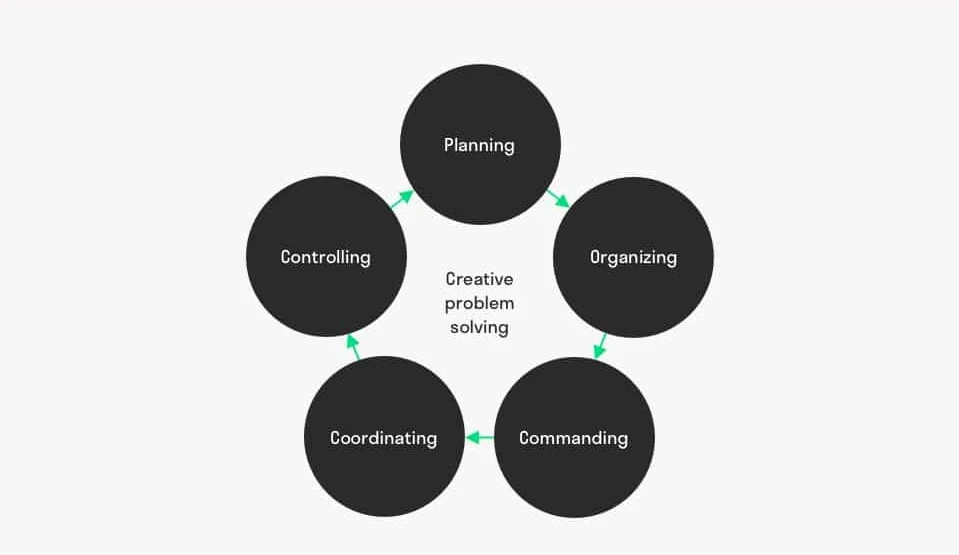
The controlling function comprises coordination, reporting, and budgeting, and hence the controlling function can be broken into these three separate functions.
Based upon these seven functions, Luther Gulick coined the word POSDCORB, which generally represents the initials of these seven functions i.e. P stands for Planning, O for Organizing, S for Staffing, D for Directing, Co for Co-ordination, R for reporting & B for Budgeting.
But, Planning, Organizing, Staffing, Directing, and Controlling are widely recognized functions of management.
1 Planning
Planning is future-oriented and determines an organization’s direction. It is a rational and systematic way of making decisions today that will affect the future of the company. It is a kind of organized foresight as well as corrective hindsight. It involves predicting of the future as well as attempting to control the events. It involves the ability to foresee the effects of current actions in the long run in the future.
Planning is the continuous process of making present entrepreneurial decisions systematically and with best possible knowledge of their futurity, organizing systematically the efforts needed to carry out these decisions and measuring the results of these decisions against the expectations through organized and systematic feedback
Peter Drucker
An effective planning program incorporates the effect of both external as well as internal factors. The external factors are shortages of resources; both capital and material, general economic trend as far as interest rates and inflation are concerned, dynamic technological advancements, increased governmental regulation regarding community interests, unstable international political environments, etc.
The internal factors that affect planning are limited growth opportunities due to saturation requiring diversification, changing patterns of the workforce, more complex organizational structures, decentralization, etc.
2 Organizing
Organizing requires a formal structure of authority and the direction and flow of such authority through which work subdivisions are defined, arranged, and coordinated so that each partrelates to the other part in a united and coherent manner so as to attain the prescribed objectives.
To organize a business is to provide it with everything useful or its functioning i.e. raw material, tools, capital and personnel’s.
Henry Fayol
Thus the function of organizing involves the determination of activities that need to be done in order to reach the company goals, assigning these activities to the proper personnel, and delegating the necessary authority to carry out these activities in a coordinated and cohesive manner.
It follows, therefore, that the function of organizing is concerned with:Identifying the tasks that must be performed and grouping them whenever necessary Assigning these tasks to the personnel while defining their authority and responsibility.Delegating this authority to these employees Establishing a relationship between authority and responsibility Coordinating these activities
3 Staffing
Staffing is the function of hiring and retaining a suitable work-force for the enterprise both at managerial as well as non-managerial levels. It involves the process of recruiting, training, developing, compensating, and evaluating employees and maintaining this workforce with proper incentives and motivations. Since the human element is the most vital factor in the process of management, it is important to recruit the right personnel.
Managerial function of staffing involves manning the organization structure through the proper and effective selection, appraisal & development of personnel to fill the roles designed in the structure
Kootz & O’Donnell
This function is even more critically important since people differ in their intelligence, knowledge, skills, experience, physical condition, age, and attitudes, and this complicates the function. Hence, management must understand, in addition to the technical and operational competence, the sociological and psychological structure of the workforce.
4 Directing
The directing function is concerned with leadership, communication, motivation, and supervision so that the employees perform their activities in the most efficient manner possible, in order to achieve the desired goals.
The leadership element involves issuing instructions and guiding the subordinates about procedures and methods.The communication must be open both ways so that the information can be passed on to the subordinates and the feedback received from them.Motivation is very important since highly motivated people show excellent performance with less direction from superiors.Supervising subordinates would lead to continuous progress reports as well as assure the superiors that the directions are being properly carried out.
5 Controlling
The function of control consists of those activities that are undertaken to ensure that the events do not deviate from the pre-arranged plans. The activities consist of establishing standards for work performance, measuring performance and comparing it to these set standards, and taking corrective actions as and when needed, to correct any deviations.
Controlling is the measurement & correction of performance activities of subordinates in order to make sure that the enterprise objectives and plans desired to obtain them as being accomplished
Koontz & O’Donnell
The controlling function involves:
- Establishment of standard performance.
- Measurement of actual performance.
- Measuring actual performance with the pre-determined standard and finding out the deviations.
- Taking corrective action.
All these five functions of management are closely interrelated. However, these functions are highly indistinguishable and virtually unrecognizable on the job. It is necessary, though, to put each function separately into focus and deal with it.
Let’s have look in Function of management and their Sub-Function
| Functions | Sub- Functions |
|---|---|
| Planning | Forecasting, decision making, strategy formulation, policy making, programming, scheduling, budgeting, problem-solving, innovation, investigation and research. |
| Organising | Grouping of Functions, Departmentation, delegation, decentralization, activity analysis, task allocation. |
| Staffing | Manpower planning, job analysis, Recruitment, Selection, Training, Placement, Compensation,Promotion, appraisal, etc. |
| Directing | Supervision, Motivation, communication, Leadership, etc. |
| Controlling | Fixation of standard, recording, measurement, reporting corrective action. |