Tag: economics

  • Forecasting: Meaning, Nature, Planning and Forecasting, Importance and Limitations

    Forecasting: Meaning, Nature, Planning and Forecasting, Importance and Limitations

    For businesses to operate successfully, they need to be able to anticipate future trends and events. This is where forecasting comes in. Forecasting is the process of making predictions about the future based on past data and current trends. It is an essential tool for businesses of all sizes, as it allows them to make informed decisions about everything from production levels to marketing campaigns.

    What is Forecasting

    Forecasting involves predicting future events that can impact a business. By analyzing past data, identifying trends, and considering current conditions, businesses can anticipate future sales, finances, customer demand, and market shifts. This information empowers informed decision-making, effective planning, and proactive risk management. Forecasting methods encompass a range of techniques, from analyzing historical data to employing sophisticated statistical models. However, it’s crucial to acknowledge that the future is inherently uncertain. Unforeseen events can significantly impact the accuracy of forecasts, necessitating regular review and updates as new information becomes available.

    Nature of Forecasting

    Forecasting involves utilizing past data, identifying trends, and recognizing patterns to make informed predictions about future events or outcomes. This practice is fundamental for effective planning and decision-making across various fields, including business, finance, economics, and meteorology.

    Key aspects of forecasting include:

    • Goal-Oriented Focus: The primary objective of forecasting is to support informed decision-making, effective risk management, and strategic planning to achieve specific goals and objectives.
    • Inherent Uncertainty: The future is inherently unpredictable. Unexpected events or factors can significantly impact the accuracy of any forecast.
    • Reliance on Assumptions: Forecasting often relies on specific assumptions about future conditions. If these assumptions prove inaccurate, the forecast’s reliability diminishes.
    • Time Horizon Variability: Forecasts can be generated for different timeframes, such as short-term, medium-term, and long-term. Generally, the accuracy of predictions decreases as the forecast horizon extends further into the future.
    • Diverse Methodologies: A wide range of methods and techniques are employed in forecasting, encompassing both qualitative approaches (such as expert opinions and market research) and quantitative methods (such as statistical modeling and data analysis).
    • Continuous Adaptation: Forecasting is an ongoing process that necessitates regular review and updates. New information, changes in market conditions, and shifts in underlying assumptions require adjustments to the forecast.

    Planning and Forecasting

    Planning and forecasting are interconnected processes crucial for effective decision-making and resource allocation.  

    • Planning: Involves setting goals, determining the best course of action to achieve those goals, and efficiently utilizing resources (time, money, and personnel).  
    • Forecasting: Involves making educated predictions about future events or trends based on past data, patterns, and statistical analysis.  

    Forecasting provides the essential information and predictions that guide the planning process. Conversely, planning helps organizations determine priorities and allocate resources based on the forecasted outcomes. For example, a business can use sales forecasts to determine production levels, marketing strategies, and staffing needs. This allows the company to create a detailed plan to achieve its sales targets and effectively utilize its resources.  

    Importance of Forecasting in Business

    Forecasting plays a vital role in business success by:

    • Improving Decision-Making: By anticipating future events, businesses can make more informed decisions, increasing their chances of success.  
    • Optimizing Resource Allocation: Forecasting helps businesses allocate resources effectively, such as adjusting production levels, staffing requirements, and budgets to meet anticipated demand.  
    • Mitigating Risks: By identifying potential risks and uncertainties, businesses can develop contingency plans and strategies to minimize potential negative impacts.  
    • Setting Realistic Goals: Forecasting enables businesses to set achievable goals and targets, providing a framework for monitoring progress and making necessary adjustments.  
    • Improving Financial Planning: Accurate financial forecasts are crucial for budgeting and financial planning, enabling businesses to estimate revenues, costs, and cash flow effectively.  
    • Optimizing Supply Chain Management: Forecasting helps optimize inventory levels, reduce stockouts, and minimize holding costs by predicting demand and ensuring a smooth flow of goods within the supply chain.  

    Limitations of Forecasting

    Despite its importance, forecasting has inherent limitations:

    • Uncertainty: The future is inherently uncertain, and unforeseen events can significantly impact the accuracy of any forecast.  
    • Data Dependence: The accuracy of forecasts relies heavily on the quality and completeness of the data used. Inaccurate or incomplete data can lead to unreliable predictions.  
    • Assumption Reliance: Forecasts often rely on assumptions about future conditions, which may not always hold true.  
    • Complexity: Forecasting can be a complex process, especially when dealing with large datasets and sophisticated models.  
    • Time-Consuming: The process of developing and maintaining accurate forecasts can be time-consuming, requiring ongoing data collection, analysis, and updates.  
    • Limited Scope: Forecasts may not always account for all possible factors or unforeseen events, potentially limiting their accuracy and applicability.

  • What is Business Cycles? Phases, Types, Theory, Nature

    What is Business Cycles? Phases, Types, Theory, Nature

    What is the Business Cycle

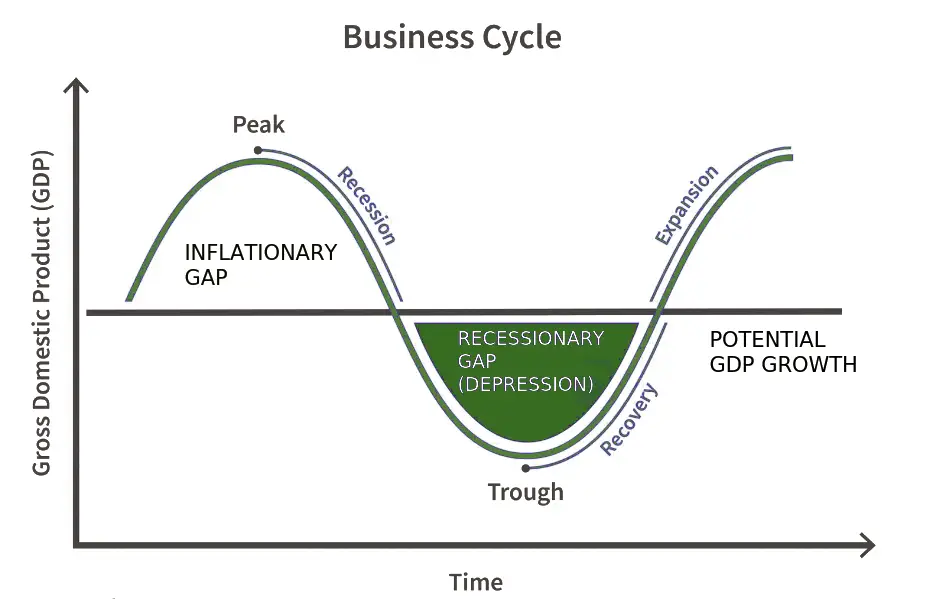
    The business cycle refers to the recurring fluctuations in economic activity, characterized by periods of expansion and contraction. These fluctuations are typically measured by changes in real GDP (Gross Domestic Product).  

    Business Cycle Definition

    A business cycle is a recurring pattern of economic activity, consisting of periods of expansion (growth) and contraction (recession) in economic activity. These cycles are not regular or predictable in their duration or intensity.  

    Phases of Business Cycle

    • Expansion: This is a period of economic growth characterized by increasing GDP, rising employment, and falling unemployment. Consumer and business confidence are high, leading to increased spending and investment.  
    • Peak: The peak marks the highest point of economic activity in the cycle. Economic growth slows down, and inflationary pressures may emerge.  
    • Contraction: This is a period of economic decline characterized by falling GDP, rising unemployment, and declining consumer and business confidence. This phase is often referred to as a recession.  
    • Trough: The trough represents the lowest point of economic activity in the cycle. Economic growth reaches its minimum, and unemployment reaches its peak.  

    Nature of Business Cycle

    • Cyclical nature: The most prominent characteristic is their cyclical nature, with recurring periods of expansion and contraction. However, the length and intensity of these cycles vary significantly.  
    • General nature: Business cycles are a pervasive phenomenon, affecting most economies around the world. They impact various sectors of the economy, including production, employment, and investment.  

    Types of Business Cycle

    • Kondratieff Waves (Long Waves): These are long-term cycles, lasting 50-60 years, driven by major technological innovations.  
    • Juglar Cycles (Medium Waves): These are medium-term cycles, lasting 7-11 years, associated with fluctuations in investment and inventory levels.  
    • Kitchin Cycles (Short Waves): These are short-term cycles, lasting 3-4 years, primarily driven by fluctuations in inventory levels.

    Business Cycle Theory

    Various economic theories attempt to explain the causes and mechanisms of business cycles:

    • Hawtrey Monetary Theory: This theory emphasizes the role of credit and money supply in driving business cycles.
    • Innovation Theory: This theory, associated with Joseph Schumpeter, argues that technological innovations trigger periods of rapid economic growth, followed by periods of adjustment and decline.
    • Keynesian Theory: This theory highlights the role of aggregate demand fluctuations in driving business cycles.  
    • Hicks Theory: This theory, based on the concept of multipliers and accelerators, explains how small shocks can amplify and propagate through the economy.
    • Samuelson theory: This theory utilizes a mathematical model to demonstrate how fluctuations in investment can generate cyclical behavior in the economy.

    Conclusion

    Business cycles are a fundamental feature of capitalist economies. Understanding their causes and consequences is crucial for policymakers and businesses to make informed decisions and navigate economic fluctuations effectively.

  • What is Inflation in Economics? Definition, Causes, Type, Effects

    What is Inflation in Economics? Definition, Causes, Type, Effects

    In this article, you’ll learn about What is Inflation in Economics? Definition, Causes, Type, Effects and more.

    What is Inflation in Economics?

    Inflation is a sustained increase in the general price level of goods and services in an economy over time.  

    Inflation in Economics Definition

    In simpler terms, inflation means that it costs more money to buy the same goods and services today compared to yesterday.  

    Causes of Inflation in Economics

    • Demand-Pull Inflation: This occurs when aggregate demand in the economy exceeds aggregate supply. This excess demand can be driven by factors such as increased government spending, increased consumer spending, or increased investment.  
    • Cost-Push Inflation: This occurs when the costs of production for businesses increase, forcing them to raise prices to maintain profit margins. These increased costs can be due to factors such as rising wages, increased raw material prices, or supply chain disruptions.  
    • Built-In Inflation: This type of inflation is driven by past inflationary expectations. If people expect prices to rise in the future, they may demand higher wages, which in turn leads to higher prices.

    Characteristics of Inflation in Economics

    • Sustained Increase: Inflation is not a one-time price increase, but rather a persistent upward trend in the general price level.  
    • General Price Level: Inflation affects the prices of a wide range of goods and services across the economy, not just specific items.  
    • Reduces Purchasing Power: Inflation erodes the purchasing power of money, meaning that consumers can buy fewer goods and services with the same amount of money.  

    Types of Inflation in Economics

    • Moderate Inflation: A relatively low and stable rate of inflation, typically considered to be around 2-3% per year.
    • Galloping Inflation: A rapid and accelerating rate of inflation, often exceeding 10% per year.  
    • Hyperinflation: An extremely rapid and uncontrolled rate of inflation, often exceeding 50% per month.  

    Other Types of Inflations

    • Currency Inflation: Occurs due to an excessive increase in the money supply.
    • Credit Inflation: Results from excessive credit creation, leading to increased demand and inflationary pressures.  
    • Profit-induced Inflation: Arises when businesses increase prices to maximize profits.  
    • Deficit-induced Inflation: Caused by government budget deficits, which are often financed through borrowing or printing money.  
    • Wage-induced Inflation: Driven by rapid increases in wages, which push up production costs and ultimately lead to higher prices.  
    • Scarcity-induced Inflation: Occurs when supply-side shocks, such as natural disasters or war, lead to shortages of goods and services, driving up prices.

    Effects of Inflation

    • Redistribution effect of inflation: Inflation can redistribute wealth and income. For example, it can erode the value of savings and fixed-income investments, while benefiting borrowers who repay debts with cheaper money.  
    • Social impact of inflation: High inflation can create social unrest and uncertainty. It can erode consumer confidence, discourage investment, and increase income inequality.  
    • Impact on economy balance: High inflation can distort economic decision-making, making it difficult for businesses to plan and invest. It can also lead to a decline in international competitiveness.  

    Stages of Inflation

    • Pre Full Employment Stage: Mild inflationary pressures may emerge as the economy approaches full employment.
    • Full Employment Stage: Inflation may accelerate as the economy reaches full employment and demand for resources intensifies.  
    • Post-full Employment Stage: If demand continues to outpace supply, inflation can spiral out of control, leading to galloping or hyperinflation.  

    Conclusion

    Inflation is a complex economic phenomenon with significant implications for individuals, businesses, and the overall economy. Understanding the causes and effects of inflation is crucial for policymakers to implement effective measures to maintain price stability.  

  • What is Gross National Product (GNP)? Definition, Components

    What is Gross National Product (GNP)? Definition, Components

    In this article, you’ll learn about What is Gross National Product (GNP)? Definition, Components and more.

    Gross National Product (GNP) Definition

    Gross National Product (GNP) is a broad measure of a nation’s total economic activity. It represents the market value of all final goods and services produced by a country’s residents, regardless of their location.  

    What is National Income?

    National Income refers to the total income earned by a country’s residents in a given period. It encompasses various forms of income, such as wages, salaries, profits, rents, and interest.  

    What is Gross National Product (GNP)?

    GNP focuses on the output produced by a country’s citizens and businesses, even if that production occurs outside the country’s borders. For instance, if a U.S. company operates a factory in Mexico, the output of that factory would be included in the U.S. GNP.  

    Components of Gross National Product (GNP)

    GNP can be calculated using the following components:

    • Government Expenditure: This includes all government spending on goods and services, such as infrastructure projects, defense, and social programs.  
    • Consumption Expenditure: This represents the total spending by households on goods and services for personal use, such as food, clothing, and entertainment.  
    • Investment Expenditure: This includes spending on capital goods, such as machinery, equipment, and buildings, used to produce other goods and services. It also includes changes in inventories.  
    • Exports: This represents the value of goods and services produced domestically and sold to foreign countries.  
    • Imports: This represents the value of goods and services imported from other countries.  

    Key Points

    • GNP is closely related to Gross Domestic Product (GDP), which measures the total value of goods and services produced within a country’s borders, regardless of who produced them.  
    • GNP has been largely replaced by GDP as the primary measure of economic output in most countries.  
    • GNP provides a broader perspective on a nation’s economic activity by considering the output of its citizens and businesses worldwide.  
  • Economic Statics and Dynamics: Definition, What, Importance

    Economic Statics and Dynamics: Definition, What, Importance

    In this article, you’ll learn about Economic Statics and Dynamics: Definition, What, Importance

    Economic Statics Definition

    Economic Statics deals with the study of economic phenomena under the assumption that all variables remain constant, except for the one under immediate consideration.

    What is Economic statics?

    Economic statics focuses on analyzing economic situations where variables are at rest or in a state of equilibrium. It investigates the conditions necessary for economic equilibrium and the forces that maintain it. In simpler terms, it studies the economy as if it were a snapshot in time, capturing the relationships between variables at a particular point.  

    Importance of Economic statics

    • Simple and easy method of economic analysis: It provides a simplified framework for understanding complex economic relationships by isolating the impact of individual variables.  
    • Basis of the principle of free trade: The concept of comparative advantage, a cornerstone of free trade theory, is rooted in static analysis.
    • Robbins’ definition is also the subject matter: Robbins, in his famous definition of economics, emphasizes the allocation of scarce resources among competing ends. This concept of allocation is central to static analysis.  
    • Gives knowledge of the conditions of equilibrium: It helps identify the conditions under which markets and the economy as a whole can achieve a state of equilibrium.
    • Basis of dynamic analysis: Static analysis provides a foundation for understanding how economic systems change over time. By understanding the conditions of equilibrium, we can analyze how disturbances can disrupt equilibrium and how the system adjusts.
    • Keynes theory is also static in nature: While Keynesian economics deals with macroeconomic issues, many of its core concepts, such as the consumption function and the investment multiplier, are based on static analysis.

    Limitations of Economic Statics

    • Constancy of Variables: The assumption of constant variables is often unrealistic in the real world, where economic conditions are constantly changing.
    • Unrealistic Assumptions: Other simplifying assumptions, such as perfect competition and rational behavior, may not always hold true.
    • Ignores Time Element: By focusing on equilibrium, static analysis neglects the crucial role of time in economic processes.
    • Does not explain the Path of Equilibrium: It does not explain how the economy moves from one equilibrium state to another.

    Economic Dynamics Definition

    Economic Dynamics deals with the study of economic phenomena over time, considering how variables change and interact with each other.  

    What is Economic Dynamics?

    Economic dynamics analyzes how economic systems evolve and adjust over time. It examines the processes of growth, fluctuations, and development. It considers factors such as technological change, population growth, and investment behavior that drive economic change.

    Importance of Economic Dynamics

    • Study of Time Element: It explicitly incorporates the time dimension, which is crucial for understanding how economic systems evolve.
    • Trade Cycles: It helps explain the causes and consequences of business cycles, such as recessions and booms.
    • Basis of many Economic Theories: Many important economic theories, such as growth theory and business cycle theory, are rooted in dynamic analysis.
    • More Flexible Approach: It provides a more flexible and realistic approach to analyzing economic phenomena compared to static analysis.  
    • Realistic Approach: It recognizes the dynamic nature of economic systems, where variables are constantly changing and interacting.

    Limitations of Economic Dynamics

    • Complex Approach: Dynamic analysis can be more complex and mathematically challenging than static analysis.  
    • Not Fully Developed: The field of economic dynamics is still evolving, and many aspects of economic change remain poorly understood.

    Conclusion

    Both economic statics and dynamics offer valuable insights into economic behavior. Static analysis provides a simplified framework for understanding equilibrium conditions, while dynamic analysis examines how economic systems evolve over time. By combining insights from both approaches, economists can gain a more comprehensive understanding of the complex and ever-changing nature of economic phenomena.

  • Laws of Economics: Definition Type, Nature, Application

    Laws of Economics: Definition Type, Nature, Application

    In this article, you’ll learn about What is Laws of Economics: Definition Type, Nature, Application and more.

    What is Laws of Economics?

    Laws of Economics are fundamental principles that govern economic behavior and explain how various economic factors interact. These laws, while not as absolute as laws of physics, offer valuable insights into how individuals, businesses, and governments make decisions regarding production, consumption, and resource allocation.

    Laws of Economics

    Some of the most fundamental laws of economics include:

    • Law of Demand: This law states that as the price of a good or service increases, the quantity demanded by consumers typically decreases, all other factors remaining constant. This inverse relationship between price and quantity demanded is a cornerstone of microeconomics.  
    • Law of Supply: This law states that as the price of a good or service increases, the quantity supplied by producers typically increases, all other factors remaining constant. This direct relationship between price and quantity supplied is another fundamental principle of microeconomics.  

    Nature of Laws of Economics

    It’s crucial to understand that economic laws possess certain characteristics:

    • Lack of Exactness: Unlike laws in physics, economic laws are not always precise. They often involve human behavior, which is complex and influenced by numerous factors. Therefore, economic predictions are often subject to a degree of uncertainty.  
    • Hypothetical: Economic laws are often based on certain assumptions, such as “all other things being equal” (ceteris paribus). In reality, these conditions are rarely perfectly met, which can limit the accuracy of predictions.  
    • Statement of Propensity: Economic laws often describe tendencies or propensities rather than absolute rules. For example, the law of demand states that generally, as price increases, quantity demanded decreases. However, there may be exceptions due to factors like consumer preferences, income levels, and availability of substitutes.  

    Application of Economic Laws

    Understanding economic laws has numerous practical applications:

    • Formulation of Economic Policies of Countries: Governments utilize economic laws to design and implement policies aimed at promoting economic growth, reducing poverty, and controlling inflation. For example, understanding the law of supply and demand can help policymakers determine appropriate tax levels or subsidies to influence market outcomes.  
    • Formulation of Economic Policies of Organizations: Businesses apply economic principles to make informed decisions about pricing, production, and resource allocation. For example, understanding consumer demand can help businesses set competitive prices and develop effective marketing strategies.  

    Conclusion

    While not as absolute as laws in the natural sciences, economic laws provide a valuable framework for understanding and analyzing economic behavior. By studying these principles, students can develop a deeper understanding of how markets function, how economic decisions are made, and how economic policies can impact individuals, businesses, and society as a whole.

  • What is Demand? Determinants, Types, and Importance

    What is Demand? Determinants, Types, and Importance

    What is Demand in Economics?

    Demand in Economics is an economic principle that can be defined as the quantity of a product that a consumer desires to purchase goods and services at a specific price and time.

    Factors such as the price of the product, the standard of living of people, and changes in customers’ preferences influence the demand. The demand for a product in the market is governed by the Laws of Economics.

    Demand Definition

    The word ‘demand’ is used to imply the quantity (how much) of a given commodity or service, the consumers are willing and able to buy, in a market during the particular period of time, at any price, or at any income or at any price of related goods.

    Demand is not just the desire for the commodity, rather when the desire is supported by the means to purchase, the willingness of the consumer to use those means to buy the commodity, and purchasing power of the consumer, then only it is termed as demand.

    Determinants of Demand

    1. Price of the Commodity: Other things being constant, there is an inverse relationship between the commodity’s price and its demand, i.e. an increase in the price of the commodity, results in the decrease in its demand, and vice versa. 

    For instance: The rise in the price of detergent produced by A Ltd. will decrease its demand, as the price-sensitive consumers may choose detergent produced by some other company over the detergent produced by A Ltd.

    1. Price of Related Goods: Related goods refer to the goods whose change in price may change the quantity demanded of a commodity. The related goods are classified as:
    1. Complementary Goods: The products which are used or taken together or simultaneously are called complementary goods. 

    For instance: Shampoo and Conditioner wherein a fall in the price of Shampoo leads to the rise in the demand of Conditioner.

    1. Competing Goods: When two commodities share similar wants and can be used interchangeably are called as Competing Goods or Substitute Goods.

    For instance: Soap or Shower Gel wherein a fall in the price of Shower Gel results in the fall in quantity demanded of its Soap. So, there is a direct relationship between demand for the commodity and the price of its substitutes.

    1. Income of the Consumer: Other things remain constant, the income level of the consumer also influences the demand for a commodity, as the buying power of the consumer depends on the income level itself.The nature of consumer goods decides the nature of the relationship between income and the quantity demanded. As the income of the consumer increases, the consumer wants more of a given commodity, but this is not true in all the situations, as in case of inferior goods, where the rise in the level of income leads to decrease in its demand, because the consumer switch to better quality product, which they can afford after the rise in their income.
    1. Consumer Expectations: When the price of a particular commodity, is expected to rise in the near future, the demand for that good, goes up, for that particular time. In the same way, when the price of a commodity is expected to fall, the demand for it usually comes down, as the customers will postpone the purchase. 

    For instance: If the gold prices are expected to rise in the coming time, then its demand increases for that duration.

    1. Tastes and Preferences of Consumer: The tastes and preferences of the consumer also have a significant effect on the demand for its commodity. We all know that when something is in fashion, it is high in demand, which may change over a period of time.
      For instance: With the introduction of 5G technology handsets in the market, the demand for 4G smartphones has been reduced.
      1. Demonstration Effect: A person’s demand for a particular good or service is also influenced by his seeing his relative, friend, colleagues, neighbours consuming it. There are two main reasons behind it, i.e. by seeing the other person consuming it, the individual also gets the desire to consume the same, or he/she thinks that if his relative can afford it, then he/she can also afford it. This is called a Demonstration Effect.
      2. Snob Effect: The opposite of the demonstration effect is the snob effect, which says that if a commodity is common among all the people, some people will stop using it, leading to the decrease in overall demand.
      3. Veblen Effect: Goods which are high in price is a status symbol for rich people and so are consumed by that class only, to fulfil their need for prestige. This is called a Veblen Effect.

    In addition to the above factors, there are factors like the size of the population, the composition of the population, national income, and its distribution, which also affect the demand for a commodity.

    Types of Demand in Economics

    Types of Demand in Economics are:

    1. Price Demand
    2. Income Demand
    3. Cross Demand
    4. Individual demand and Market demand
    5. Joint Demand
    6. Composite Demand
    7. Direct and Derived Demand

    Price Demand

    Price demand is a demand for different quantities of a product or service that consumers intend to purchase at a given price and time period assuming other factors, such as prices of the related goods, level of income of consumers, and consumer preferences, remain unchanged.

    Price demand is inversely proportional to the price of a commodity or service. As the price of a commodity or service rises, its demand falls and vice versa.

    Therefore, price demand indicates the functional relationship between the price of a commodity or service and the quantity demanded. It can be mathematically expressed as follows:

    Therefore, price demand indicates the functional relationship between the price of a commodity or service and the quantity demanded. It can be mathematically expressed as follows:

    DA= f (PA) where,
    DA = Demand for commodity A
    f = Function
    PA =Price of commodity A

    Income Demand

    Income demand is a demand for different quantities of a commodity or service that consumers intend to purchase at different levels of income assuming other factors remain the same.

    Generally, the demand for a commodity or service increases with an increase in the level of income of individuals except for inferior goods. Therefore, demand and income are directly proportional to normal goods whereas demand and income are inversely proportional to inferior goods.

    The relationship between demand and income can be mathematically expressed as follows:

    DA = f ( YA ), where,
    DA = Demand for commodity A
    f = Function
    YA = Income of consumer A

    Cross Demand

    Cross demand is refers to the demand for different quantities of a commodity or service whose demand depends not only on its own price but also the price of other related commodities or services.

    For example, tea and coffee are considered to be the substitutes of each other. Thus, when the price of coffee increases, people switch to tea. Consequently, the demand for tea increases. Thus, it can be said that tea and coffee have cross demand.

    Mathematically, this can be expressed as follows:

    DA = f (PB), where,
    DA = Demand for commodity A
    f = Function
    PB = Price of commodity B

    Individual demand and Market demand

    Individual demand and market demand: This is the classification of demand based on the number of consumers in the market. In dividual demand refers to the quantity of a commodity or service demanded by an individual consumer at a given price at a given time period.

    For example, the quantity of sugar that an individual or household purchases in a month is the individual or household demand. The individual demand of a product is influenced by the price of a product, the income of customers, and their tastes and preferences.

    On the other hand, market demand is the aggregate of individual demands of all the consumers of a product over a period of time at a specific price while other factors are constant.

    Joint Demand

    Joint demand is the quantity demanded two or more commodities or services that are used jointly and are, thus demanded together.

    For example, car and petrol, bread and butter, pen and refill, etc. are commodities that are used jointly and are demanded together.

    Composite Demand

    Composite demand is the demand for commodities or services that have multiple uses. For example, the demand for steel is a result of its use for various purposes like making utensils, car bodies, pipes, cans, etc.

    For example, the demand for steel is a result of its use for various purposes like making utensils, car bodies, pipes, cans, etc. In the case of a commodity or service having composite demand, a change in price results in a large change in the demand. This is because the demand for the commodity or service would change across its various usages.

    Direct and Derived Demand

    Direct and derived demand: Direct demand is the demand for commodities or services meant for final consumption. This demand arises out of the natural desire of an individual to consume a particular product.

    For example, the demand for food, shelter, clothes, and vehicles is direct demand as it arises out of the biological, physical, and other personal needs of consumers.

    On the other hand, derived demand refers to the demand for a product that arises due to the demand for other products.

    For example, the demand for cotton to produce cotton fabrics is derived demand.

    Importance of Demand

    Demand is considered the basis of the entire process of economic development, hence demand plays an important role in the economic, social and political fields.

    The importance of demand are:

    1. Importance in Consumption
    2. Advantageous to producers
    3. Importance in Exchange
    4. Importance in Distribution
    5. Importance in Public Finance
    6. Importance of Law of Demand and Elasticity of Demand
    7. Importance in Religion, Culture and Politics
  • What is Economics? Nature, Scope, and Assumptions

    What is Economics? Nature, Scope, and Assumptions

    What is Economics?

    Economics is that branch of social science that is concerned with the study of how individuals, households, firms, industries, and government take decisions relating to the allocation of limited resources to productive uses, so as to derive maximum gain or satisfaction.

    Simply put, it is all about the choices we make concerning the use of scarce resources that have alternative uses, with the aim of satisfying our most pressing infinite wants and distributing them among ourselves.

    Economics Definition

    Defining economics has always been a controversial issue since time immemorial. Definition of economics by different economists have different viewpoints. Some economists had a viewpoint that economics deals with problems, such as inflation and unemployment while others believed that economics is a study of money,

    Therefore, a simple definition of economics is defined by taking four definition

    Wealth Definition of Economics

    Economics is the study of the nature and causes of nations’ wealth or simply as the study of wealth.

    Adam Smith

    Key Features of Wealth economics definition

    1. The main objective of Economics is to gain maximum wealth as possible
    2. The core of economic activity: are production, distribution and consumption.
    3. It deals with the causes of the creation of wealth in an economy.
    4. The term ‘wealth’ used in this definition referred to material wealth.

    Welfare Definition of Economics

    It is a neo-classical definition of economics by Alfred Marshall.

    It is the study of mankind in the ordinary business of life. It enquires how he gets his income and how he uses it. In one view, it is a study of wealth and on other hand it is part of study of man.

    Alfred Marshall

    Key features of Welfare economics definition

    1. It defines Economics as the study of activities related to a human being and their material welfare.
    2. Marshall clarified that Economics is related to incomes of individuals and its uses for creating material welfare.
    3. Collectively incomes of a group of individuals form the wealth of a nation and ultimate goal is to increase welfare of individual by their routine activities.

    Scarcity Definition of Economics

    It is a pre-Keynesian definition of economics by robbins in his book ‘Essays on the Nature and Significance of the Economic Science’ (1932).

    Economics is a science which studies human behaviour as a relationship between ends and scarce means which have alternative uses.

    Lionel Charles Robbins

    Key features of Scarcity economics definition

    1. It recognized that Economics is a science deal with the economic behaviours of a human being.
    2. It also focuses on optimum utilisation of scarce resources.
    3. It provides three basic features of human existence, which are unlimited wants, limited resources, and alternative uses of limited resources
    4. There is a need for efficient use of scarce resources, and the primary objective of Economics is to ensure efficiency in the use of resources with a purpose to satisfy human wants.

    Growth Definition of Economics

    This is the modern perspective definition of economics by Samuelson. He provided the growth-oriented definition of economics.

    Economics is the study of how man and society choose with or without the use of money to employ the scarce productive resources, which have alternative uses, to produce various commodities over time and distributing them for consumption, how or in the future among various person or groups in society.

    Paul Samuelson

    Key features of Growth economics definition

    1. It deals with the allocation of scarce resource to be used in productive purposes.
    2. The selection of the most efficient use of the resources from alternative ways.
    3. The growth of economies will depend upon the consumption and production in the economy.
    4. This definition also points towards Economics as a study of an economic system.

    Economics have different definition of economics by different economists and social thinkers with different objectives and contexts. All these definitions are correct and none can be taken as universally acceptable.

    This is a classical definition of economics by Adam Smith, who is also considered as the father of modern economics.

    Nature of Economics

    1. Economics is a science: Science is an organised branch of knowledge, that analyses cause and effect relationship between economic agents. Further, economics helps in integrating various sciences such as mathematics, statistics, etc. to identify the relationship between price, demand, supply and other economic factors.
      • Positive Economics: A positive science is one that studies the relationship between two variables but does not give any value judgment, i.e. it states ‘what is’. It deals with facts about the entire economy.
      • Normative Economics: As a normative science, economics passes value judgement, i.e. ‘what ought to be’. It is concerned with economic goals and policies to attain these goals.
    2. Economics is an art: Art is a discipline that expresses the way things are to be done, so as to achieve the desired end. Economics has various branches like production, distribution, consumption and economics, that provide general rules and laws that are capable of solving different problems of society.

    Therefore, economics is considered as science as well as art, i.e. science in terms of its methodology and arts as in application. Hence, economics is concerned with both theoretical and practical aspects of the economic problems which we encounter in our day-to-day life.

    Scope of Economics

    • Microeconomics: The part of economics whose subject matter of study is individual units, i.e. a consumer, a household, a firm, an industry, etc. It analyses the way in which the decisions are taken by the economic agents, concerning the allocation of the resources that are limited in nature.It studies consumer behaviour, product pricing, firm’s behaviour. Factor pricing, etc.
    • Macro Economics: It is that branch of economics which studies the entire economy, instead of individual units, i.e. level of output, total investment, total savings, total consumption, etc. Basically, it is the study of aggregates and averages. It analyses the economic environment as a whole, wherein the firms, consumers, households, and governments make decisions.It covers areas like national income, general price level, the balance of trade and balance of payment, level of employment, level of savings and investment.

    The fundamental difference between micro and macroeconomics lies in the scale of study. Further, in microeconomics, more importance is given to the determination of price, whereas macroeconomics is concerned with the determination of income of the economy as a whole.

    Nevertheless, microeconomics and macroeconomics are complementary to one another, as they both aimed at maximizing the welfare of the economy as a whole.

    From the standpoint of microeconomics, the objective can be achieved through the best possible allocation of scarce resources. Conversely, if we talk about macroeconomics, this goal can be attained through the effective use of the resources of the economy.

    Assumptions in Economics

    There are certain assumptions in economics about an economic situation to happen in the future. Economists use assumptions to break down complex economic processes and advocate different theories to understand economic variables.

    Three important assumptions in economics, are as follows:

    1. Consumers have rational preferences
    2. Existence of perfect competition
    3. Existence of equilibrium

    Consumers have rational preferences

    This assumption states that consumers act in a rational manner and focus on satisfying their needs.

    It is also assumed that the tastes of consumers remain constant for a long period. For instance, a consumer who is vegetarian may not change his/her preferences in the near future.

    Existence of perfect competition

    According to this assumption, there is perfect competition in an economy, wherein there are numerous buyers and sellers.

    It is assumed that homogenous products exist in the market and both buyers and sellers cannot affect prices.

    Existence of equilibrium

    As per this assumption, equilibrium exists wherein both consumers and entrepreneurs achieve maximum satisfaction.

    In a market, there can be two types of equilibrium: industry equilibrium and firm equilibrium. The industry is at equilibrium if profits achieved are normal. On the other hand, a firm is at the state of equilibrium if its profits are maximum.

  • What is Supply? Determinants, Types, Function

    What is Supply? Determinants, Types, Function

    What is Supply in Economics? ?

    Supply is an economic principle that can be defined as the quantity of a product that a seller is willing to offer in the market at a particular price within a specific time.

    The supply of a product is influenced by various determinants, such as price, cost of production, government policies, and technology. It is governed by the law of supply, which states a direct relationship between the supply and price of a product, while other factors remain the same.

    Supply Definition

    In economics, “Supply” implies the quantity (how much) of a commodity that the producers, manufacturers, or sellers are willing and able to offer to the market at different prices during a particular period of time.

    Basically, supply is something that the firm offers for sale, to the target audience in the market, which may not be something that the firm succeeds in selling, because everything that is offered is for sale, may not get sold.

    Economist has given different supply definition but the essence is the same.

    Supply may be defined as a schedule which shows the various amounts of a product which a particular seller is willing and able to produce and make available for sale in the market at each specific price in a set of possible prices during a given period.

    McConnell

    Supply refers to the quantity of a commodity offered for sale at a given price, in a given market, at given time.

    Anatol Murad

    Classification of supply

    Supply can be classified into two categories, which are individual supply and market supply.

    1.Individual Supply

    Individual Supply connotes the quantity of a good or service which an individual organization is willing and able to produce and offer for sale.

    An individual supply schedule is an indicator of various quantities of a product offered for sale by a producer at different prices.

    2.Market Supply

    Market Supply implies how much of a commodity, all the producers in the market are willing and able to produce and offer for sale is called market supply.

    Market supply schedule reflects the different quantities of a product that all the firms in the market are ready to supply at set market price, during a particular period of time.

    Determinants of Supply

    • Price of a good: Other things remain constant when the relative price of a commodity is high, it is supplied in great quantity, as firm produces the commodity to earn profit and the profit of the firm increases with an increase in its price.
    • Price of related goods: When the price of other goods, i.e. competing or complementary goods rise, it becomes comparatively profitable to the firm to produce and offer the other good than the good in question. For instance: A farmer produces two crops tea and coffee and if the price of tea increases, then in such a situation, it will be more profitable for the farmer to produce more tea. Therefore, the farmer may shift his resources from the coffee production to that of tea. In this way, the supply of tea may increase and coffee will fall.
    • Price of inputs: The price of factors of production (inputs), i.e. land, labor, capital, entrepreneur also affects the supply of the commodity, in a way that if there is an increase in the price of a factor of production, then the cost of producing a commodity which uses that particular factor in excess will be more in comparison to the commodity, which uses the same factor in less quantity.
    • State of the art technology: Innovations in the product, usually make the product better than before, and also better than its competitors, with the limited resources which the company possess. Thus the company will increase the supply of the products with state of the art technology and reduce the supply of the product which is displaced.
    • Taxes and subsidies: Goods and services tax is levied on goods, which increases the overall cost of production and so the supply of the commodity will increase only when the price of the commodity rises. Conversely, government subsidies usually decrease the cost of production and hence it is beneficial to the firm to increase the supply of goods.
    • Nature of competition: When there is a cut-throat competition between firms in the market, the firm wants to increase their share to the maximum, for which they supply more of the commodity. Further, when there is a new entry to the industry, it also increases the supply of the existing goods in the market.
    • Firm’s business objective: The primary objective of the firm, i.e. profit maximization or sales maximization or the combination of the two, also influence the market supply of the commodity. So, when the firm wants to increase the profit, it will decrease the supply of the commodity, which can help the firm in increasing the price when there is a high demand for it. In contrast, when the firm wants to increase its sales, it will simply raise the supply.

    Apart from the given factors, there are other factors like natural factors especially in the case of agricultural products, which influence the supply. Further, the future expectation of the products about the price rise/fall may also influence the supply of the commodity in the market.

    Types of Supply

    • Market Supply
    • Short-term Supply
    • Long-term Supply
    • Joint Supply

    Supply Function

    Supply function is the mathematical expression of law of supply. In other words, supply function quantifies the relationship between quantity supplied and price of a product, while keeping the other factors at constant.

    The law of supply expresses the nature of the relationship between quantity supplied and price of a product, while the supply function measures that relationship.

    The supply function can be expressed as:

    Qs = f (PaPbPc, T, Tp)

    Where,
    Qs = Supply
    Pa = Price of the good supplied
    Pb = Price of other goods
    Pc = Price of factor input
    T = Technology
    Tp = Time Period

    According to the supply function, the quantity supplied of a good (Qs) varies
    with the price of that good (Pa), the price of other goods (Pb), the price
    of factor input (Pc), the technology used for production (T), and time period
    (Tp)

  • What is Niche Market? Characteristics and Example

    What is Niche Market? Characteristics and Example

    What is Niche Market?

    A niche market is a subset of a market on which a particular product or service is focused. The market subset is usually based on five different market segments: geographic, demographic, firmographic, behavioral and psychographic.

    Niche marketing involves dividing the traditional market into smaller groups having homogenous needs for a product, and selecting one such group which is different from the mainstream business.

    Development of a niche market acts as an opportunity to sell tailored products and services to the specific group, which are overlooked by the other firms and then devising strategies to cater the audience belonging to that group or niche.

    It begins with acknowledging the needs and preferences of the few customers and then making efforts to transform it into a larger market.

    Examples of Niche Market

    1. There are many niches, within the larger laptop market. Gaming Laptops would be considered as a niche market, as it will offer laptops to professional gamers, animators and multimedia artists, programmers, audio professionals and many more.
    2. Within a larger soap market, there exists a niche market for hand-made soaps, which will target only those customers who want chemical-free soaps, which are less harsh on the skin.
    3. In a larger cooking oil market, there is a niche market for cold-pressed oil, which focuses on buyers who give more preference to quality or health.

    Characteristics of Niche Market

    A niche market is characterised by:

    • Unique set of needs: Niche market is represented by specialist needs among the audience, served by a few competitors.
    • Ample size: The size of the niche market should be large enough to earn profits.
    • Sufficient purchasing ability: While selecting a particular niche, the firm must lay emphasis on the purchasing ability of the target customers.
    • No real competitors: Markets that are not recognized by other firms or the competitors have negligible interest in it.
    • Resources, competencies and skills: Firm possesses the needed resources, competencies and skills, to exploit the niche.
    • Need for special treatment: Niches are typified by the customer group whose needs are often ignored by the existing players in the market.
    • Growth prospects: The firm seeking to enter a niche market, should focus on the growth prospects, i.e. the opportunities to grow and expand.
    • Customers Goodwill: In order to excel in a market niche, first of all the firm should understand clearly and thoroughly, ‘what their customers need’. Further, niche customers are so loyal, that they can pay a higher price to get the product.
    • Firm achieve economies through specialization: The primary advantage of pursuing a niche strategy is that the firm seeks dominance in the market and achieve economies through specialization.
    • Provides barriers to entry for competitors: Niche market should be such that which presents barriers to entry for competitors because it is not likely to attract competitors easily.
    • Greater profit margins: A niche marketer knows the customer’s group and their needs so well that it serves them in the best manner. This leads to greater margins due to the premium price for the value addition, and strong brand loyalty. Further, the customers are ready to pay a premium price for the product which exactly satisfies their needs.

    A niche market is an extremely concentrated market, with a specific group of audience and focusing on a specific product. That is why, the marketing strategies target the specifications and features of the product, which is capable of fulfilling distinctive market needs. By doing this the company aims at surviving competition and become a market leader.

    It distinguishes the product offered by the firm with other products in the market and caters the customers who demand a unique or premium product.

    What is the difference between target market and niche market?

    Target Market: Your target market is your ideal client – the person or group of people you serve. In other words, the group of people you TARGET with your marketing.

    Niche Market: Your niche on the other hand is your area of specialty. It’s your service focus or HOW you help your target market.

    How to Find a Niche Market ?

    1. Reflect on your passions and interests.
    2. Identify customers’ problems and needs.
    3. Research the competition.
    4. Define your niche and its profitability.
    5. Test your product or service.