Tag: Organisational Behaviour

  • Difference between groups and teams

    Difference between groups and teams

    When we use the terminologies, group and team, we mostly take these as synonyms of each other. Though both refers to the assemblage of two or more individuals, a team is a particular type of a group which is more focused towards the desired mutual goal with every member contributing in the best possible manner.

    Difference between groups and teams

    Groups differ from teams in several ways:

    1. Task orientation: Teams require coordination of tasks and activities to achieve a shared aim. Groups do not need to focus on specific outcomes or a common purpose.
    2. Degree of interdependence: Team members are interdependent since they bring to bear a set of resources to produce a common outcome. Individuals in a group can be entirely disconnected from one another and not rely on fellow members at all.
    3. Purpose: Teams are formed for a particular reason and can be short- or long-lived. Groups can exist as a matter of fact; for example, a group can be comprised of people of the same race or ethnic background.
    4. Degree of formal structure: Team members’ individual roles and duties are specified and their ways of working together are defined. Groups are generally much more informal; roles do not need to be assigned and norms of behavior do not need to develop.
    5. Familiarity among members: Team members are aware of the set of people they collaborate with, since they interact to complete tasks and activities. Members of a group may have personal relationships or they may have little knowledge of each other and no interactions whatsoever.

    Groups Vs Teams

    GroupsTeams
    Members work independently and they often are not working towards the same goal.Members work inter-dependently and work towards both personal and team goals, and they understand these goals are accomplished best by mutual support.
    Members focus on mostly on themselves because they are not involved in the planning of their group’s objectives and goals.Members feel a sense of ownership towards their role in the group because they committed themselves to goals they helped create.
    Members are given their task or told what their duty/job is, and suggestions are rarely welcomed.Members collaborate and use their talent and experience to contribute to the success of the team’s objectives.
    Members may not fully understand what is taking place in their group.Members base their success on trust and encourage all members to express their opinions, varying views and question.
    Members may or may not participate in group decision making, and conformity is valued more than positive results.Members participate equally in decision- making, but each member understands that the leader might need to make the final decision of the team cannot reach consensus.
  • Perception Definition, Nature & Process

    Perception Definition, Nature & Process

    Perception means perceiving, i.e., giving meaning to the environment around us. It can be defined as a process which involves seeing, receiving, selecting, organising, interpreting and giving meaning to the environment.

    Perception Definition

    A process by which individuals organize and interpret their sensory impressions in order to give meaning to their environment.

    Stephen P. Robbins

    Perception is an important meditative cognitive process through which persons make interpretations of the stimuli’s or situation they are faced with.

    Fred Luthans

     Nature of perception

    • Perception is the intellectual process.
    • Perception is the basic cognitive or psychological process.
    • Perception becomes a subjective process and different people may perceive the same event differently.

    Perception and Sensation

    There is a distinction between sensation and perception. Sensation is the response of a physical sensory organ. The physical senses are vision, hearing, tough, smell and taste. These senses are bombarded by stimuli and reactions in particular sense organ take place because of these, e.g., of sensation may be reaction of eye to colour, ear to sound and so on. Sensation percedes perception. Perception is much more than sensation. Perception depends upon the sensory raw data.

    The perceptual process adds to or/and subtracts from the sensory world. Perception is determined by both physiological and psychological characteristics, of the organism. However, sensation only activates the organs of the body and is not affected by such psychological factors as learning and motives. Activation of eyes to see an object is sensation and the inference what is being seen is perception. For managerial action, it is the latter which is important.

    Perceptual Process

    Perception is a process of receiving, selecting, organising, interpreting, checking and reacting to stimuli. This is like an input-through put-output process in which the stimuli can be considered as ‘inputs’ transformation of ‘input’ through selection, organization and interpretation as ‘through puts’ and the ultimate behaviour/action as ‘output’. The whole perceptional process can be presented as follows : These are explained one by one

    Perceptual Process
    Perceptual Process
    1. Receiving Stimuli : The first process in the perception is the presence of stimuli. The stimuli are received from the various sources. Through the five organs. It is a physiological aspect of perception process. Stimuli may be external to us (such as sound waves) and inside us (such as energy generation by muscles).
    2. Selection of Stimuli : After receiving the stimuli or data, some are selected. Others are screened out. Two types of factors affect selection of stimuli for processing : external and internal factors. External factors relate to stimuli such as intensity of stimuli, its size, movement, repetition, etc. Internal factors, relate to the perceiver such as his/her age, learning, interest, etc. Normally, he will select the objects which interest him and will avoid that for which he is indifferent. This is also called ‘selective perception’.
    3. Organization of Stimuli: Organising the bits of information into a meaningful whole is called “organization”. There are three ways by which the selected data, i.e., inputs are organised. These are
      • Grouping: In grouping, the perceiver groups the various stimuli on the basis of their similarity or proximity. For example, all the workers coming from the same place may be perceived as similar on the basis of proximity.
      • Closure: When faced with incomplete information, people fill up the gaps themselves to make the information meaningful. This may be done on the basis of past experience, past data, or hunches. For example, in many advertisement, alphabets are written by putting electric bulbs indicating the shape of the concerned alphabets but broken lines. In such cases, people tend to fill up the gap among different bulbs to get meaning out of these.
      • Simplification: People identify main stimulus features and assesses how they are organized. He interprets a stimulus situation, the perceiver simples the information.

    Importance of perception

    People in organisations are always assessing others. Managers must appraise their subordinate’s performance, evaluate how co-workers are working. When a new person joins a department he or she is immediately assessed by the other persons. These have important effect on the organisation. 

    • Employment Interview: Interviewers make perceptual judgments that are often inaccurate. Different interviewers see different things in the same candidate and arrive at different conclusions about the applicant. Employment interview is an important input into the hiring decision, and perceptual factors influence who is hired and vis-à-vis the Quality of an organisation’s labour force. 
    • Performance Appraisals: An employee’s performance appraisal is very much dependent on the perceptual process. An employee’s future is closely tied to his or her appraisal – promotions, increments and continuation of employment are among the common outcomes.

    The performance appraisal represents an assessment of an employee’s work. While this may be objective most jobs are evaluated in subjective terms. Subjective measures are judgmental. The evaluator forms a general impression of an employee’s work, to the degree that managers use subjective measures in appraising employee’s the evaluator perceives to be `good or bad’ employee characteristics/behaviours will significantly influence the appraisal outcome.

    • Assessing Level of Effort: In many organisations, the level of an employee’s effort is given high importance. Assessment of an individual’s effort is a subjective judgment susceptible to perceptual distortions and bias. 
    • Assessing Loyalty: Another important judgment that managers decide about employees is, whether they are loyal to the organisation?
    • Implications of Perception on Performance and Satisfaction Productivity: What individuals perceive from their work situation will influence their productivity. More than the situation itself than whether a job is actually interesting or challenging is not relevant.
      How a manager successfully plans and organizes the work of his subordinates and actually helps them in structuring their work is far less important than how his subordinates perceive his efforts. Therefore, to be able to influence productivity, it is necessary to assess how workers perceive their jobs. 
    • Absenteeism and Turnover: Absence and Turnover are some of the reactions to the individual’s perception. Managers must understand how each individual interprets his job and where there is a significant difference between what is seen and what exists and try to eliminate the distortions. Failure to deal with the differences when individuals perceive the job in negative terms will result in increased absenteeism and turnover. 
    • Job Satisfaction: Job satisfaction is a highly subjective, and feeling of the benefits that derive from the job. Clearly his variable is critically linked to perception. If job satisfaction is to be improved, the worker’s perception of the job characteristics, supervision and the organisation as a whole must be positive. 

    Understanding the process of perception is important because

    1. It is unlikely that any person’s definition of reality will be identical to an objective assessment of reality.
    2. It is unlikely that two different person’s definition of reality will be exactly the same.
    3. Individual perceptions directly influences the behaviour exhibited in a given situation. The important fact is that people who work together often see things differently, and this difference can create problems in their ability to work together effectively.
  • Conflict: Definition , Nature and Types

    Conflict: Definition , Nature and Types

    In this article, you’ll learn about What is Conflict, Nature of Conflict, Levels of Conflict, Types Of Conflict and more.

    What is Conflict?

    Conflict is a process in which one party perceives that another party has taken or will take actions that are incompatible with one’s own interests. It refers to some form of friction, disagreement, or discord arising within a group when the beliefs or actions of one or more members of the group are either resisted by or unacceptable to one or more members of another group.

    Nature of Conflict

    1. Conflict is a Process

    Conflict occurs in ‘layers’. First layer is always misunderstanding. The other layers are differences of values, differences of viewpoint, differences of interest, and interpersonal differences. It is also called a process because it begins with one party perceiving the other to oppose or negatively affect its interests and ends with competing, collaborating, compromising or avoiding.

    2. Conflict is Inevitable

    Conflict exists everywhere. No two persons are the same. Hence they may have individual differences. And the differences may be because of values or otherwise, lead to conflict. Although inevitable, conflict can be minimized, diverted and/or resolved. Conflict develops because we are dealing with people’s lives, jobs, children, pride, self-concept, ego and sense of mission. Conflict is inevitable and often good, for example, good teams always go through a “form, storm, norm and perform” period.

    3. Conflict is a Normal Part of Life

    Individuals, groups, and organizations have unlimited needs and different values but limited resources. Thus, this incompatibility is bound to lead to conflicts. The conflict is not a problem, but if it is poorly managed then it becomes a problem.

    4. Perception

    It must be perceived by the parties to it, otherwise it does not exist. In interpersonal interaction, perception is more important than reality. What we perceive and think affects our behaviour, attitudes, and communication.

    5. Opposition

    One party to the conflict must be perceiving or doing something the other party does not like or want.

    6. Interdependence and Interaction

    There must be some kind of real or perceived interdependence. Without interdependence, there can be no interaction. Conflict occurs only when some kind of interaction takes place.

    7. Everyone is inflicted with Conflict

    Conflict may occur within an individual, between two or more individuals, groups or between organisations.

    8. Conflict is Multidimensional

    It comes into different ways in accordance with degree of seriousness and capacity. At times, it may improve even a difficult situation.

    Levels of Conflict

    1. Intrapersonal Conflict refers to conflict within one person. This type of conflict is a product of an individual’s mind, heart, values, and preferences. It can happen if an individual is torn between two competing desires, like doing something or not doing something.
    2. Interpersonal Conflict might arise between two or more individuals within the organization. This type of conflict can be caused by differences in personality, communication styles, or work habits.
    3. Intragroup Conflict occurs within a group or team. This type of conflict can arise due to differences in opinions, goals, or work processes.
    4. Intergroup Conflict happens between two or more groups or departments within the organization. This type of conflict can be caused by differences in goals, values, or resources.

    Understanding and managing these levels of conflict is essential for promoting a healthy work environment and effective problem resolution.

    Types Of Conflict

    There are several different types of conflict

    1. Relationship Conflict
    2. Value Conflict
    3. Interest Conflict

    Relationship Conflict is a personal perspective and can arise when one person behaves in a negative manner or another person has a skewed perception due to things like stereotypes and rumors. The relationship between people is affected negatively, and in the workplace, performance is eroded due to poor team cohesion.

    Value Conflict arises when two people or groups have dissenting views on moral values– that basic understanding of what is naturally right or wrong. Relationship and value conflicts are the most subjective conflict types, because they are based totally on what someone “feels” about a person or situation.

    Interest Conflict arises when one person’s desired outcome is in conflict with another person or group’s interests. Typically, this occurs when one person believes that another person’s desires if enacted, will prevent his or her own interests from being met. This type of conflict can be experienced when two people who have relationship conflict are required by a team
    manager to work as a part of a team.

  • Models of Organisational Behaviour

    Models of Organisational Behaviour

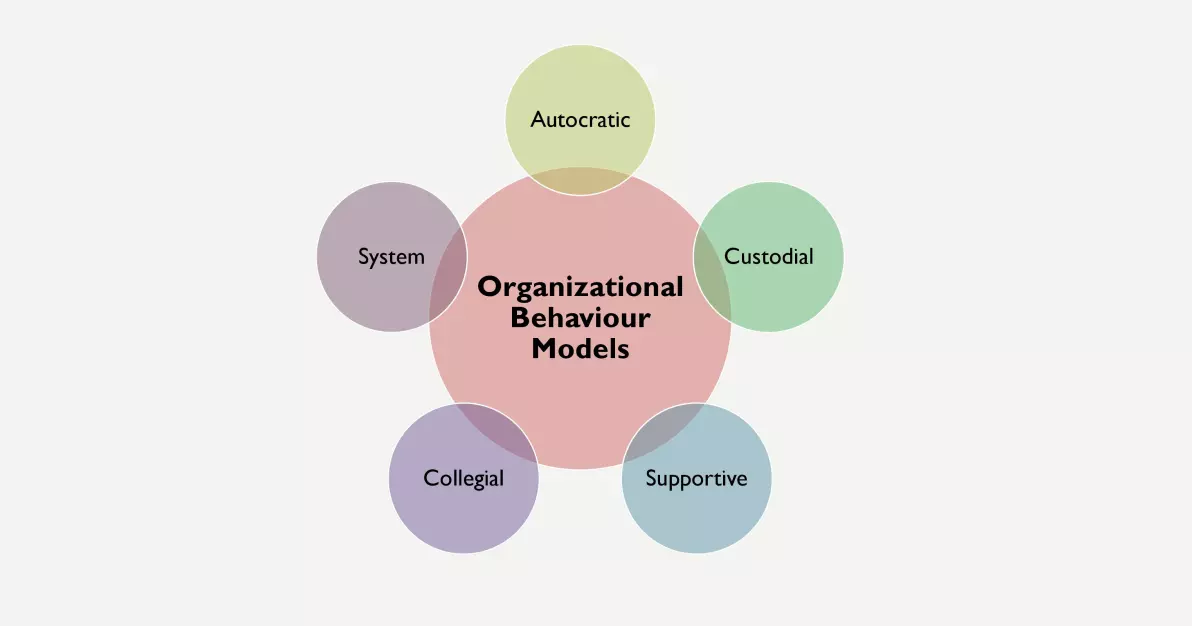
    In this article, you’ll learn about Models of Organisational Behaviour. Since the dawn of industrial revolution, four models of organisational behaviour have been followed by managers of different organisations at different times.

    These are

    1. Autocratic Model
    2. Custodial Model
    3. Supportive Model
    4. Collegial Model
    5. System Model
    Model  Autocratic  CustodialSupportiveCollegialSystem
    Basis of Model  Power Economic resources  LeadershipPartnership Partnership
    Managerial orientation  AuthorityMoneySupport  Teamwork     Teamwork
    Employee orientationObedience   Security and benefitsJob performanceResponsible behaviour
    Employee psychological result  Dependence on bossDependence on Organization   SecurityParticipationSelf – discipline Self – motivation
    Employee needs metSubsistence SecurityStatus and recognitionSelf – actualizationHigher order needs
    Performance resultMinimumPassive Cooperation Awakened drivesModerate enthusiasm Full enthusiasm 

    Models of Organizational Behaviour

    Autocratic Model 

    • The autocratic model depends on power. Those who are in command must have the power to demand ―you do this-or else, meaning that an employee who does not follow orders will be penalized. 
    • In an autocratic environment the managerial orientation is formal, official authority. This authority is delegated by right of command over the people to it applies. 
    • Under autocratic environment the employee is obedience to a boss, not respect for a manager
    • The psychological result for employees is dependence on their boss, whose power to hire, fire, and ―perspire they is almost absolute. 
    • The boss pays minimum wages because minimum performance is given by employees. They are willing to give minimum performance-though sometimes reluctantly-because they must satisfy subsistence needs for themselves and their families.
    • Some employees give higher performance because of internal achievement drives, because they personally like their boss, because the boss is ―a natural-born leader, or because of some other factor; but most of them give only minimum performance. 

    The Custodial Model 

    • A successful custodial approach depends on economic resources
    • This approach depends on money to pay wages and benefits.
    • Since employee’s physical needs are already reasonably met, the employer looks to security needs as a motivating force. If an organization does not have the wealth to provide pensions and pay other benefits, it cannot follow a custodial approach.
    • The custodial approach leads to employee dependence on the organization. Rather than being dependence on their boss for their weekly bread, employees now depend on organizations for their security and welfare. 
    • Employees working in a custodial environment become psychologically preoccupied with their economic rewards and benefits. As a result of their treatment, they are well maintained and contended. However, contentment does not necessarily produce strong motivation; it may produce only passive cooperation. The result tends to be those employees do not perform much more effectively than under the old autocratic approach. 

    The Supportive Model 

    • The supportive model depends on leadership instead of power or money. Through leadership, management provides a climate to help employees grow and accomplish in the interests of the organization the things of which they are capable. 
    • The leader assumes that workers are not by nature passive and resistant to organizational needs, but that they are made so by an inadequately supportive climate at work. They will take responsibility, develop a drive to contribute, and improve themselves if management will give them a chance. Management orientation, therefore, is to support the employee’s job performance rather than to simply support employee benefit payments as in the custodial approach. 
    • Since management supports employees in their work, the psychological result is a feeling of participation and task involvement in the organization. Employee may say ―we instead of ―they when referring to their organization. 
    • Employees are more strongly motivated than by earlier models because of their status and recognition needs are better met. Thus they have awakened drives for work. 

    The Collegial Model 

    • A useful extension of the supportive model is the collegial model. The term ―collegial relates to a body of people working together cooperatively. 
    • The collegial model depends on management’s building a feeling of partnership with employees. The result is that employees feel needed and useful. They feel that managers are contributing also, so it is easy to accept and respect their roles in their organization. Managers are seen as joint contributors rather than as bosses. 
    • The managerial orientation is toward teamwork. Management is the coach that builds a better team 
    • The employee’s response to this situation is responsibility. For example employees produce quality work not because management tells them to do so or because the inspector will catch them if they do not, but because they feel inside themselves an obligation to provide others with high quality. They also feel an obligation to uphold quality standards that will bring credit to their jobs and company. 
    • The psychological result of the collegial approach for the employee is self-discipline. Feeling responsible, employees discipline themselves for performance on the team in the same way that the members of a football team discipline themselves to training standards and the rules of the game. 
    • In this kind of environment employees normally feel some degree of fulfillment, worthwhile contribution, and self-actualization, even though the amount may be modest in some situation. This self-actualization will lead to moderate enthusiasm in performance. 

    The System Model 

    • An emerging model of organization behavior is the system model. It is the result of a strong search for higher meaning at work by many of today’s employees; they want more than just a paycheck and job security from their jobs. Since they are being asked to spend many hours of their day at work, they want a work context there that is ethical, infused with integrity and trust, and provides an opportunity to experience a growing sense of community among coworkers. 
    • To accomplish this, managers must increasingly demonstrate a sense of caring and compassion, being sensitive to the needs of a diverse workforce with rapidly changing needs and complex personal and family needs. 
    • In response, many employees embrace the goal of organizational effectiveness, and reorganize the mutuality of company-employee obligations in a system viewpoint. They experience a sense of psychological ownership for the organization and its product and services. 
    • They go beyond the self-discipline of the collegial approach until they reach a state of self-motivation, in which they take responsibility for their own goals and actions. 
    • As a result, the employee needs that are met are wide-ranging but often include the highest-order needs (e.g., social, status, esteem, autonomy, and self actualization).  Because it provides employees an opportunity to meet these needs through their work as their work as well as understand the organization’s perspectives, this new model can engender employees’ passion and commitment to organizational goals. They are inspired; they feel important; they believe in the usefulness and viability of their system for the common good.