What is Motivation?
Motivation is defined as inner burning passion caused by need, wants, and desire which propels an individual to exert his physical and mental energy to achieve desired objectives.
Motivation is goal-directed behavior. People are motivated when they expect that a course of action is likely to lead to the attainment of a goal and a valued reward – one that satisfies their needs and wants.
Three Components of Motivation
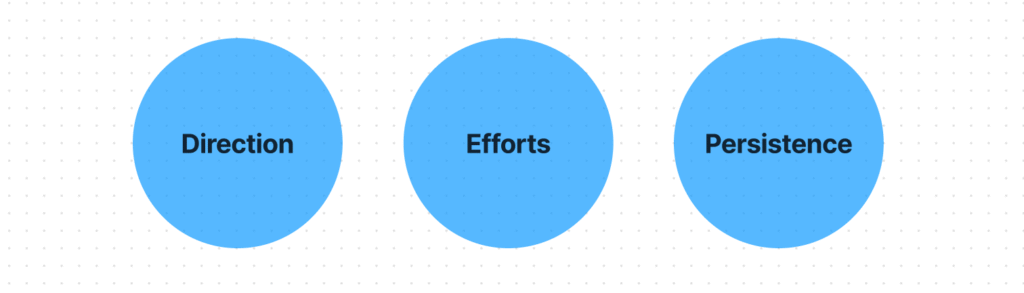
- Direction: what a person is trying to do.
- Effort: how hard a person is trying.
- Persistence: how long a person keeps on trying.
Dynamics of Motivation
Motivation is triggered by the psychological tension comes due to the unfulfilled need and drives consumers to buy. Consumers strive consciously and unconsciously to bring down their tension by selecting goals in anticipation of fulfilling their needs.
Basic idea of marketing is to identify and fulfill the needs. Marketers tend to fulfill unfelt or dormant needs. Basic needs of consumer do not change but the product fulfilling the need may change.
A product-focused towards the consumer need ensures that companies remain in forefront of the search for new and effective solutions. This helps companies to survive and grow even in tough competition.
Level of motivation
The level of motivation would depend on the intensity and urgency of need. Consumer motivational levels may vary from low to high depending on how important is that purchase. Besides, various Influences affecting consumers’ buying include familiarity with the purchase, status factors and overall expense & value.
Where fulfillment rewards are low, as with routine purchases like salt, sugar, tea, shampoo etc., motivation levels are also relatively low and involve little decision-making behavior.
On the other hand, with a complex, risky and emotionally-charged process such as buying a new car, the drive to achieve the best result is high.
Motivational behavior
The behavioral aspect of consumer motivation concerns the actions we take before purchasing and consuming goods or services. We might do a lot of research-evaluating alternatives, testing, and sampling before making a purchase decision.
Marketers aim to gain the most impact and eventual sales by linking their products and services to clearly defined consumer needs and by understanding what motivates people to buy.
Motivation Definition
Motivation is the willingness to exert high levels of effort toward organisational goals, conditioned by the effort’s ability to satisfy some individual needs.
Stephen P Robbins
It is the way in which urges, drives, desires, aspirations, strivings or needs direct, control or explains the behaviour of human beings.
D.E. McFarland
It is the desire within an individual that stimulates him or her to action.
George R. Terry
It is a process of stimulating people to action to accomplish desired goals.
Scot
It is the way in which urges, drives, desires, aspirations, strivings need direct, control or explain the behaviour of human beings.
Mc Farland
It is a willingness to expand energy to achieve a goal or reward. It is a force that activates dormant energies and sets in motion the action of the people. It is the function that kindles a burning passion for action among the human beings of an organisation.
C.B. Mamoria
It is steering one’s actions toward certain goals and committing a certain part of one’s energies to reach them.
S.W Gellerman
Concept of Motivation
Need: A need is a condition of lack or deficit of something required by the organism/person.
Motives: Motive is defined as an inner state that energises, activates (or moves) and directs (or chanalises) the behaviour towards certain goals.
Types of Motivation
The two types of motivation are:
- Intrinsic motivation
- Extrinsic motivation
Intrinsic motivation
Intrinsic motivation can arise from self-generated factors that influence people’s behaviour. It is not created by external incentives.
It can take the form of motivation by the work itself when individuals feel that their work is important, interesting and challenging and provides them with a reasonable degree of autonomy (freedom to act), opportunities to achieve and advance, and scope to use and develop their skills and abilities.
Extrinsic motivation
Extrinsic motivation occurs when things are done to or for people to motivate them.
These include rewards, such as incentives, increased pay, praise, or promotion; and punishments, such as disciplinary action, withholding pay, or criticism. Extrinsic motivators can have an immediate and powerful effect, but will not necessarily last long.
Characteristics of Motivation
Characteristics of motivation are :
- Motivation is a psychological phenomenon
- Motivation is a continuous process
- Motivation is caused due to anticipated perceived value from an action
- Motivation varies from person to person and time to time
- An individual is motivated by positive or negative motivation
Motivation is a psychological phenomenon
It is the inner desire of an individual to achieve something more. More is the individual motivated better performance and organization relations.
Motivation is a continuous process
Since need and desire are endless so the need is a continuous phenomenon if one need is satisfied the other need emerges.
Motivation is caused due to anticipated perceived value from an action
Perceived value is the probability or expectancy. motivation= value × expectancy.
Motivation varies from person to person and time to time
Motivation is different for different persons and it also varied according to time and place because wants are different for different people, according to time and places.
An individual is motivated by positive or negative motivation
Positive motivation is based on incentives or rewards. Incentives can be monetary and non-monetary.
Negative motivation is based on penalties, calling for explanation, threats, fear, etc. Fear of losing the job or promotion
Importance of Motivation
Broadly, the importance of motivation is as follow:
- High level of performance
- Low employee turn over and absenteeism
- Acceptance of organization change
- Organizational image
High level of performance
Organizations must ensure that the employees have a high degree of motivation. A highly motivated employee puts extra effort into work and has a sense of belonging to the organization.
The efficiency of work will be improved, wastage will be minimum which will result in increased productivity, and performance level will be high.
Low employee turn over and absenteeism
Low level of motivation is a root cause of low turnover and absenteeism. High level of absenteeism causes a low level of production, poor quality, wastages, and disruption in production schedules.
Increased turnover is disastrous for any organization as it puts a strain on the financial position of the organization due to additional recruitment, selection, training and development.
Acceptance of organization change
Social change and technological evolution that happen in the external environment have a greater impact on the motivation of the employee. Management must ensure that the changes are introduced in the organization and their benefits explained to the employees so that there is no resistance to change and organizational growth is achieved.
Re-engineering, empowerment, job enrichment, job rotation, the introduction of new technology and processes will go a long way to boost employee morale and achieve a high degree of motivation.
Organizational image
Employees are the mirrors of any organization. Regular training & development programs should be organized to keep employees updated with the latest skills. It will have a positive impact on the employees and the image of the organization will be improved.
The high organizational image will contribute towards the brand image of the product and services the organization is marketing.
Tools of Motivation to Boost Employee Morale
It is very important for an organization to have a happy and satisfied workforce. A discontented and unmotivated staff may drastically impact the productivity and work relationship of the organization. Hence organizations use different motivational tools to boost the morale of their employees.
These can be physical or monetary rewards, or internal and intrinsic that uses psychological measures to enhance the self-esteem of the employees.
Some of the motivational tools applied by the organizations are discussed below:
- Job Characteristic Model
- Job Redesign
- Alternative Work Arrangements
- Empowerment
- Participative Management
- Quality of Work Life (QWL)
- Motivation Through Variable Pay Programs
- Mentoring
- Employee Counseling
Motivation Theories
Motivation theories are categories into two: content and process theories.
Content theory
Content theories try to figure “what” motivates people. Following are the motivation theories in content theory perspective.
- Maslow’s need Hierarchy
- Herzberg’s Motivation-Hygiene Theory
- McClelland’s Needs Theory
- Alderfer’s ERG Theory
Process theory
Process theories try to figure “How” the motivation occurs. Following are the motivation theories in process theory perspective.
- Vroom’s Expectancy Theory
- Adam’s Equity Theory
- Reinforcement Theory
- Carrot and Stick Approach to Motivation