
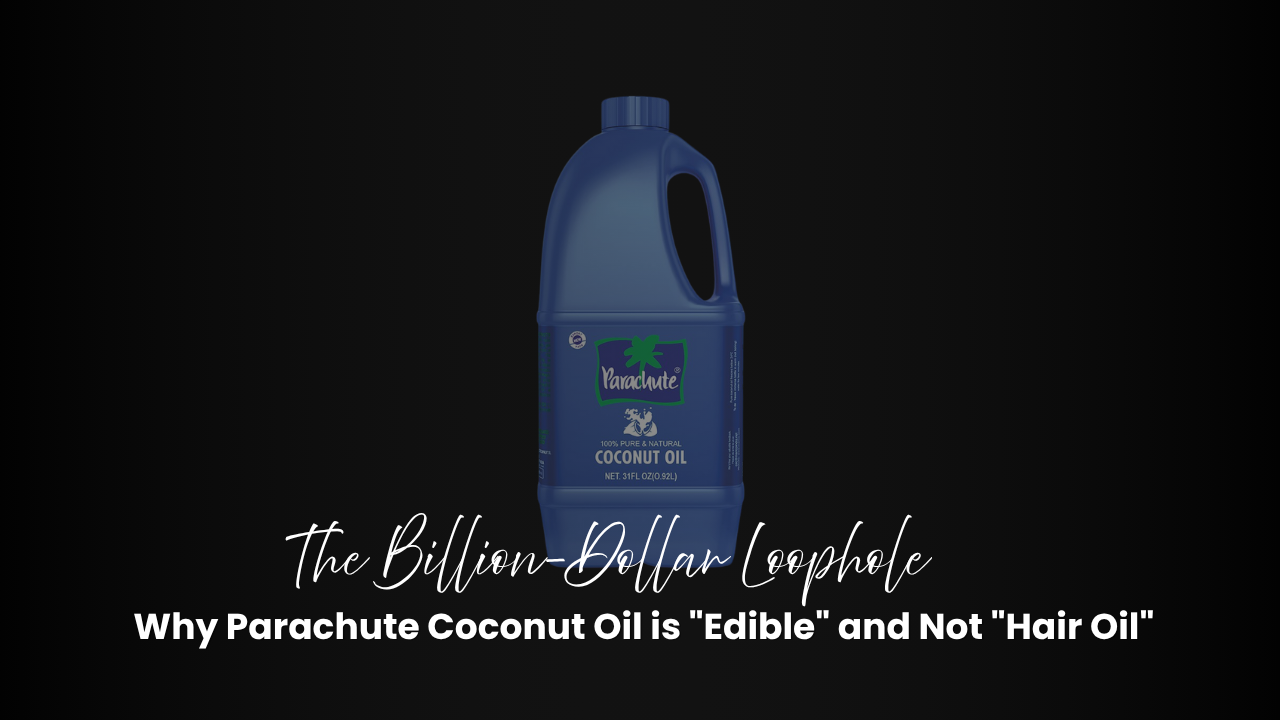
If you grew up in India, you know Parachute’s iconic blue bottle is synonymous with hair care. But here’s a secret that the company, Marico, brilliantly uses to save crores of rupees: Parachute is legally classified as edible oil, not hair oil.
This isn’t just a marketing trick—it’s a masterclass in tax efficiency.
The Misleading Label (That’s Not Misleading)
Take a look at a bottle of Parachute Coconut Oil. You’ll notice two key facts:
- The bottle explicitly states it is “100% Pure Coconut Oil Made from the finest coconuts.”
- Crucially, it carries the FSSAI (Food Safety and Standards Authority of India) license, meaning it meets the safety standards to be consumed as a food product.
What you won’t find anywhere on the label is the word “hair oil.”
The Power of the GST Rate
So why does this labeling matter so much? The answer lies in the Goods and Services Tax (GST):
- Edible Oil (Food Product): The tax rate is significantly lower, typically 5% GST.
- Hair Oil (Cosmetic/Personal Care Product): The tax rate is much higher, typically 18% GST.
By cleverly positioning their pure coconut oil as a food-grade product (which it technically is, being 100% pure coconut oil), Parachute saves the massive difference between 5% and 18% GST on every single bottle sold! This amounts to crores of profit every year.
The Supreme Court’s Verdict
As expected, tax authorities challenged this classification, arguing that because the product is primarily used as a hair oil, it should be taxed as one.
The matter went up to the courts, and in 2005, the Supreme Court settled the issue. The ruling was simple and a huge win for Marico:
If a product meets the safety and purity standards required for edible consumption, it must be taxed as an edible product, regardless of how the consumer chooses to use it.
Since Parachute met all the standards to be deemed edible, the court ruled that it was eligible to pay the lower 5% tax.
This landmark decision allowed Parachute to continue leveraging the tax loophole, ensuring their product remains highly profitable and confirming their status as a business legend.