Author: Rashmi Kumari

  • The Great Indian Paint Heist: How Vijay Mallya Lost Berger to Two Brothers

    The Great Indian Paint Heist: How Vijay Mallya Lost Berger to Two Brothers

    Did you know that the famous business tycoon Vijay Mallya once owned one of India’s biggest paint companies, Berger Paints? Even more incredible is the story of how he lost it, and how two brothers turned that failing company into a ₹10,000 crore success!

    This is a true story of risk, focus, and the power of Indian entrepreneurship.

    Mallya’s Distraction and Berger’s Decline

    Back in 1991, Vijay Mallya did indeed own Berger Paints. However, Mallya’s attention was elsewhere. He was heavily focused on his other ventures: the liquor business and his ambitious Kingfisher Airlines.

    As a result, Berger Paints suffered from neglect and was severely underperforming. It was, in business terms, running on “God’s grace”—a complete mess.

    The Entry of the Dhingra Brothers

    Enter the Dhingra Brothers from Amritsar.

    The Dhingras were already successful in the paint industry. Starting with a small shop 20 years earlier, they had worked their way up to become one of the largest exporters of paint from India to Russia. They had big dreams and saw a massive opportunity.

    They decided to go all-in: they put everything at risk and acquired Berger Paints from Vijay Mallya. This was a company ten times bigger than their existing business!

    The Shocking Truth and the Turnaround Plan

    After the acquisition, the Dhingra brothers were shocked. The company was in even worse shape than they imagined. They realized a massive overhaul was needed.

    They got straight to work and implemented a brilliant two-part strategy:

    1. Employee Motivation: They transformed Berger from a slow-moving multinational into a homegrown Indian powerhouse. They motivated employees for growth by offering them stock options, making every employee feel like an owner.
    2. Smart Management: They cut out all unnecessary costs and implemented strict cash management protocols. No more wasteful spending!

    The Unbelievable Result

    The results of their focused approach were nothing short of spectacular.

    The Dhingra brothers grew Berger Paints from a struggling company with minimal sales to a massive enterprise hitting ₹10,000 crores in sales!

    Today, Berger Paints stands tall as the second-largest paint company in India, a testament to the vision and focus of the Dhingra Brothers. They prove that with the right focus, even a failing business can be turned into a spectacular success story.

  • Adam’s Equity Theory of Motivation

    Adam’s Equity Theory of Motivation

    Adam’s Equity Theory, also known as simply Equity Theory, is a theory of motivation that focuses on fairness in the workplace. Developed by J. Stacy Adams in 1963, it proposes that employees are motivated by their perception of fairness between the inputs they contribute and the outputs they receive compared to their colleagues.

    Key Concepts of Adams’ Equity Theory

    • Inputs: These are the contributions an employee makes to their job. Inputs can include education, experience, skills, effort, dedication, and time spent working.
    • Outputs: These are the rewards an employee receives from their job. Outputs can include salary, benefits, recognition, promotions, and opportunities for growth.
    • Comparison Other: This refers to the process employees go through when they compare their own ratio of inputs to outputs with that of their colleagues.

    The Core Principle: Perceived Fairness

    Adams’ Equity Theory states that employees strive to maintain a sense of fairness (equity) between their own input-to-output ratio and that of their referent others (colleagues they compare themselves to). When employees perceive equity, they are more likely to be motivated and satisfied with their work. Conversely, when employees perceive inequity, they experience distress and take steps to restore a sense of fairness.

    Equity vs. Inequity: Potential Responses

    • Equity: When employees perceive a fair balance between their contributions and rewards compared to their colleagues, they are likely to be motivated, satisfied, and maintain their current level of effort.
    • Under-equity: When employees perceive they are putting in more effort or receiving fewer rewards than their colleagues, they may feel undervalued and demotivated. This can lead to behaviors such as decreased effort, reduced productivity, increased absenteeism, or even looking for a new job.
    • Over-equity: When employees perceive they are receiving more rewards or putting in less effort than their colleagues, they may feel guilty or anxious. This can lead to behaviors such as increased effort to justify their perceived advantage or hiding their true abilities to avoid appearing like they are not contributing enough.

    Implications for Managers

    Understanding Adams’ Equity Theory can help managers create a work environment that fosters motivation and fairness. Here are some key takeaways:

    • Transparency in Rewards: Communicating clearly about how salaries, benefits, and other rewards are determined can help employees understand the rationale behind their outputs.
    • Job Design: Ensuring that job tasks are challenging but achievable and that employees have the resources they need to succeed can help them feel their inputs are valued.
    • Performance Recognition: Providing recognition for effort and achievement, not just outcomes, can help employees feel valued even if they face challenges.
    • Open Communication: Encouraging open communication with employees allows them to voice concerns about fairness and work collaboratively to find solutions.

    Limitations of Adams’ Equity Theory

    • Subjectivity of Perceptions: Perceptions of fairness are subjective and can vary greatly between individuals.
    • Focus on Tangible Rewards: The theory primarily focuses on tangible rewards, neglecting the importance of intrinsic motivators like the work itself or the desire for growth.
    • Limited Scope: The theory may not fully explain motivation in all situations, particularly complex ones with many contributing factors.

    Despite these limitations, Adams’ Equity Theory remains a valuable tool for understanding employee motivation and promoting fairness in the workplace. By fostering a sense of equity, managers can create a more motivated and productive workforce.

  • Maslow’s Hierarchy of Needs

    Maslow’s Hierarchy of Needs

    Psychologist Abraham Maslow proposed Maslow’s Hierarchy of Needs theory in psychology in 1940. Maslow’s hierarchy of needs is one of the earliest and best-known of motivation theories.

    Maslow wanted to understand what motivates people. He believed that individuals possess a set of motivation systems unrelated to rewards or unconscious desires.

    Maslow (1943) stated that people are motivated to achieve certain needs. When one need/goal is fulfilled then a person seeks to fulfil the next one, and so on.

    Maslow’s Hierarchy of Needs

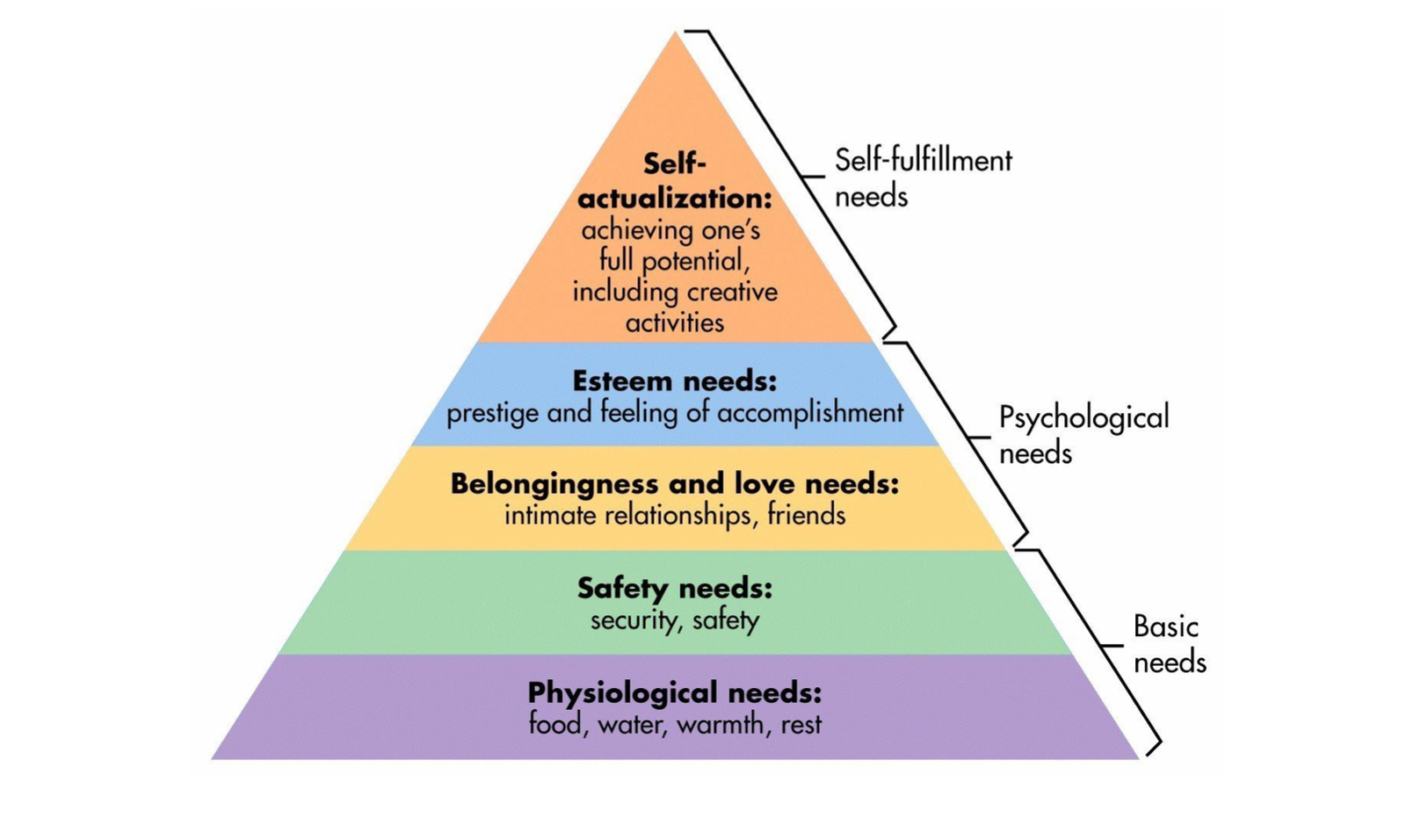
    The Maslow’s Hierarchy of Needs theory assumes that people are motivated to satisfy 5 levels of needs those are a psychological need, security need, social need, esteem and self-actualization needs.

    Maslow’s Hierarchy of Needs
    Maslow’s Hierarchy of Needs

    Maslow categorized the five needs into higher and lower orders.

    Lower-order: Physiological and Safety.
    Higher-order needs: Love and Belonging, Esteem, and Self-actualization.

    1. Physiological Needs
    2. Security Needs
    3. Love and Belonging Needs
    4. Esteem Needs
    5. Self-Actualization Needs

    Maslow suggests that five levels of needs are arranged in accordance with the importance. Starting from the bottom of the hierarchy, an individual is motivated first and foremost to psychological need.

    When the need are satisfied then he is motivated and moves up the hierarchy to satisfy security need. This moving up and process continue till the end-user reaches the self-actualization

    Physiological Needs

    Definition: Physiological needs are considered the most important because they are a most immediate need and hence are also known as basic needs.

    • These are also needed our body to stay functional.
    • It is the bottom and most important needs.

    Example:
    1. It includes food, clothes, shelter, air, water, sexual activities etc.
    2. Basic pay, workspace in the context of organization behaviour.

    Security Needs

    Definition: Security or safety needs are referred to as a requirement for a secure physical and emotional environment.

    • The need is free from worry about money and job security and desire for safe working condition.
    • Security needs are satisfied for people in the workplace by job continuity.
    • A grievance resolving system and an adequate insurance and sentiment benefit package.

    Example:
    1. Financial security, Heath and wellness, a desire for adequate housing.
    2. Job security, adequate medical benefits, and safe working conditions in the context of organization behaviour.

    Love and belongingness Needs

    Definition: Love and belongingness are needs related to a special aspect of human life. They include the needed for love and affection and the need is affected by one’s peers.

    • For most people, these needs are satisfied by a combination of family and community relationship and friendship on the job.
    • Manager can help the ensure the satisfaction of these important needs by allowing social interaction and making employees feel like a part of a team or workgroup.

    Example:
    1. Social acceptance, need to belong, to relate to others.
    2. Good co-workers and supervisors, participating in social functions in the context of organization behaviour.
    3. Friendship, intimacy, trust, and acceptance, receiving and giving affection and love.

    Esteem Needs

    Definition: The Esteem needs are concerned with self-respect, self-confidence, feeling of personal worth.

    • A feeling of being unique and recognition satisfaction. It is the image of the self in the eye of others.
    • A person with high esteem thinks that people think highly of him. It is our esteem that gives us a recognition of our skill.

    Example:
    1. when someone says that he is funny, entertaining and amiable. He must have heard other saying the most of think about him.
    2. Promotions and being recognized at work in the context of organization behaviour.

    Self-Actualization Needs

    Definition: Self-actualization is the realizing of oneself. Many people reach a stage in their life where they start wondering what is expected out of them in their life.

    • It is the final need on Maslow’s Hierarchy of Needs.
    • They hear a voice that tells them to fulfil their destiny. Such people to figure out the meaning of their lives and faces of an existential question.

    Example:
    1. Obtaining our full potential, becoming confident, eager to express our beliefs, and willing to reach out to others to help them.
    2. Challenging projects, opportunity for innovation and creativity in the context of organization behaviour.

    Deficiency Needs vs Growth Needs


    Physiological, security, social, and esteem needs arose due to deprivation are termed as deficiency needs. In order to avoid unpleasant feelings or consequences, we must satisfy these lower-level needs.

    Growth needs don’t stem from a lack of something, but rather from a desire to grow as a better individual. It is termed as the highest level of the pyramid.

    Advantages of Maslow’s Hierarchy of Needs

    • Simple to understand
    • It takes into account human nature
    • Relevant in all field

    Disadvantages of Maslow’s Hierarchy of Needs

    • Needs do not necessarily follow a hierarchy
    • The theory is difficult to test/measure
  • Vroom’s Expectancy Theory of Motivation

    Vroom’s Expectancy Theory of Motivation

    Expectancy theory is a motivation theory first proposed by Victor Vroom of the Yale School of Management in 1964. The theory also assumes that people are rational and logically calculating.

    Maslow’s Hierarchy of Needs and Herzberg Two Factor Theory were based on the relationship between internal needs and the resulting effort expended to fulfil them, while Vroom’s Expectancy Theory separates effort, performance and outcomes.

    What is Vroom’s Expectancy Theory?

    Vroom’s Expectancy Theory is one of the process of motivation theories. It is based on the idea that people believe that effort will lead to desired outcomes. Through experience, the individual expects that they can achieve performance. Finally, they direct their effort towards outcomes which help to fulfil their needs.

    According to Vroom’s Expectancy Theory, motivation boils down to the decision of how much efforts to exert in a specific situation.

    Expectancy Theory Assumptions

    Vroom’s Expectancy Theory has assumed four assumptions:

    1. First assumption: is that individuals join organizations with some expectations about their motivations, needs, and past experiences. These influence how individuals behave in an organization.
    2. Second assumption: is that an individual’s behavior is a result of conscious choice. That is, people are independent to behave in a certain way according to their own expectancy calculations.
    3. Third assumption: is that individuals expect different things from the organization (e.g., job security, advancement, good salary  and challenge).
    4. Fourth assumption: is that individuals will behave in a certain way so as to optimize outcomes for them personally.

    Components of Expectancy Theory

    The expectancy theory state three components that are linked to a person’s motivation. These components are:

    1. Expectancy
    2. Instrumentality
    3. Valence

    Expectancy

    Expectancy means an individual belief that particular degree of effort will lead to increased performance.

    • Effort–performance relationship.
    • Expectancy is a probability which may vary from 0 to 1.
    • Expectancy of 0 indicates that the effort has no impact on performance.
    • Expectancy of 1 indicates that a particular first-level outcome will follow behaviour.

    Example: if I work harder then this will be better.

    Instrumentality

    Instrumentality represent a person’s belief that a particular outcome is dependent on a specific level of performance

    • Performance–reward relationship
    • This is a perception by an individual that first level outcome is associated with second-level outcome.
    • Instrumentality ranges from -1 to 1.
    • An instrument of 1 indicates that a particular outcome is totally dependent on performance on performance
    • An instrumentality of 0 indicates that there is no relationship between performance and outcome
    • Finally, an instrumentality of -1 reveals that high-performance reduces the chance of obtaining outcome why low performance increase a chance

    Example: superior performance is instrumental in getting a promotion

    Valence

    Valence refers to the positive or negative value the people place on outcome.

    • Rewards–personal goals relationship
    • We assign value to an outcome depending on our requirements and needs.
    • Mostly people attach high value to outcome such as increased salary, promotion or recognition but no value to stress or layoffs.
    • An outcome of valence depends on individual needs and is measured with scale ranging from negative value to a positive value.

    Example: If an employee has a strong preference for attaining a reward, valence is positive.

    Vroom’s Expectancy Theory Formula

    Vroom’s Expectancy Theory proposed the formula to calculate the motivational force

    Motivation = Expectancy x Instrumentality x Valence

    The multiplier effect in the equation is significant. High level of expectancy, instrumentality, and valence will leads to results in higher levels of motivation.

    • The overall level of motivation will be zero if, any one of the three factors is zero.
    • Therefore, even if an individual thinks that his effort will lead to better performance, which will result in reward, motivation will be zero if the valence of the reward he expects to receive is zero.
    • Example: if he believes that the reward he will receive for his effort has no value for him.

    How a Manager can use Expectancy Theory?

    The managers can be benefitted from the expectancy theory as it helps them to understand the psychological processes that cause motivation.

    • The thinking, perceptions, beliefs, estimates of chances and probabilities and other such factors of employees strongly influence their motivation, performance and behaviour. It makes the process of understanding organizational behaviour easier.
    • By understanding the factors that motivate and demotivate individual employees, the managers can create a work environment, climate and culture that will increase the motivation levels of employees

    Advantages of the Expectancy Theory

    • Self-interest: an individual who wants to achieve minimize dissatisfaction and attain maximum satisfaction.
    • Common sense: explains the gamut of motivation by breaking it down into separately recognizable stages.
    • More scientific: It explains many of the phenomenon related to employee efforts, work performance, employee motivation etc. that are observed in organizations.

    Limitations of the Expectancy Theory

    • Idealistic theory: few experts believe that the complexity of the theory makes it difficult not only to test but also to implement.
    • Limited use and is more valid where individuals clearly perceive effort– performance and performance–reward linkages.
  • Difference between groups and teams

    Difference between groups and teams

    When we use the terminologies, group and team, we mostly take these as synonyms of each other. Though both refers to the assemblage of two or more individuals, a team is a particular type of a group which is more focused towards the desired mutual goal with every member contributing in the best possible manner.

    Difference between groups and teams

    Groups differ from teams in several ways:

    1. Task orientation: Teams require coordination of tasks and activities to achieve a shared aim. Groups do not need to focus on specific outcomes or a common purpose.
    2. Degree of interdependence: Team members are interdependent since they bring to bear a set of resources to produce a common outcome. Individuals in a group can be entirely disconnected from one another and not rely on fellow members at all.
    3. Purpose: Teams are formed for a particular reason and can be short- or long-lived. Groups can exist as a matter of fact; for example, a group can be comprised of people of the same race or ethnic background.
    4. Degree of formal structure: Team members’ individual roles and duties are specified and their ways of working together are defined. Groups are generally much more informal; roles do not need to be assigned and norms of behavior do not need to develop.
    5. Familiarity among members: Team members are aware of the set of people they collaborate with, since they interact to complete tasks and activities. Members of a group may have personal relationships or they may have little knowledge of each other and no interactions whatsoever.

    Groups Vs Teams

    GroupsTeams
    Members work independently and they often are not working towards the same goal.Members work inter-dependently and work towards both personal and team goals, and they understand these goals are accomplished best by mutual support.
    Members focus on mostly on themselves because they are not involved in the planning of their group’s objectives and goals.Members feel a sense of ownership towards their role in the group because they committed themselves to goals they helped create.
    Members are given their task or told what their duty/job is, and suggestions are rarely welcomed.Members collaborate and use their talent and experience to contribute to the success of the team’s objectives.
    Members may not fully understand what is taking place in their group.Members base their success on trust and encourage all members to express their opinions, varying views and question.
    Members may or may not participate in group decision making, and conformity is valued more than positive results.Members participate equally in decision- making, but each member understands that the leader might need to make the final decision of the team cannot reach consensus.
  • Herzberg Two Factor Theory

    Herzberg Two Factor Theory

    Herzberg Two Factor Theory is also known as the Herzberg’s motivation-hygiene theory and dual-factor theory was coined by Frederick Herzberg in 1959.

    What is the Two Factor Theory?

    Herzberg Two Factor Theory or Herzberg’s Motivation-Hygiene Theory, argues that there are two factors that influence the motivation of the employee in the organization.

    In 1959, Herzberg conducted a study on 200 engineers and accountants from over nine companies in the United States.

    He asked professionals to describe two important incidents at their job. when did they felt either extremely bad or exceptionally good about their jobs and rated their feelings on these experiences.

    Responses about satisfied feelings are generally related to “job content” (motivation factors/ satisfiers ) and responses about dissatisfied feelings are associated with “job context” (hygiene factor/ dissatisfiers). This is why it is known as Two Factor Theory.

    Motivation factors

    Motivation factors, which are the drivers of human behavior related to the intrinsic nature of the work.

    There are six motivation factors that include:

    1. Achievement
    2. Recognition
    3. Work itself
    4. Responsibility
    5. Advancement
    6. Possibility of Growth

    Achievement

    Achievement factor refers to successful performance of individual’s work tasks, solving problems, justification and seeing the results of one’s work.

    Recognition

    Recognition depends on praise, notice and criticism received from colleagues or management and it mainly means getting recognition due to achievement in tasks.

    Work itself

    Work itself describes the actual content of one’s job, basically meaning the tasks of the job.

    Responsibility

    Responsibility means the sense of responsibility given to an employee for his/her own work or being given new responsibilities.

    Advancement

    Advancement refers to a change in one’s position at work and, therefore, involves the concept of promotion.

    Possibility of Growth

    JOb must give equal and adequate opportunities for the employee to learn new skills and to achieve career advancement.

    Hygiene Factors

    Hygiene factors, which are contingent factors may demotivate the employee.

    These are hygiene factors which includes:

    1. Company Policy
    2. Work Conditions
    3. Supervision
    4. Salary
    5. Interpersonal Relations
    6. Job Security

    Company policy

    Company policy and administration relate specifically to organization management at workplaces and they also require personnel policies.

    Work conditions

    Working conditions require the physical environment of working and especially the available facilities with all their space and tools, for instance.

    Supervision

    Supervision, refers to the actual behavior of managers towards employees, for example, how fair or unfair they are and how willing they are to envoy responsibilities.

    Salary

    Salary is an economic benefit for work.

    Interpersonal Relations

    It refer to the social interactions between colleagues and between workers and their supervisors.

    Job Security

    The employee must have a sense of belongingness and feel secure. They must not work under the stress that their job can be laid off anytime.

    Four State in Organization

    Four different combinations can exist at an organization:

    High Hygiene + High Motivation

    Employees are highly motivated and have few complaints.

    High Hygiene + Low Motivation

    Employees is not highly motivated and have few complaints.

    Low Hygiene + High motivation

    Employees are motivated but have a lot of complaints.

    Low hygiene + Low motivation

    Employees is not motivated and also have a lot of complaints

    Two factor theory or Herzberg’s Motivation-Hygiene theory sought that manager should consider all the two factors in order to optimally motivate and satisfy employees to get the best out of them rather than to be one-sided in considering factors to motivate employees.

    How Manager can use Two Factor Theory?

    Every organization and manager wants the team to give their best possible performance. But How do you motivate employees? Motivating people really works when eliminating the things that bother them.

    Eliminate job dissatisfaction

    According to Herzberg (1987) managers can eliminate the dissatisfaction among the employee by applying the motivation factors of two factor theory as follow:

    • Fix poor and obstructive company policies.
    • Provide effective, supportive and non-intrusive supervision.
    • Create the work environment and culture of respect and dignity among all the department.
    • Provide competitive wages and salaries and job security.
    • Providing meaningful work for all positions and build job status.

    Create job satisfaction

    According to Herzberg (1987), job enrichment is the motivating factors that are needed to be addressed. He suggested that every job should be examined to determine how it could be made better and more satisfying to the person doing it.

    Hence, managers need to consider and include:

    • Providing equal and adequate opportunities for achievement and growth.
    • Recognizing employee contributions.
    • Assigning work that matches the skills and abilities of the employee and is rewarding.
    • Assigning equal responsibility among each team member as possible.
    • Providing opportunities for internal promotions.
    • Offering training and development opportunities so that employee can pursue the growth in his career.

    Critique of Two Factor Theory

    Although, Two Factor Theory has a few issues with it but still it is widely used.

    First, when things are going well employees tend to look at the aspects of their work that they like and project them onto themselves. But, dring bad times, external factor play a big role.

    Another, critique of Two Factor Theory is that Herzberg didn’t take account that external factors might influence productivity. He only consider job satisfaction results in higher productivity.

    Finally, it is only applies to white-collar employees.

    Summary of Two Factor Theory

    Two Factor Theory is one of the content motivation theories. Herzberg in Two Factor Theory or Herzberg’s Motivation-Hygiene Theory states that two factors affect motivation in the workplace.

    These two factor are hygiene factors and motivating factors.

    • Workers motivated to work harder by motivators e.g. more responsibility and appreciation etc..
    • Workers can become de-motivated if hygiene factors are not met e.g. salary and work conditions.

    To successfully implement two factor theory, first hygiene factor should be resolved. once those are resolved, then motivators factor should be implemented to enhance motivation.


  • Team: Definition, Characteristics, Types, and Team Building

    Team: Definition, Characteristics, Types, and Team Building

    What is Team

    A group of people with a full set of complementary skills required to complete a task, job, or project.

    Team members

    • Operate with a high degree of interdependence, 
    • Share authority and responsibility for self-management, 
    • Are accountable for the collective performance, and 
    • Work toward a common goal and shared rewards.

    A team becomes more than just a collection of people when a strong sense of mutual commitment creates synergy, thus generating performance greater than the sum of the performance of its individual members

    A group does not necessarily constitute a team. Teams normally have members with complementary skills and generate synergy through a coordinated effort which allows each member to maximize their strengths and minimize their weaknesses.

    Characteristics of Teams

    • There is a clear unity of purpose.  There was free discussion of the objectives until members could commit themselves to them; the objectives are meaningful to each group member. 
    • The group is self-conscious about its own operations. The group has taken time to explicitly discuss group process — how the group will function to achieve its objectives. The group has a clear, explicit, and mutually agreed-upon approach: mechanics, norms, expectations, rules, etc.

    Frequently, it will stop to examine how well it is doing or what may be interfering with its operation.

    Whatever the problem may be, it gets open discussion and a solution found. 

    • The group has set clear and demanding performance goals for itself and has translated these performance goals into well-defined concrete milestones against which it measures itself. The group defines and achieves a continuous series of “small wins” along the way to larger goals. 
    • The atmosphere tends to be informal, comfortable, relaxed.

    There are no obvious tensions, a working atmosphere in which people are involved and interested. 

    • There is a lot of discussion in which virtually everyone participates, but it remains pertinent to the purpose of the group. If discussion gets off track, someone will bring it back in short order. The members listen to each other. Every idea is given a hearing. People are not afraid of being foolish by putting forth a creative thought even if it seems extreme. 
    • People are free in expressing their feelings as well as their ideas. 
    • There is disagreement and this is viewed as good.

    Disagreements are not suppressed or overridden by premature group action. The reasons are carefully examined, and the group seeks to resolve them rather than dominate the dissenter. Dissenters are not trying to dominate the group; they have a genuine difference of opinion. If there are basic disagreements that cannot be resolved, the group figures out a way to live with them without letting them block their efforts. 

    • Most decisions are made at a point where there is general agreement.

    However, those who disagree with the general agreement of the group do not keep their opposition private and let an apparent consensus mask their disagreement. The group does not accept a simple majority as a proper basis for action. 

    • Each individual carries his or her own weight, to meet or exceed the expectations of other group members. Each individual is respectful of the mechanics of the group: arriving on time, coming to meetings prepared, completing agreed upon tasks on time, etc. When action is taken, clears assignments are made (who-what-when) and willingly accepted and completed by each group member. 
    • Criticism is frequent, frank and relatively comfortable. The criticism has a constructive flavor — oriented toward removing an obstacle that faces the group. 
    • The leadership of the group shifts from time to time.

    The issue is not who controls, but how to get the job done.  

    Team building

    Team building is a collective term for various types of activities used to enhance social relations and define roles within teams, often involving collaborative tasks. It is distinct from team training, which is designed to improve efficiency, rather than interpersonal relations.

    Teams can be classified according to their objective. The four most common forms of teams you are likely to find in an organization are problem-solving teams, self-managed teams, cross-functional teams, and virtual teams.

    1. Problem Solving Teams

    They are typically composed of 5 to 12 employees from the same department who meet for a few hours each week to discuss ways of improving quality, efficiency, and the work environment. Organizations are relaying more and more on problem-solving teams to help solve organizational problems.

    In problem-solving teams, members share ideas or offer suggestions on how work process and methods can be improved. Rarely, however, are these teams given the authority to unilaterally implement any of their suggested actions.

    2. Self Managed Teams

    They are generally composed of 10 to 15 people who take on the responsibilities of their former supervisors. Typically, these responsibilities include:

    • Collective control over the pace of work,
    • Determination of work assignments,
    • Organization of breaks, and
    • Collective choice of inspection procedures used.

    Fully self-managed teams select their own members, and the members evaluate each other’s performance. As a result, supervisory positions take on decreased importance and may even be eliminated.

    3. Cross – Functional Teams

    Cross-functional teams are made of employees at about the same hierarchical level, but from different work areas, who come together to accomplish a task.

    Cross-functional teams are an effective means of allowing people from diverse areas within an organization to exchange information, develop new ideas, solve problems, and coordinate complex projects. Cross-functional teams bring people with different functional specialties to better invent design, or deliver a product or service. The general goals of using cross-functional team include some combination of innovation, speed and quality that come from early coordination among the various specialties

    4. Virtual Teams

    Virtual teams use computers technology to tie tighter physically dispersed members in order to achieve a common goal. They allow people to collaborate online, whether they are only a room apart or separated by continents.

    The three primary factors that differentiate virtual teams from face-to-face teams are:

    • The absence of Para verbal and nonverbal cues.
    • Limited social context.
    • The ability to overcome time and space constraints.
  • Motivation Theories

    Motivation Theories

    Motivation is an inner psychological force which activates and compares the person to behave in a particular manner. There are many motivation theories under the concept of motivation.

    Motivation Theories

    Motivation theories are categories into two: content and process theories.

    Content theory: focus on “what” motivates people.

    Process theory: focus on “how” motivation occurs.

    Content Motivation Theories

    Content theories try to figure “what” motivates people. It is also known as needs theory. It is concerned with individual needs and goals.
    Following are the motivation theories in content theory perspective.

    • Maslow’s hierarchy of needs
    • Herzberg’s Motivation-Hygiene Theory (Two-factor theory)
    • McClelland’s Needs Theory
    • Alderfer’s ERG Theory

    Maslow’s hierarchy of needs

    Maslow’s hierarchy of needs is a motivational theory in psychology. Maslow’s classified the human need into five hierarchy category.

    • Physiological need: These are a basic need for human life related to survival and maintenance.
      Example: Food, cloth, shelter, air etc. Getting a job in organization context.
    • Safety need: Once physiological needs are met. One’s attention turn to safety and stability.
      Example: Economic security and safety from physical danger such as war, crime etc. job security in organization context.
    • Social need: Those needs which are related to interaction with other people and may include need for friends, need for belongingness and to give and receive love.
      Example: Having good work relationships in the context of an organisation.
    • Esteem needs: It includes prestige, recognition, acceptance, admiration and self-respect.
      Example: Appreciated for what an individual can do, in the context of an organisation.

    Herzberg’s Motivation-Hygiene Theory

    Frederick Herzberg proposed a motivation-hygiene theory or Two-factor theory. According to Herzberg, satisfaction and dissatisfaction are two separate dimensions.

    • Satisfaction is affected by motivators and dissatisfaction is affected by hygiene factor, which is the key idea for managers.
    • This theory suggests to improve hygiene factor (dissatisfiers) and to provide motivators (satisfiers) for the motivation of employees.
    • Motivation cannot take place only by improving the highest factor in the work environment.
    • So, the manager has to improve hygiene factor for removal of dissatisfaction from the minds of employees and to provide motivators to increase satisfaction among the employees.

    Process Motivation Theories

    Process theories try to figure “How” the motivation occurs. It is concerned with the “process” of motivation.
    Following are the motivation theories from the process theory perspective.

  • What Is Job Satisfaction? Definition, Factors and Importance

    What Is Job Satisfaction? Definition, Factors and Importance

    What is Job Satisfaction?

    Job satisfaction is the level of contentment a person feels regarding his or her job. This feeling is mainly based on an individual’s perception of satisfaction. Job satisfaction can be influenced by a person’s ability to complete required tasks, the level of communication in an organization, and the way management treats employees.

    Choose a job you love, and you will never have to work a day in your life.

    Confucius

    Factors Affecting Job Satisfaction

    An employee’s overall satisfaction with his job is the result of a combination of factors — and financial compensation is only one of them. Management’s role in enhancing employees’ job satisfaction is to make sure the work environment is positive, morale is high and employees have the resources they need to accomplish the tasks they have been assigned.

    • Working Conditions

    Because employees spend so much time in their work environment each week, it’s important for companies to try to optimize working conditions. Such things as providing spacious work areas rather than cramped ones, adequate lighting and comfortable work stations contribute to favorable work conditions. Providing productivity tools such as upgraded information technology to help employees accomplish tasks more efficiently contributes to job satisfaction as well.

    • Opportunity for Advancement

    Employees are more satisfied with their current job if they see a path available to move up the ranks in the company and be given more responsibility and along with it higher compensation. Many companies encourage employees to acquire more advanced skills that will lead to the chance of promotion. Companies often pay the cost of tuition for employees taking university courses, for example. During an employee’s annual performance review, a supervisor should map out a path showing her what she needs to accomplish and what new skills she needs to develop in order to be on a track to advancement within the organization.

    • Workload and Stress Level

    Dealing with a workload that is far too heavy and deadlines that are impossible to reach can cause job satisfaction to erode for even the most dedicated employee. Falling short of deadlines results in conflict between employees and supervisors and raises the stress level of the workplace. Many times, this environment is caused by ineffective management and poor planning. The office operates in a crisis mode because supervisors don’t allow enough time for employees to perform their assigned tasks effectively or because staff levels are inadequate.

    • Respect from Co-Workers

    Employees seek to be treated with respect by those they work with. A hostile work environment — with rude or unpleasant co-workers — is one that usually has lower job satisfaction. Managers need to step in and mediate conflicts before they escalate into more serious problems requiring disciplinary action. Employees may need to be reminded what behaviors are considered inappropriate when interacting with co-workers.

    • Relationship with Supervisors

    Effective managers know their employees need recognition and praise for their efforts and accomplishments. Employees also need to know their supervisor’s door is always open for them to discuss any concerns they have that are affecting their ability to do their jobs effectively and impeding their satisfaction at the office.

    • Financial Rewards

    Job satisfaction is impacted by an employee’s views about the fairness of the company wage scale as well as the current compensation she may be receiving. Companies need to have a mechanism in place to evaluate employee performance and provide salary increases to top performers. Opportunities to earn special incentives, such as bonuses, extra paid time off or vacations, also bring excitement and higher job satisfaction to the workplace.

    Therefore, the employer should tell employees early and often that it is the employees’ responsibility to recognize and pursue their own career contentment.  Employers’ emphasis should be on matching employees with meaningful work. Employees who learn to take charge of their own happiness at work will be highly motivated. Satisfied employees will stay with the company for a relatively long period. Thus, they must concentrate on removing dissatisfies from the workplace to enable employees to get on with their own satisfaction in an environment. Managers must concentrate on employing the right people for the organization in order to maximize on the possibility that employees will be satisfied.

    Importance of Job satisfaction

    Job satisfaction is a matter of great significance for employers. 

    • Lower staff turnover
    • Higher productivity
    • Reduction in conflicts and complaints
    • Punctuality (reduced lateness)
    • Better worked morale

    Job satisfaction and productivity

    In the right conditions and settings, job satisfaction can to a great degree lead to higher productivity. If employees feel that their jobs are fun and interesting, they will be more willing to give extra effort at work for the benefit of the whole organization. Instead if employees have the feeling that their occupations are meaningless and boring, they will have a negative attitude which will definitely lead to a decline in productivity.

    Job satisfaction helps to create a better working environment

    When employees are enjoying a higher degree of job satisfaction they tend to be more helpful and friendly with their colleagues at work. This helps to promote teamwork where sharing of information and knowledge is enhanced. Moreover studies have shown that job satisfaction among employees may lead to a better and safer working environment with lesser negative conflicts which otherwise would impede the smooth running of the organization.

    Job satisfaction and absenteeism and turnover

    High rate of turnover has always been a great problem to many organizations. It obviously results in loss of potentials and talents and causes huge losses in terms of additional costs. According to Sattler and Mullen, generally, the more productive people are, the more satisfied they tend to be and when employees feel satisfied they are less likely to leave the organization.

    Employee satisfaction can lead to customer satisfaction

    When our staff is happy, our customers will be too. At the heart of these endeavors is a strong belief that today’s employee satisfaction, loyalty and commitment influence tomorrow’s customer satisfaction, loyalty and commitment-and, ultimately, the organization’s profit and growth.

  • Key Elements of Organizational Behaviour

    Key Elements of Organizational Behaviour

    In this article, you’ll learn about Key Elements of Organizational Behaviour such as People, Structure, Technology, Environment and more.

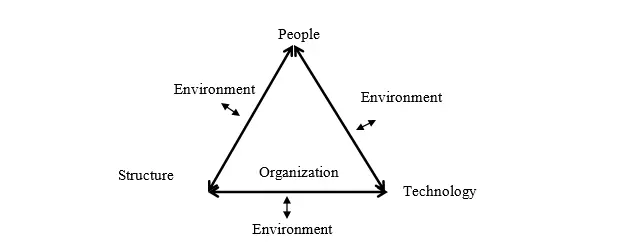
    The key elements of organizational behaviour are people, structure technology and the environment in which the organizations operates. When people join together in an organisation to accomplish an objective, some kind of structure is required. People also use technology to help get the job done, so there is an interaction of people, structure and the technology. In addition, these elements are influenced by the external environment, and they influence it.

    Key Elements in Organizational Behaviour
    Key Elements in Organizational Behaviour

    Key Elements of Organizational Behaviour

    Each of the four elements of organizational behaviour will be considered briefly.

    People

    People make up the internal social system of the organisation. They consist of individuals and groups. There are formal and informal groups. Groups are dynamic. They form, change and disband. Organizations exist to serve people, rather than people existing to serve organizations.

    Structure

    Structure defines the formal relationships of people in organisations. Different jobs are required to accomplish all of an organisation’s activities. There are managers and employees, accountants and assemblers. These people have to be related in some structural way so that their work can be effectively co-ordinated. These relationships create complex problems of cooperation, negotiation and decision-making.

    Technology

    Technology provides the resources with which people work and affects the tasks that they perform. The technology used has a significant influence in working relationships. The great benefit of technology is that it allows people to do more and better work, but it also restricts people in various ways. It has costs as well as benefits.

    Environment

    All organizations operate within an external environment A single organisation does not exist alone. It is part of a larger system that contains many other elements such as Govt., the family, and other organizations. 

    All of these mutually influence each other in a complex system that creates a context for a group of people. Individual organizations, such as factory or a school, cannot escape being influenced by this external environment. It influences the attitudes of people, affects working conditions, and provides competition for resources and power. It must be considered in the study of human behaviour in organizations.

    Who is the father of organizational behaviour?

    Frederick Winslow Taylor, a 19th-century engineer and one of the first management consultants, is often called the “father of scientific management” and is considered one of the pioneers of organizational behavior.

    Who invented organizational behaviour?

    The need for organizational behavior began following the industrial revolution. Max Weber and Frederick Taylor were two of the early pioneers of business management. Both men were interested in developing the innate motivation of employees.