Author: Rashmi Kumari

  • Perception Definition, Nature & Process

    Perception Definition, Nature & Process

    Perception means perceiving, i.e., giving meaning to the environment around us. It can be defined as a process which involves seeing, receiving, selecting, organising, interpreting and giving meaning to the environment.

    Perception Definition

    A process by which individuals organize and interpret their sensory impressions in order to give meaning to their environment.

    Stephen P. Robbins

    Perception is an important meditative cognitive process through which persons make interpretations of the stimuli’s or situation they are faced with.

    Fred Luthans

     Nature of perception

    • Perception is the intellectual process.
    • Perception is the basic cognitive or psychological process.
    • Perception becomes a subjective process and different people may perceive the same event differently.

    Perception and Sensation

    There is a distinction between sensation and perception. Sensation is the response of a physical sensory organ. The physical senses are vision, hearing, tough, smell and taste. These senses are bombarded by stimuli and reactions in particular sense organ take place because of these, e.g., of sensation may be reaction of eye to colour, ear to sound and so on. Sensation percedes perception. Perception is much more than sensation. Perception depends upon the sensory raw data.

    The perceptual process adds to or/and subtracts from the sensory world. Perception is determined by both physiological and psychological characteristics, of the organism. However, sensation only activates the organs of the body and is not affected by such psychological factors as learning and motives. Activation of eyes to see an object is sensation and the inference what is being seen is perception. For managerial action, it is the latter which is important.

    Perceptual Process

    Perception is a process of receiving, selecting, organising, interpreting, checking and reacting to stimuli. This is like an input-through put-output process in which the stimuli can be considered as ‘inputs’ transformation of ‘input’ through selection, organization and interpretation as ‘through puts’ and the ultimate behaviour/action as ‘output’. The whole perceptional process can be presented as follows : These are explained one by one

    Perceptual Process
    Perceptual Process
    1. Receiving Stimuli : The first process in the perception is the presence of stimuli. The stimuli are received from the various sources. Through the five organs. It is a physiological aspect of perception process. Stimuli may be external to us (such as sound waves) and inside us (such as energy generation by muscles).
    2. Selection of Stimuli : After receiving the stimuli or data, some are selected. Others are screened out. Two types of factors affect selection of stimuli for processing : external and internal factors. External factors relate to stimuli such as intensity of stimuli, its size, movement, repetition, etc. Internal factors, relate to the perceiver such as his/her age, learning, interest, etc. Normally, he will select the objects which interest him and will avoid that for which he is indifferent. This is also called ‘selective perception’.
    3. Organization of Stimuli: Organising the bits of information into a meaningful whole is called “organization”. There are three ways by which the selected data, i.e., inputs are organised. These are
      • Grouping: In grouping, the perceiver groups the various stimuli on the basis of their similarity or proximity. For example, all the workers coming from the same place may be perceived as similar on the basis of proximity.
      • Closure: When faced with incomplete information, people fill up the gaps themselves to make the information meaningful. This may be done on the basis of past experience, past data, or hunches. For example, in many advertisement, alphabets are written by putting electric bulbs indicating the shape of the concerned alphabets but broken lines. In such cases, people tend to fill up the gap among different bulbs to get meaning out of these.
      • Simplification: People identify main stimulus features and assesses how they are organized. He interprets a stimulus situation, the perceiver simples the information.

    Importance of perception

    People in organisations are always assessing others. Managers must appraise their subordinate’s performance, evaluate how co-workers are working. When a new person joins a department he or she is immediately assessed by the other persons. These have important effect on the organisation. 

    • Employment Interview: Interviewers make perceptual judgments that are often inaccurate. Different interviewers see different things in the same candidate and arrive at different conclusions about the applicant. Employment interview is an important input into the hiring decision, and perceptual factors influence who is hired and vis-à-vis the Quality of an organisation’s labour force. 
    • Performance Appraisals: An employee’s performance appraisal is very much dependent on the perceptual process. An employee’s future is closely tied to his or her appraisal – promotions, increments and continuation of employment are among the common outcomes.

    The performance appraisal represents an assessment of an employee’s work. While this may be objective most jobs are evaluated in subjective terms. Subjective measures are judgmental. The evaluator forms a general impression of an employee’s work, to the degree that managers use subjective measures in appraising employee’s the evaluator perceives to be `good or bad’ employee characteristics/behaviours will significantly influence the appraisal outcome.

    • Assessing Level of Effort: In many organisations, the level of an employee’s effort is given high importance. Assessment of an individual’s effort is a subjective judgment susceptible to perceptual distortions and bias. 
    • Assessing Loyalty: Another important judgment that managers decide about employees is, whether they are loyal to the organisation?
    • Implications of Perception on Performance and Satisfaction Productivity: What individuals perceive from their work situation will influence their productivity. More than the situation itself than whether a job is actually interesting or challenging is not relevant.
      How a manager successfully plans and organizes the work of his subordinates and actually helps them in structuring their work is far less important than how his subordinates perceive his efforts. Therefore, to be able to influence productivity, it is necessary to assess how workers perceive their jobs. 
    • Absenteeism and Turnover: Absence and Turnover are some of the reactions to the individual’s perception. Managers must understand how each individual interprets his job and where there is a significant difference between what is seen and what exists and try to eliminate the distortions. Failure to deal with the differences when individuals perceive the job in negative terms will result in increased absenteeism and turnover. 
    • Job Satisfaction: Job satisfaction is a highly subjective, and feeling of the benefits that derive from the job. Clearly his variable is critically linked to perception. If job satisfaction is to be improved, the worker’s perception of the job characteristics, supervision and the organisation as a whole must be positive. 

    Understanding the process of perception is important because

    1. It is unlikely that any person’s definition of reality will be identical to an objective assessment of reality.
    2. It is unlikely that two different person’s definition of reality will be exactly the same.
    3. Individual perceptions directly influences the behaviour exhibited in a given situation. The important fact is that people who work together often see things differently, and this difference can create problems in their ability to work together effectively.

  • Conflict: Definition , Nature and Types

    Conflict: Definition , Nature and Types

    In this article, you’ll learn about What is Conflict, Nature of Conflict, Levels of Conflict, Types Of Conflict and more.

    What is Conflict?

    Conflict is a process in which one party perceives that another party has taken or will take actions that are incompatible with one’s own interests. It refers to some form of friction, disagreement, or discord arising within a group when the beliefs or actions of one or more members of the group are either resisted by or unacceptable to one or more members of another group.

    Nature of Conflict

    1. Conflict is a Process

    Conflict occurs in ‘layers’. First layer is always misunderstanding. The other layers are differences of values, differences of viewpoint, differences of interest, and interpersonal differences. It is also called a process because it begins with one party perceiving the other to oppose or negatively affect its interests and ends with competing, collaborating, compromising or avoiding.

    2. Conflict is Inevitable

    Conflict exists everywhere. No two persons are the same. Hence they may have individual differences. And the differences may be because of values or otherwise, lead to conflict. Although inevitable, conflict can be minimized, diverted and/or resolved. Conflict develops because we are dealing with people’s lives, jobs, children, pride, self-concept, ego and sense of mission. Conflict is inevitable and often good, for example, good teams always go through a “form, storm, norm and perform” period.

    3. Conflict is a Normal Part of Life

    Individuals, groups, and organizations have unlimited needs and different values but limited resources. Thus, this incompatibility is bound to lead to conflicts. The conflict is not a problem, but if it is poorly managed then it becomes a problem.

    4. Perception

    It must be perceived by the parties to it, otherwise it does not exist. In interpersonal interaction, perception is more important than reality. What we perceive and think affects our behaviour, attitudes, and communication.

    5. Opposition

    One party to the conflict must be perceiving or doing something the other party does not like or want.

    6. Interdependence and Interaction

    There must be some kind of real or perceived interdependence. Without interdependence, there can be no interaction. Conflict occurs only when some kind of interaction takes place.

    7. Everyone is inflicted with Conflict

    Conflict may occur within an individual, between two or more individuals, groups or between organisations.

    8. Conflict is Multidimensional

    It comes into different ways in accordance with degree of seriousness and capacity. At times, it may improve even a difficult situation.

    Levels of Conflict

    1. Intrapersonal Conflict refers to conflict within one person. This type of conflict is a product of an individual’s mind, heart, values, and preferences. It can happen if an individual is torn between two competing desires, like doing something or not doing something.
    2. Interpersonal Conflict might arise between two or more individuals within the organization. This type of conflict can be caused by differences in personality, communication styles, or work habits.
    3. Intragroup Conflict occurs within a group or team. This type of conflict can arise due to differences in opinions, goals, or work processes.
    4. Intergroup Conflict happens between two or more groups or departments within the organization. This type of conflict can be caused by differences in goals, values, or resources.

    Understanding and managing these levels of conflict is essential for promoting a healthy work environment and effective problem resolution.

    Types Of Conflict

    There are several different types of conflict

    1. Relationship Conflict
    2. Value Conflict
    3. Interest Conflict

    Relationship Conflict is a personal perspective and can arise when one person behaves in a negative manner or another person has a skewed perception due to things like stereotypes and rumors. The relationship between people is affected negatively, and in the workplace, performance is eroded due to poor team cohesion.

    Value Conflict arises when two people or groups have dissenting views on moral values– that basic understanding of what is naturally right or wrong. Relationship and value conflicts are the most subjective conflict types, because they are based totally on what someone “feels” about a person or situation.

    Interest Conflict arises when one person’s desired outcome is in conflict with another person or group’s interests. Typically, this occurs when one person believes that another person’s desires if enacted, will prevent his or her own interests from being met. This type of conflict can be experienced when two people who have relationship conflict are required by a team
    manager to work as a part of a team.

  • Emerging trends in Organizational behavior

    Emerging trends in Organizational behavior

    In this article, we are going to learn about Emerging trends in Organizational behavior. Organizations have witnessed a great development from the olden times particularly in respect of structure, operations and people. There is a considerable change in the cross-culture environment, influence of MNCs, growth in the technical know-how and quality management which has provided different environment in the modern organizations.

    Emerging trends in Organizational behavior

    • Globalization
    • Emerging employment relationships 
    • changing workforce
    • Knowledge Management
    • Information technology and OB

    Globalization

    Organisation in recent days has changed the style of working and tries to spread worldwide. Trapping new market place, new technology or reducing cost through specialization or cheap labour are few of the different reasons that motivates organizations to become global Moreover the way companies integrate their business practices with other countries has also changed. Instead of controlling the whole supply chain countries outsource some part of it to gain advantage of specialization.

    Thomas Friedman highlights this phenomenon in his book “The world is flat” There are several types of organizational changes that has occurred to help business adopt to globalization, as the old principles no longer work in the age of globalization Strategic changes, technological change, change in organizational cultural including organizational structural change and a redesign of work tasks are some of the important one.

    In line with these changes, there is strong expectation of employee to improve their knowledge and become an integral part of successful business formula in order to respond to the challenges brought by the global economy. In other words it leads to formation of a learning organisation, which is characterized by creating, gaining and transferring the knowledge, and thus constantly modifying the organizational behavior.

    Emerging employment relationship

    Changing trends in organisations in recent years have made it utmost important to consider some of the emerging employee relations issues which can affect employers in the coming decade. Understanding these issues will help management to better plan and respond to changes in the workplace. Employer employee relationship is also showing change in the modern era. Employers are no more autocrats and participative style of leadership is welcomed.

    Flexible working hours and increased authority motivates employees to perform to their best. Management now welcomes upward communication and participation of lower level employees in the decision making process.

    Changing workforce

    The demographic of the workforce has changed in the recent years.. This is due to a number of factors such as an aging population, labour shortages and immigration. Another significant factor that has changed the workforce is the changes in the attitudes of workers. Employers need to adapt their recruitment, training and management processes to adapt to changing workforce.

    An example of this is that where employers may have previously looked to younger people as a source of recruits, they may now have to broaden their view as there are currently a large number of older people either currently employed or seeking employment. These people may need extra training to bring their skills up to date.

    New parents now want to work closer to home or from home, employers may find that they need to make this a possible option in order to retain or find new staff. Allowing people to work from home will also make the employer and job more attractive to a wider range of people.

    Recent days is also witnessing a shortage of skilled labour in many sectors. Hence employers may have to take on less skilled workers initially and develop them, rather than simply hiring experienced people. Hiring employees from overseas also serves the purpose.

    Knowledge Management

    Knowledge management is a structured activity that improves an organization’s capacity to acquire, share, and utilize knowledge for its survival and success. Knowledge management is around us from a very long period of time in one form or the other. The decisions we make and the action we take both are enabled by knowledge of some type. Hence to improve quality of these actions and decisions it is important to understand the process of knowledge management.

    Studies in knowledge management has proved an inseparable relationship between knowledge management and organizational culture (Davenport and Prusak,2000; Von Krogh, 2000; Nonaka and Takeuchi, 1995) Research has also proved that organizational culture is a major barrier to leveraging intellectual assets. They focus on four ways in which culture influences organizational behaviours central to knowledge creation, sharing, and use.

    The first is the shared assumptions about what knowledge is and which knowledge is worth managing. Second is the relationship between individual and organizational knowledge. Third is the context for social interaction that determines how knowledge will be used in particular situations. Fourth is the processes by which knowledge is created, legitimated, and distributed in organizations.

    There are three basic elements of knowledge management

    1. Knowledge acquisition: It is method of learning through experiences, sensation or perception. 
    2. Knowledge sharing: Knowledge sharing is a process through which knowledge is shared among family, friends or any community.
    3. Knowledge dissemination: It is conceptual and instrumental use of new knowledge. Increased awareness and ability to make informed choice among available alternatives are the outcomes of knowledge dissemination.
    4.  Knowledge maps: Knowledge maps guide employees to understand what knowledge is needed to increase their efficiency and productivity and where these knowledge are located. 

    Information Technology and OB

    Technological change and advancement is one of the most salient factors impacting organizations and employees today. In particular, the prominence of information technology (IT) has grown many folds in recent years. This innovation in IT has opened new ways for conducting business that are different from the past. Technology has changed the nature of work as well as the roles of employees.

    Managerial decision making, stress handling, and attitude towards work have changed as an impact of technology. It is also seen from decades that there is a normal tendency of human being to resist to changes, making adoption of new technologies a little difficult. 

    It has become important for the business and management to understand and take these issues into consideration while introducing or implementing any new technology. Frequent sessions on change management can help employees understand, use and adopt new technologies easily. 

  • Approaches to Organizational Behaviour

    Approaches to Organizational Behaviour

    In this article, you’ll learn about approaches to Organizational Behaviour. Studying approaches to organizational behavior is valuable for several reasons, as it provides insights into understanding, managing, and improving the dynamics within an organization.

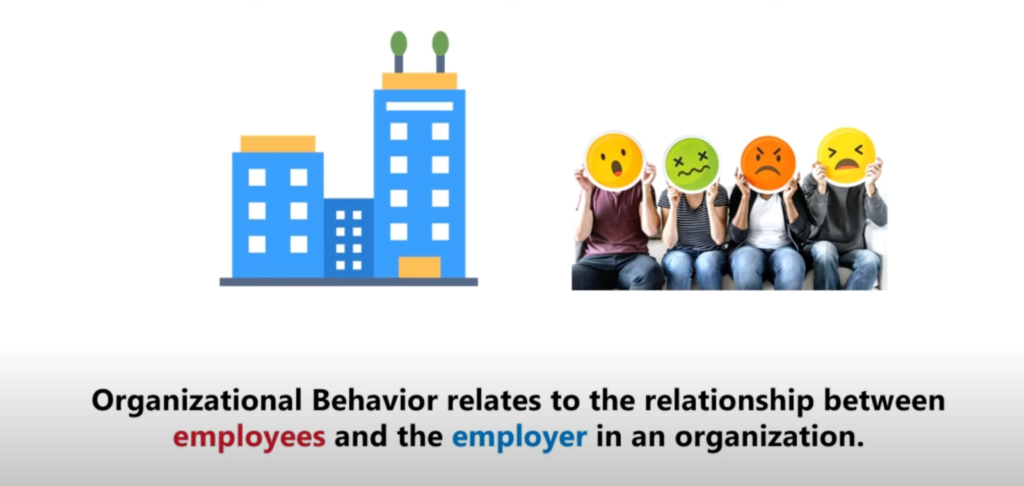
    Organizational Behavior relates to the relationship between employees and the employer in an organization.

    Both are working towards the realization of the goals and objectives of any organization, and a close and fruitful coordination between the two is one of the major factors towards this realization.

    Organizational behavior approaches are a result of the research done by experts in this field.

    There are 5 Approaches to Organizational Behaviour

    1. Human resources (supportive) approach 

    The human resources approach is developmental. It is concerned with the growth and development of people towards higher levels of competency, creativity, and fulfillment because people are the central resource in any organisation and any society. The nature of the human resources approach can be understood by comparing it with the traditional management approach in the early 1900s.

    In the traditional approach, managers decided what should be done and management was directive and controlling. The human resources approach, on the other hand, is supportive. It helps employees become better, more responsible persons and then tries to create a climate in which they may contribute to the limits of their improved abilities. Essentially, the human resources approach means that better people achieve better results.

    Give a person a fish, and you feed that person for a day, Teach a person to fish, and you feed that person for life.

    2. Contingency approach

    Traditional management relied on the principle of ―one best way of managing. There was a correct way to organize, delegate, and divide work. The correct way is applied regardless of the type of organisation or situation involved. The contingency approach to organizational behaviour means that different situations require different behavioural practices for effectiveness.

    No longer is there a one best way. Each situation must be analysed carefully to determine the significant variables that exist in order to establish the kinds of practices that will be more effective. The strength of the contingency approach is that it encourages analysis of each situation prior to action, while at the same time discouraging habitual practice based on Universal assumptions about people.

    The contingency approach also is more interdisciplinary, more system oriented, and more research-oriented than the traditional approach. Thus it helps to use in the most appropriate manner all the current knowledge about people in organisations.

    3. Productivity approach

    Productivity is a ratio that compares units of output with units of input. If more outputs can be produced from the same amount of inputs, productivity is improved or if fewer inputs can be used to produce the same amount of outputs, productivity has increased.

    The idea of productivity does not imply that one should produce more output; rather it is a measure of how efficiently one produces whatever output is desired. Consequently, better productivity is a valuable measure of how well resources are used in society. It means that less is consumed to produce each unit of output. There is less waste and better conservation of resources.

    Productivity often is measured in terms of economic inputs and outputs, but human and social inputs and outputs are also important, For example. if better organizational behaviour can improve job satisfaction, a human output or benefit occurs. In the same manner, when employee development programmes lead to a by-product of better citizens in a community, a valuable social output occurs.

    Equations showing the role of organizational behaviour is work systems

    Knowledge X skill                           =          Ability

    Attitude X situation                         =         Motivation

    Ability X Motivation                      =         Potential human performance

    Human performance X Resources  =          Organizational productivity

    4. Systems Approach

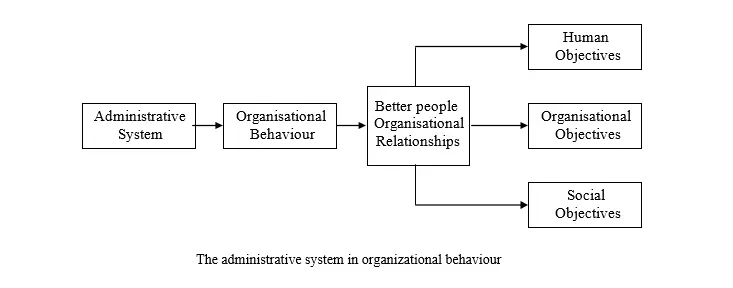
    A system implies that there are many variables in organisations and that each of them affects all the others in a complex relationship. All people in organisations should be concerned with improving organizational behaviour.  Managers represent the administrative system and their role is to use organizational behaviour to improve people – organisation relationships as shown in the following figure.

    Managers try to build a climate in which people are motivated work together, productively, and become more effective persons.

    Systems Approach
    Systems Approach

    When organizational behaviour is applied with a systems approach it creates a triple reward system in which human, organizational and social objectives are met. People find more satisfaction in work when there is cooperation and teamwork. They are learning to grow and contribute. The organization also is more successful, because it operates more effectively.

    Quality is better and costs are less. Perhaps the greatest beneficiary of the triple reward system is society itself; because it has better products and services, better citizens and a climate of co-operation and progress.

    5. Interdisciplinary Approach

    This approach advocates that efficiency can be attained by finding the right methods to get the job done through specialization on the job by planning and scheduling, by using standard operating mechanisms, establishing standard time to do the job, by proper selection and training of personnel and through wage incentives.

  • Models of Organisational Behaviour

    Models of Organisational Behaviour

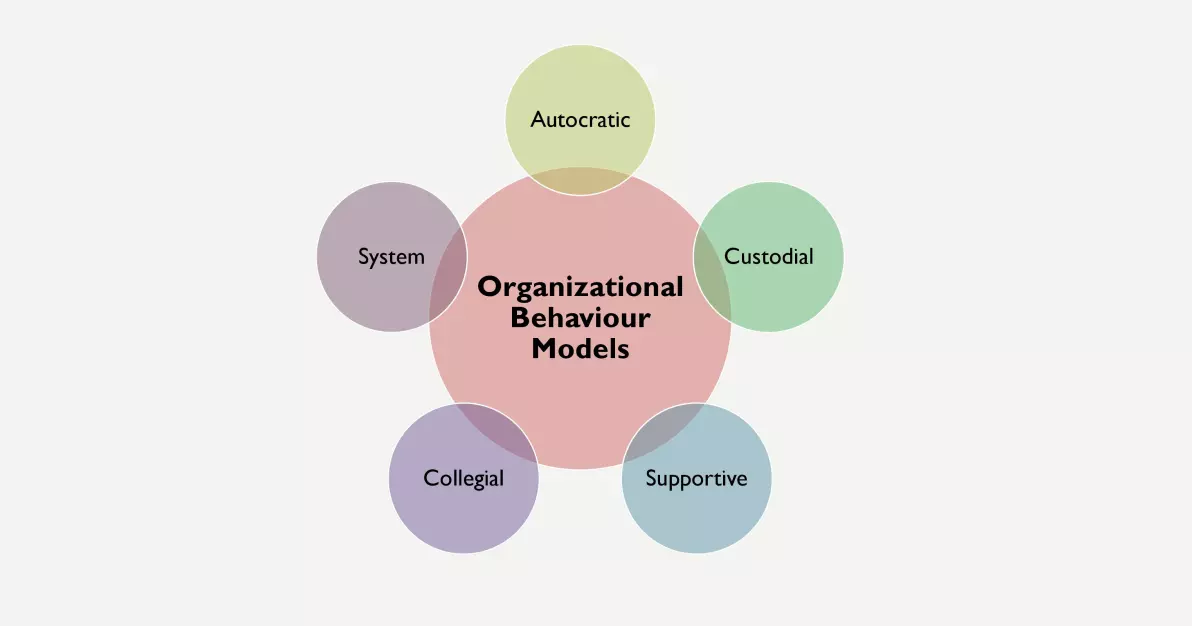
    In this article, you’ll learn about Models of Organisational Behaviour. Since the dawn of industrial revolution, four models of organisational behaviour have been followed by managers of different organisations at different times.

    These are

    1. Autocratic Model
    2. Custodial Model
    3. Supportive Model
    4. Collegial Model
    5. System Model
    Model  Autocratic  CustodialSupportiveCollegialSystem
    Basis of Model  Power Economic resources  LeadershipPartnership Partnership
    Managerial orientation  AuthorityMoneySupport  Teamwork     Teamwork
    Employee orientationObedience   Security and benefitsJob performanceResponsible behaviour
    Employee psychological result  Dependence on bossDependence on Organization   SecurityParticipationSelf – discipline Self – motivation
    Employee needs metSubsistence SecurityStatus and recognitionSelf – actualizationHigher order needs
    Performance resultMinimumPassive Cooperation Awakened drivesModerate enthusiasm Full enthusiasm 

    Models of Organizational Behaviour

    Autocratic Model 

    • The autocratic model depends on power. Those who are in command must have the power to demand ―you do this-or else, meaning that an employee who does not follow orders will be penalized. 
    • In an autocratic environment the managerial orientation is formal, official authority. This authority is delegated by right of command over the people to it applies. 
    • Under autocratic environment the employee is obedience to a boss, not respect for a manager
    • The psychological result for employees is dependence on their boss, whose power to hire, fire, and ―perspire they is almost absolute. 
    • The boss pays minimum wages because minimum performance is given by employees. They are willing to give minimum performance-though sometimes reluctantly-because they must satisfy subsistence needs for themselves and their families.
    • Some employees give higher performance because of internal achievement drives, because they personally like their boss, because the boss is ―a natural-born leader, or because of some other factor; but most of them give only minimum performance. 

    The Custodial Model 

    • A successful custodial approach depends on economic resources
    • This approach depends on money to pay wages and benefits.
    • Since employee’s physical needs are already reasonably met, the employer looks to security needs as a motivating force. If an organization does not have the wealth to provide pensions and pay other benefits, it cannot follow a custodial approach.
    • The custodial approach leads to employee dependence on the organization. Rather than being dependence on their boss for their weekly bread, employees now depend on organizations for their security and welfare. 
    • Employees working in a custodial environment become psychologically preoccupied with their economic rewards and benefits. As a result of their treatment, they are well maintained and contended. However, contentment does not necessarily produce strong motivation; it may produce only passive cooperation. The result tends to be those employees do not perform much more effectively than under the old autocratic approach. 

    The Supportive Model 

    • The supportive model depends on leadership instead of power or money. Through leadership, management provides a climate to help employees grow and accomplish in the interests of the organization the things of which they are capable. 
    • The leader assumes that workers are not by nature passive and resistant to organizational needs, but that they are made so by an inadequately supportive climate at work. They will take responsibility, develop a drive to contribute, and improve themselves if management will give them a chance. Management orientation, therefore, is to support the employee’s job performance rather than to simply support employee benefit payments as in the custodial approach. 
    • Since management supports employees in their work, the psychological result is a feeling of participation and task involvement in the organization. Employee may say ―we instead of ―they when referring to their organization. 
    • Employees are more strongly motivated than by earlier models because of their status and recognition needs are better met. Thus they have awakened drives for work. 

    The Collegial Model 

    • A useful extension of the supportive model is the collegial model. The term ―collegial relates to a body of people working together cooperatively. 
    • The collegial model depends on management’s building a feeling of partnership with employees. The result is that employees feel needed and useful. They feel that managers are contributing also, so it is easy to accept and respect their roles in their organization. Managers are seen as joint contributors rather than as bosses. 
    • The managerial orientation is toward teamwork. Management is the coach that builds a better team 
    • The employee’s response to this situation is responsibility. For example employees produce quality work not because management tells them to do so or because the inspector will catch them if they do not, but because they feel inside themselves an obligation to provide others with high quality. They also feel an obligation to uphold quality standards that will bring credit to their jobs and company. 
    • The psychological result of the collegial approach for the employee is self-discipline. Feeling responsible, employees discipline themselves for performance on the team in the same way that the members of a football team discipline themselves to training standards and the rules of the game. 
    • In this kind of environment employees normally feel some degree of fulfillment, worthwhile contribution, and self-actualization, even though the amount may be modest in some situation. This self-actualization will lead to moderate enthusiasm in performance. 

    The System Model 

    • An emerging model of organization behavior is the system model. It is the result of a strong search for higher meaning at work by many of today’s employees; they want more than just a paycheck and job security from their jobs. Since they are being asked to spend many hours of their day at work, they want a work context there that is ethical, infused with integrity and trust, and provides an opportunity to experience a growing sense of community among coworkers. 
    • To accomplish this, managers must increasingly demonstrate a sense of caring and compassion, being sensitive to the needs of a diverse workforce with rapidly changing needs and complex personal and family needs. 
    • In response, many employees embrace the goal of organizational effectiveness, and reorganize the mutuality of company-employee obligations in a system viewpoint. They experience a sense of psychological ownership for the organization and its product and services. 
    • They go beyond the self-discipline of the collegial approach until they reach a state of self-motivation, in which they take responsibility for their own goals and actions. 
    • As a result, the employee needs that are met are wide-ranging but often include the highest-order needs (e.g., social, status, esteem, autonomy, and self actualization).  Because it provides employees an opportunity to meet these needs through their work as their work as well as understand the organization’s perspectives, this new model can engender employees’ passion and commitment to organizational goals. They are inspired; they feel important; they believe in the usefulness and viability of their system for the common good.
  • Perceptual: Errors, Types, and Management

    Perceptual: Errors, Types, and Management

    A perceptual error is the inability to judge humans, things or situations fairly and accurately. Examples could include such things as bias, prejudice, stereotyping, which have always caused human beings to error in different aspects of their lives

    Sources of errors in perception

    The main sources of errors in perception include the following:

    • Not collecting enough information about other people. 
    • Basing our judgements on information that is irrelevant or insignificant. 
    • Seeing what we expect to see and what we want to see and not investigating further.
    • Allowing early information about someone to affect our judgement despite later and contradictory information. 
    • Accepting stereotypes uncritically. 
    • Allowing our own characteristics to affect what we see in others and how we judge them. 
    • Attempting to decode non-verbal behavior outside the context in which it appears. Basing attributions on flimsy and potentially irrelevant evidence. 

    The process of making evaluations, judgements or ratings of the performance of employees is subject to a number of systematic perception errors. This is particularly problematic in a performance appraisal context. These are: 

    • Central tendency: Appraising everyone at the middle of the rating scale. 
    • Perception Contrast error: Basing an appraisal on comparison with other employees rather than on established performance criteria. 
    • Different from me: Giving a poor appraisal because the person has qualities or characteristics not possessed by the appraiser. 
    • Halo effect: Appraising an employee undeservedly on one quality (performance, for example) because s/he is perceived highly by the appraiser on another quality (attractiveness). 
    • Horn effect: The opposite of the halo effect. Giving someone a poor appraisal on one quality (attractiveness) influences poor rating on other qualities. (performance). 
    • Initial impression: Basing an appraisal on first impressions rather than on how the person has behaved throughout the period to which appraisal relates.
    • Latest behavior: Basing an appraisal on the person’s recent behavior.
    • Lenient or generous rating: Perhaps the most common error, being consistently generous in appraisal mostly to avoid conflict.
    • Performance dimension error: Giving someone a similar appraisal on two distinct but similar qualities, because they happen to follow each other on the appraisal form.
    • Same as me: Giving a good appraisal because the person has qualities or characteristics possessed by the appraiser. 
    • Spill over effect: Basing this appraisal, good or bad, on the results of the previous appraisal rather than on how the person has behaved during the appraisal period.
    • Status effect: Giving those in higher level positions consistently better appraisals than those in lower level jobs.
    • Strict rating: Being consistently harsh in appraising performance.

    Types of perceptual errors in workplace

    There are many types of perceptual errors in workplace

    1.Selective Perception-People generally interpret according to their basis of interests,idea and backgrounds.It is the tendency not to notice and forget the stimuli that cause emotional discomfort.For example we might think that fresher graduates with above 80 % marks will exceptionally do well in technical interviews of respective subjects

    2.Halo Effect-We misjudge people by concentrating on one single behavior or trait.It has deep impact and give inaccurate result most of the time.For example we always have an impression of a lazy person can never be punctual in any occasion.

    3.Stereotypes-We always have a tendency to classify people to a general groups /categories in order to simplify the matter.For example-Women are always good homemakers and can do well in work life balance

    4.Contrast Effect-We again sometimes judge people in comparison to others . This example generally found in sports,academics and performance review

    5.Projection-This is very common among Perceptual errors.Projection of one’s own attitude,personality or behavior into some other person.For example- To all honest people,everybody is honest.

    6.Impression-We all know the term “first impression is the last impression” and we apply that too .For example-During the time of hiring, thought like this “The most decent and modest person in the interview can do very well in every roles and responsibilities ” always arise.

    Errors in perception can be overcome by

    • Taking more time and avoiding instant or `snap’ judgements about others. 
    • Collecting and consciously using more information about other people. 
    • Developing self-awareness and an understanding of how our personal biases are preferences affect our perceptions and judgements of other people. 
    • Checking our attributions – particularly the links we make between aspects of personality and appearance on the one hand and behaviour on the other.

    Therefore, it can be said that if we are to improve our understanding of others, we must first have a well-developed knowledge of ourselves — our strengths, our preferences, our weaknesses and our biases. The development of self-knowledge can be an uncomfortable process.

    In organizational settings, we are often constrained in the expression of our feelings (positive and negative) about other people due to social or cultural norms and to the communication barriers erected by status and power differentials. This may in part explain the enduring emphasis in recent years on training courses in social and interpersonal skills, self-awareness and personal growth.

  • What is Leadership? Definition, Nature , Style & More

    What is Leadership? Definition, Nature , Style & More

    What is Leadership ?

    Leadership is the interpersonal influence exercised in a situation and directed through the communication process, towards the attainment of a specialized goal or goals.

    Leadership involves:

    1. establishing a clear vision,
    2. sharing that vision with others so that they will follow willingly,
    3. providing the information, knowledge and methods to realize that vision, and
    4. Co-ordinating and balancing the conflicting interests of all members and stakeholders.

    Nature of Leadership

    There are two main approaches to leadership—traitist and situationist. In the early times leadership was considered to originate from the personal qualities of the leader and insufficient attention was given to the contribution of the group structure and situation.

    The early studies focused their attention on certain traits to compare leaders with non-leaders. Later studies, however, revealed the fallacy of the traitist approach. Gibb remarked that the leader traits are relative to a specific social situation and are not exhibited in isolation.

    He pointed out that attempts to find a consistent pattern of traits that characterize leaders had failed and said that the attributes of leadership are any or all of those personality characteristics that in any particular situation make it possible for a person either to contribute to achievement of a group, goal or to be seen as doing so by other group members. The person who becomes a leader surpasses others in some qualities required by the goal in the particular situation.

    The situationist approach to leadership provides a corrective to the traitist approach which regarded leaders as uniquely superior individuals who would lead in whatever situation or time they might find themselves. 

    The situationist approach emphasizes that leadership is specific to a specific situation. It is a way of behaving exhibited by individuals in differing degrees in different situations. A leader in one group is not necessarily a leader in another. A leader in the class may not be a leader in the playground.

    Though leadership may be considered as behaviour specific to a given situation, yet it does not mean that there is no generality of traits on the basis of which certain persons may be rated leaders. Carter noted correctly that if leadership is absolutely specific to a given situation then it cannot be a subject of scientific analysis and generalization.

    It may also be mentioned that the leader is necessarily a part of a group and leadership is status and role in that group. It is obvious that leadership can occur only in relation to other people. No one can be a leader all by himself. The relationships which the leader bears to other individuals are status and role relationships. He is part of the group structure and as such he carries on reciprocal relationship with other members of the group.

    In sum,

    • Leadership is not a personality trait, it is a way of relating oneself to others. Leadership accrues to those who take account of others in ways that facilitate group life and group cohesion. In other words, leadership is functional in two senses: it is a function of inter-personal relations it has a function in group life.
    • Leadership is situational; who the leaders are depends upon the concrete circumstances. A leader in one group is not necessarily a leader in another.

    Styles of Leadership

    1. Autocratic or Authoritarian leadership

    An autocratic leader centralizes power and decision-making in himself. He gives orders, assigns tasks and duties without consulting the employees. The leader takes full authority and assumes full responsibility.

    Autocratic leadership is negative, based on threats and punishment. Subordinates act as he directs. He neither cares for their opinions nor permits them to influence the decision. He believes that because of his authority he alone can decide what is best in a given situation.

    Autocratic leadership is based upon close supervision, clear-cut direction and commanding order of the superior. It facilitates quick decisions, prompt action and unity of direction. It depends on a lesser degree of delegation. But too much use of authority might result in strikes and industrial disputes. It is likely to produce frustration and retard the growth of the capacity of employees.

    The employees work as hard as is necessary to avoid punishment. They will thus produce the minimum which will escape punishment.

    This leadership style is less likely to be effective because

    • The new generation is more independent and less submissive and not amenable to rigid control.
    • People look for ego satisfactions from their jobs.
    • Revolution of rising expectations changed the attitude of the people.

    Autocratic leadership may be divided into three classes:

    • The hard-boiled autocrat who relies mainly on negative influences uses the force of fear and punishment in directing his subordinates towards the organisational goals. This is likely to result in employees becoming resentful.
    • The benevolent autocrat who relies mainly on positive influences uses the reward and incentives in directing his subordinates towards the organisational goals. By using praise and pats on the back he secures the loyalty of subordinates who accept his decisions.
    • The manipulative autocrat who makes the employees feels that they are participating in decisionmaking though the manager himself has taken the decision. McGregor labels this style as Theory X.

    2. Democratic or Participative leadership

    Participative or democratic leaders decentralise authority. It is characterised by consultation with the subordinates and their participation in the formulation of plans and policies. He encourages participation in decision-making.

    He leads the subordinates mainly through persuasion and example rather than fear and force. Sometimes the leader serves as a moderator of the ideas and suggestions from his group. McGregor labels this style as Theory Y.

    Taylor’s scientific management was based on the inability of the ordinary employees to make effective decisions about their work. Hence the decision-making power was vested with the management. But recent studies indicate the need for participation by subordinates. The modern trend favours sharing the responsibility with the employees.

    This will foster enthusiasm in them. The employees feel that management is interested in them as well as in their ideas and suggestions. They will, therefore, place their suggestions for improvement.

    Advantages for democratic leadership are as follows: (i) higher motivation and improved morale; (ii) increased co-operation with the management; (iii) improved job performance; (iv) reduction of grievances and (v) reduction of absenteeism and employee turnover.

    3. The Laissez-faire or Free-rein leadership

    Free-rein leaders avoid power and responsibility. The laissez-faire or non-interfering type of leader passes on the responsibility for decision-making to his subordinates and takes a minimum of initiative in administration. He gives no direction and allows the group to establish its own goals and work out its own problems.

    The leader plays only a minor role. His idea is that each member of the group when left to himself will put forth his best effort and the maximum results can be achieved in this way. The leader acts as an umpire. But as no direction or control is exercised over the people, the organisation is likely to flounder.

    Specific leadership styles

    1. Transactional Leadership

    This style starts with the idea that team members agree to obey their leader when they accept a job. The “transaction” usually involves the organization paying team members in return for their effort and compliance on a short-term task. The leader has a right to “punish” team members if their work doesn’t meet an appropriate standard.

    Transactional leadership is present in many business leadership situations, and it does offer some benefits. For example, it clarifies everyone’s roles and responsibilities. And, because transactional leadership judges team members on performance, people who are ambitious or who are motivated by external rewards – including compensation – often thrive.

    The downside of this style is that, on its own, it can be chilling and amoral, and it can lead to high staff turnover. It also has serious limitations for knowledge-based or creative work.

    As a result, team members can often do little to improve their job satisfaction.

    2. Transformational Leader

    A transformational leader is a type of person in which the leader is not limited by his or her followers’ perception. The main objective is to work to change or transform his or her followers’ needs and redirect their thinking. Leaders that follow the transformation style of leading, challenge and inspire their followers with a sense of purpose and excitement. They also create a vision of what they aspire to be, and communicate this idea to others (their followers). According to Schultz and Schultz, there are three identified characteristics of a transformational leader:

    • Charismatic leadership has a broad knowledge of field, has a self-promoting personality, high/great energy level, and willing to take risk and use irregular strategies in order to stimulate their followers to think independently
    • Individualized consideration
    • Intellectual stimulation

    The transformational leadership style depends on high levels of communication from management to meet goals. Leaders motivate employees and enhance productivity and efficiency through communication and high visibility. This style of leadership requires the involvement of management to meet goals. Leaders focus on the big picture within an organization and delegate smaller tasks to the team to accomplish goals.

  • Group: Definition, Development, Types of Groups

    Group: Definition, Development, Types of Groups

    Groups are social entities formed by individuals with shared interests, goals, or characteristics. Emerging from human needs, groups vary in structure, purpose, and dynamics, shaping diverse interpersonal connections.

    What is Group?

    It is a collection of two or more interacting individuals with a stable pattern of relationship between them, who share common goals and who perceive themselves as being a group.

    Group Development Process/ Stages

    The group development process, also known as team development, refers to the stages that groups go through as they form, learn to work together, and achieve their goals. The most widely recognized model of group development is Tuckman’s stages of group development, which outlines five distinct stages:

    1. Forming: In this initial stage, group members get to know each other, establish ground rules, and explore their roles within the group. There is often a sense of uncertainty and politeness as members try to make a good impression.
    1. Storming: As the group delves deeper into its work, differences in opinions, working styles, and personalities can emerge, leading to conflict and competition. This stage can be challenging, but it is also necessary for the group to develop trust and open communication.
    2. Norming: Through open communication and compromise, the group begins to establish norms and expectations for behavior, communication, and decision-making. This stage is crucial for building team cohesion and creating a positive work environment.
    3. Performing: In this stage, the group has matured and is able to function effectively as a unit. Members collaborate efficiently, solve problems creatively, and achieve their goals.
    4. Adjourning (optional): If the group is temporary, it will eventually reach a stage where it needs to disband. This stage involves completing tasks, saying goodbye, and reflecting on the group experience.

    Types of Groups

    One way to classify the groups is by way of formality – formal and informal.

    Formal Groups

    • Definition: Defined by an organization or institution with a specific purpose or task. They have a predetermined structure with designated roles, rules, and procedures.
    • Examples: Work teams, committees, sports teams, project teams, government agencies.
    • Characteristics:
      • Explicit hierarchy and leadership.
      • Clearly defined goals and objectives.
      • Established rules and procedures to guide behavior.
      • Focus on achieving organizational goals efficiently.
      • Communication often follows formal channels.

    Command Groups:

    Definition: Command groups are hierarchical structures defined by an organization chart. They consist of a supervisor and their direct reports, forming a chain of command for decision-making and tasks.

    Example: A market research firm CEO and their research associates form a command group. Here, the CEO leads and assigns tasks to the associates, who report directly back to them.

    Key characteristics:

    • Clear hierarchy and leadership: Decisions and tasks flow from the supervisor down to the subordinates.
    • Formal structure: Roles and responsibilities are clearly defined based on positions within the hierarchy.
    • Focus on efficiency: The primary goal is to achieve objectives efficiently through established procedures.

    Task Groups:

    Definition: Task groups are temporary ensembles formed to achieve a specific, focused goal within a defined timeframe. These groups, often called task forces, are disbanded once the goal is achieved.

    Examples:

    • A team developing a new product.
    • A group improving a production process.
    • A committee designing a syllabus.
    • Ad hoc committees for specific complaints or process development.
    • Project groups focusing on specific initiatives.
    • Standing committees for ongoing tasks like quality control.

    Key characteristics:

    • Shared goal: Members are united by a defined objective they work together to accomplish.
    • Time-bound: The group exists only for the duration needed to complete the assigned task.
    • Flexible structure: Roles and responsibilities may be adaptable depending on the task requirements.
    • Collaborative approach: Success relies on teamwork and effective communication among members.

    Functional Groups:

    Definition: Functional groups are permanent structures within an organization established to achieve specific, ongoing goals. Unlike task groups, they continue to exist even after completing their initial objectives.

    Examples:

    • Marketing department responsible for promoting and selling products.
    • Customer service department handling customer inquiries and issues.
    • Accounting department managing financial records and transactions.

    Key characteristics:

    • Enduring structure: The group has a defined structure and remains in place over time.
    • Ongoing goals: Focuses on achieving consistent objectives within its functional area.
    • Specialized expertise: Members possess skills and knowledge specific to their function.
    • Collaborative workflow: Teams within the group work together towards shared departmental goals.

    Informal Groups

    • Definition: Form organically based on shared interests, friendships, or common experiences. They lack a formal structure and often arise spontaneously.
    • Examples: Friend groups, hobby clubs, online communities, support groups.
    • Characteristics:
      • Flexible and dynamic structure.
      • Loosely defined goals and objectives, focused on social interaction and support.
      • Informal rules and norms established by members.
      • Emphasis on building relationships and social connection.
      • Communication flows freely and organically.

    Interest Groups:

    • Definition: Enduring groups united by a shared interest beyond organizational goals.
    • Characteristics: Long-lasting, informal structure, diverse composition, specific goals unrelated to organizational objectives.
    • Example: Students forming a study group for a specific class.

    Friendship Groups:

    • Definition: Informal groups based on shared activities, beliefs, or values.
    • Characteristics: Formed voluntarily, enjoy shared activities outside work, provide social connection.
    • Example: Employee yoga group, regional cultural association, monthly kitty party lunch group.

    Reference Groups:

    • Definition: Groups individuals use for self-evaluation and comparison.
    • Characteristics: Shape behavior through social validation and comparison, influence attitudes and values.
    • Examples: Family, friends, religious affiliations.

    Primary Groups:

    • Definition: Small, intimate groups with close personal interaction and high interdependence.
    • Characteristics: Key to socialization, develop and sustain attitudes, values, and orientations.
    • Examples: Family, close friend circles.

    Secondary Groups:

    • Definition: Larger, formal groups with less frequent, impersonal interaction.
    • Characteristics: Supplement primary socialization, often organized around shared interests or goals.
    • Examples: Trade unions, member organizations (National Trust).

  • Conceptual Framework For Organizational Behaviour

    Conceptual Framework For Organizational Behaviour

    In this article, you’ll learn about Conceptual Framework For Organizational Behaviour, Organizational behaviour follows the principles of human behaviour, Organizational Behaviour is situational and more.

    A conceptual framework for understanding organizational behaviour is presented by Durbin consisting of four core propositions, which are:

    1. Organizational behaviour follows the principles of human behaviour.
    2. Organizational behaviour is situational.
    3. Organizational behaviour is based on system approach.
    4. Organizational behaviour represents a constant interaction between structure and process variables.

    Organizational behaviour follows the principles of human behaviour 

    Human beings in the organization are governed by the same physiological mechanisms both on and off the job.  Internal mechanism s provide people an extra spurt of the appropriate harmone during times of stress, whether this stress is job or non – job related.  Similarly, people at work are governed by the same psychological principles both inside and outside organizational life.  Organizational behaviour is human behaviour in a particular setting.

    Organizational Behaviour is situational

    Psychologists and other behvaioural scientists have emphasized for years that individual is a function of the interaction between personal characteristics of the individual and environmental variables.  In order to understand a person’s behaviour, the pressures placed upon him in a given situation must be understood.  Aggressive behvaiour, for example, surfaces when a normally calm individual is forced into constant and close physical proximity with other people.

    Pigors and Myres developed the concepts of situational thinking. Their analysis suggests that four situational variables are basic for anyone responsible for getting results accomplished through people.  

    These are:

    1. The human element such as individual differences.  This category includes interpersonal relationships and other social aspects of the situation.
    2. The technical factor such as production methods and equipment, management procedure, and specialized skills in any job function.
    3. Space – time dimensions and relationships such as the size and location of a plant, office or work – station.
    4. Organizational wide policies designed to achieve major organizational objectives.

    Organizational Behaviour is based on system approach

    Systems thinking is an integral part of modern organization theory.  Organizations are viewed as complex systems consisting of inter – related and inter – locking sub – systems.  Changes in any one part of the system has both known and unknown consequences in other parts of the system. 

    When modifications in the system lead to desired, positive consequences, they are called functions.  Unintended consequences in response to modification in the systems are called dysfunctions.  According to the system point of view, every inter – action has both functions and dysfunctions.

    Organizational Behaviour represents a constant interaction between structure and process variables

    Structure refers to organizational design and position.  Process refers to what happens, with or without the structure.  A retail store may use both formal advertising and public relations functions (structure) to help build its image in the community.  However, most of the store’s image is formed by words of mouth from satisfied and dissatisfied customers and employees.

    Processes emerging within a group or organization are often evident only after they are heading towardss completion.  It is almost structural requirement in any organization that managers deal with the discontents of their people, yet employees sometimes find other processes for handling them.

    The difference between structure and process represents a vital concept for understanding organizational behaviour.  Classical approaches to management neglected interpersonal processes – the human side of organization life. 

    Erring in the opposite direction (neglecting the influence of structural and technological factors) is a tendency on the part of some social psychologists.  Deeper understanding of organizational behaviour requires an ability to follow the complex shifting in relative importance between structure and process variables.

  • Fundamental concepts of Organizational Behaviour

    Fundamental concepts of Organizational Behaviour

    In this article, you’ll learn about fundamental concepts of Organizational Behaviour.

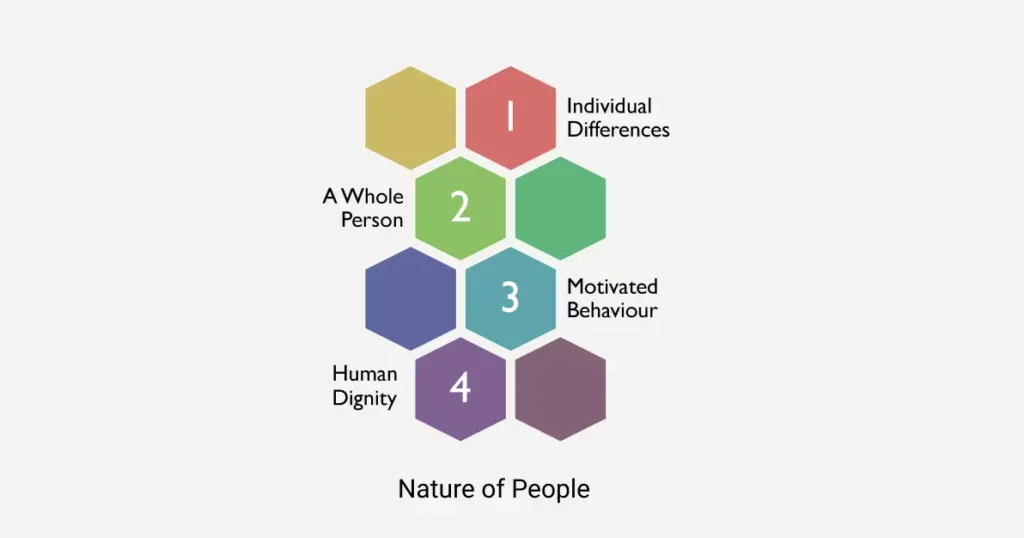
    Organizational Behaviour starts with a set of six fundamental concepts revolving around the nature of people and organizations. They are as follows:

    The Nature of people

    • Individual differences
    • A whole person
    • Motivated Behaviour
    • Value of the person (human dignity)

    The Nature of Organizations

    • Social systems
    • Mutual Interest

    Result

    • Holistic organizational behaviour

    The Nature of people

    The Nature of people
    The Nature of people

    Individual differences

    People have much in common (they become excited, or they are grieved by the loss of loved one), but each person in the world is also individually different. Each one is different from all others, probably in millions of ways, just as each of their fingerprints is different, as a far as we know. And these differences are usually substantial rather than meaningless. All people are different. This is a fact supported by science.

    The idea of individual differences comes originally from psychology. From the day of birth, each person is unique, and individual experiences after birth tend to make people even more different. Individual differences mean that management can get the greatest motivation among employees by treating manager’s approach to employees should be individual, not statistical. This belief that each person is different from all others is typically called the Law of Individual Differences.

    A whole person

    Although some organisations may wish they could employ a person’s skill or brain, they actually employ a whole person, rather than certain characteristics. Different human traits may be separately studied, but in the final analysis they are all part of one system making up a whole person.  Skill does not exist apart from background or knowledge. Human life is not totally separable from work life and emotional conditions are not separate from physical conditions. People function as total human beings.

    Motivated behaviour

    From psychology we learn that normal behaviour has certain causes. These may relate to a person’s needs and / or the consequences that result from acts. In the case of needs, people are motivated not by what we think they ought to have but by what they themselves want. To an outside observer a person’s needs may be unrealistic, but they are still controlling. This act leaves management with two basic ways to motivate people. It can show them how certain actions will increase their need fulfilment, or it can threaten decreased need fulfilment if they follow an undesirable course of action. Clearly a path towards increased need fulfilment is the better approach.

    Value of the person (human dignity)

    This concept is of a different order from the other three because it is more an ethical philosophy than a scientific conclusion. It asserts that people are to be treated differently from other factors of production because they are of a higher order in the universe. It recognizes that because people are of a higher order they want to be treated with respect and dignity – and should be treated this way. The concept of human dignity rejects the old idea of using employees as economic tools.

    The Nature of Organizations

    Social systems

    From sociology we learn that organisations are social systems; consequently activities there-in are governed by social laws as well as psychological laws. Just as people have psychological needs, they also have social roles and status. Their behaviour is influenced by their group as well as by their individual drives. In fact, two types of social systems exist side by side in organisations. One is the formal (official) social system, and the other is the informal social system.

    The existence of a social system implies that the organizational environment is one of dynamic change rather than a static set of relations. All parts of the system are interdependent and subject to influence by any other part.  Everything is related to everything else.  The idea of a social system provides a frame work for analysing organizational behaviour issues. It helps make organizational behaviour problems understandable and manageable.

    Systems Approach

    Mutual interest

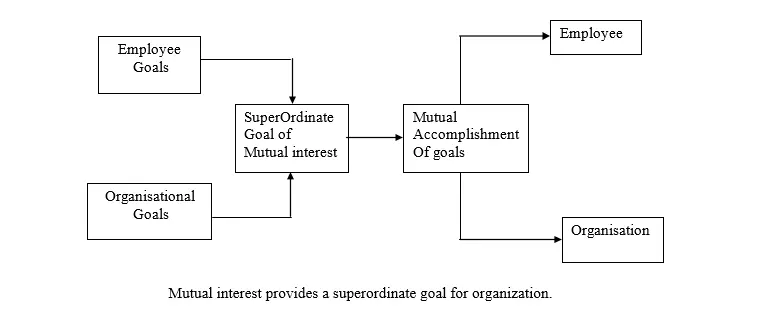
    Mutual interest is represented by the statement ―organisations, need people, and people also need organisations‖. Organisations have a human purpose. They are formed and maintained on the basis of some mutuality of interest among their participants. People see organisations as a means to help them reach their goals, while organisations need people to help reach organizational objectives. As shown in the following figure, mutual interest provides a superordinate goal that integrates the efforts of individuals and groups. The result is that they are encouraged to attack organizational problems rather than each other.

    Mutual interest provides a superordinate goal for organization

    Holistic organizational behaviour

    When the six fundamental concepts of organizational behaviour are considered together, they provide a holistic concept of the subject. Holistic organizational behaviour interprets people-organisation relationships in terms of the whole person, whole group, whole organisation, and whole social system. It takes an across-the board view of people in organisations in an effort to understand as many as possible of the factors that influence their behaviour. Issues are analysed in terms of the total situation affecting them rather than in terms of an isolated event or problem.