
Author: Anup Maurya

  • What is Business Cycles? Phases, Types, Theory, Nature

    What is Business Cycles? Phases, Types, Theory, Nature

    What is the Business Cycle

    The business cycle refers to the recurring fluctuations in economic activity, characterized by periods of expansion and contraction. These fluctuations are typically measured by changes in real GDP (Gross Domestic Product).  

    Business Cycle Definition

    A business cycle is a recurring pattern of economic activity, consisting of periods of expansion (growth) and contraction (recession) in economic activity. These cycles are not regular or predictable in their duration or intensity.  

    Phases of Business Cycle
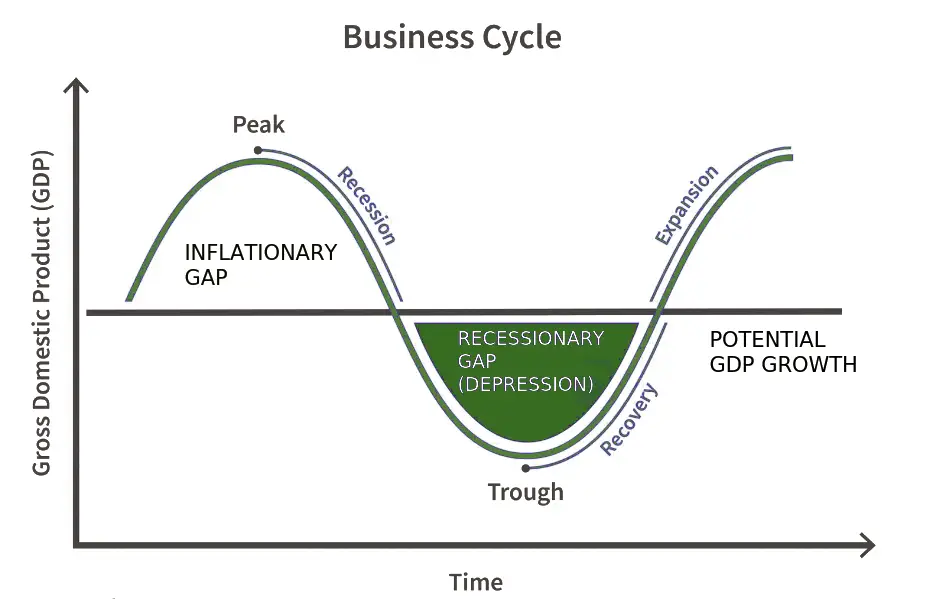
    • Expansion: This is a period of economic growth characterized by increasing GDP, rising employment, and falling unemployment. Consumer and business confidence are high, leading to increased spending and investment.  
    • Peak: The peak marks the highest point of economic activity in the cycle. Economic growth slows down, and inflationary pressures may emerge.  
    • Contraction: This is a period of economic decline characterized by falling GDP, rising unemployment, and declining consumer and business confidence. This phase is often referred to as a recession.  
    • Trough: The trough represents the lowest point of economic activity in the cycle. Economic growth reaches its minimum, and unemployment reaches its peak.  

    Nature of Business Cycle

    • Cyclical nature: The most prominent characteristic is their cyclical nature, with recurring periods of expansion and contraction. However, the length and intensity of these cycles vary significantly.  
    • General nature: Business cycles are a pervasive phenomenon, affecting most economies around the world. They impact various sectors of the economy, including production, employment, and investment.  

    Types of Business Cycle

    • Kondratieff Waves (Long Waves): These are long-term cycles, lasting 50-60 years, driven by major technological innovations.  
    • Juglar Cycles (Medium Waves): These are medium-term cycles, lasting 7-11 years, associated with fluctuations in investment and inventory levels.  
    • Kitchin Cycles (Short Waves): These are short-term cycles, lasting 3-4 years, primarily driven by fluctuations in inventory levels.

    Business Cycle Theory

    Various economic theories attempt to explain the causes and mechanisms of business cycles:

    • Hawtrey Monetary Theory: This theory emphasizes the role of credit and money supply in driving business cycles.
    • Innovation Theory: This theory, associated with Joseph Schumpeter, argues that technological innovations trigger periods of rapid economic growth, followed by periods of adjustment and decline.
    • Keynesian Theory: This theory highlights the role of aggregate demand fluctuations in driving business cycles.  
    • Hicks Theory: This theory, based on the concept of multipliers and accelerators, explains how small shocks can amplify and propagate through the economy.
    • Samuelson theory: This theory utilizes a mathematical model to demonstrate how fluctuations in investment can generate cyclical behavior in the economy.

    Conclusion

    Business cycles are a fundamental feature of capitalist economies. Understanding their causes and consequences is crucial for policymakers and businesses to make informed decisions and navigate economic fluctuations effectively.

  • What is Inflation in Economics? Definition, Causes, Type, Effects

    What is Inflation in Economics? Definition, Causes, Type, Effects

    In this article, you’ll learn about What is Inflation in Economics? Definition, Causes, Type, Effects and more.

    What is Inflation in Economics?

    Inflation is a sustained increase in the general price level of goods and services in an economy over time.  

    Inflation in Economics Definition

    In simpler terms, inflation means that it costs more money to buy the same goods and services today compared to yesterday.  

    Causes of Inflation in Economics

    • Demand-Pull Inflation: This occurs when aggregate demand in the economy exceeds aggregate supply. This excess demand can be driven by factors such as increased government spending, increased consumer spending, or increased investment.  
    • Cost-Push Inflation: This occurs when the costs of production for businesses increase, forcing them to raise prices to maintain profit margins. These increased costs can be due to factors such as rising wages, increased raw material prices, or supply chain disruptions.  
    • Built-In Inflation: This type of inflation is driven by past inflationary expectations. If people expect prices to rise in the future, they may demand higher wages, which in turn leads to higher prices.

    Characteristics of Inflation in Economics

    • Sustained Increase: Inflation is not a one-time price increase, but rather a persistent upward trend in the general price level.  
    • General Price Level: Inflation affects the prices of a wide range of goods and services across the economy, not just specific items.  
    • Reduces Purchasing Power: Inflation erodes the purchasing power of money, meaning that consumers can buy fewer goods and services with the same amount of money.  

    Types of Inflation in Economics

    • Moderate Inflation: A relatively low and stable rate of inflation, typically considered to be around 2-3% per year.
    • Galloping Inflation: A rapid and accelerating rate of inflation, often exceeding 10% per year.  
    • Hyperinflation: An extremely rapid and uncontrolled rate of inflation, often exceeding 50% per month.  

    Other Types of Inflations

    • Currency Inflation: Occurs due to an excessive increase in the money supply.
    • Credit Inflation: Results from excessive credit creation, leading to increased demand and inflationary pressures.  
    • Profit-induced Inflation: Arises when businesses increase prices to maximize profits.  
    • Deficit-induced Inflation: Caused by government budget deficits, which are often financed through borrowing or printing money.  
    • Wage-induced Inflation: Driven by rapid increases in wages, which push up production costs and ultimately lead to higher prices.  
    • Scarcity-induced Inflation: Occurs when supply-side shocks, such as natural disasters or war, lead to shortages of goods and services, driving up prices.

    Effects of Inflation

    • Redistribution effect of inflation: Inflation can redistribute wealth and income. For example, it can erode the value of savings and fixed-income investments, while benefiting borrowers who repay debts with cheaper money.  
    • Social impact of inflation: High inflation can create social unrest and uncertainty. It can erode consumer confidence, discourage investment, and increase income inequality.  
    • Impact on economy balance: High inflation can distort economic decision-making, making it difficult for businesses to plan and invest. It can also lead to a decline in international competitiveness.  

    Stages of Inflation

    • Pre Full Employment Stage: Mild inflationary pressures may emerge as the economy approaches full employment.
    • Full Employment Stage: Inflation may accelerate as the economy reaches full employment and demand for resources intensifies.  
    • Post-full Employment Stage: If demand continues to outpace supply, inflation can spiral out of control, leading to galloping or hyperinflation.  

    Conclusion

    Inflation is a complex economic phenomenon with significant implications for individuals, businesses, and the overall economy. Understanding the causes and effects of inflation is crucial for policymakers to implement effective measures to maintain price stability.  

  • What is Gross National Product (GNP)? Definition, Components

    What is Gross National Product (GNP)? Definition, Components

    In this article, you’ll learn about What is Gross National Product (GNP)? Definition, Components and more.

    Gross National Product (GNP) Definition

    Gross National Product (GNP) is a broad measure of a nation’s total economic activity. It represents the market value of all final goods and services produced by a country’s residents, regardless of their location.  

    What is National Income?

    National Income refers to the total income earned by a country’s residents in a given period. It encompasses various forms of income, such as wages, salaries, profits, rents, and interest.  

    What is Gross National Product (GNP)?

    GNP focuses on the output produced by a country’s citizens and businesses, even if that production occurs outside the country’s borders. For instance, if a U.S. company operates a factory in Mexico, the output of that factory would be included in the U.S. GNP.  

    Components of Gross National Product (GNP)

    GNP can be calculated using the following components:

    • Government Expenditure: This includes all government spending on goods and services, such as infrastructure projects, defense, and social programs.  
    • Consumption Expenditure: This represents the total spending by households on goods and services for personal use, such as food, clothing, and entertainment.  
    • Investment Expenditure: This includes spending on capital goods, such as machinery, equipment, and buildings, used to produce other goods and services. It also includes changes in inventories.  
    • Exports: This represents the value of goods and services produced domestically and sold to foreign countries.  
    • Imports: This represents the value of goods and services imported from other countries.  

    Key Points

    • GNP is closely related to Gross Domestic Product (GDP), which measures the total value of goods and services produced within a country’s borders, regardless of who produced them.  
    • GNP has been largely replaced by GDP as the primary measure of economic output in most countries.  
    • GNP provides a broader perspective on a nation’s economic activity by considering the output of its citizens and businesses worldwide.  
  • Economic Statics and Dynamics: Definition, What, Importance

    Economic Statics and Dynamics: Definition, What, Importance

    In this article, you’ll learn about Economic Statics and Dynamics: Definition, What, Importance

    Economic Statics Definition

    Economic Statics deals with the study of economic phenomena under the assumption that all variables remain constant, except for the one under immediate consideration.

    What is Economic statics?

    Economic statics focuses on analyzing economic situations where variables are at rest or in a state of equilibrium. It investigates the conditions necessary for economic equilibrium and the forces that maintain it. In simpler terms, it studies the economy as if it were a snapshot in time, capturing the relationships between variables at a particular point.  

    Importance of Economic statics

    • Simple and easy method of economic analysis: It provides a simplified framework for understanding complex economic relationships by isolating the impact of individual variables.  
    • Basis of the principle of free trade: The concept of comparative advantage, a cornerstone of free trade theory, is rooted in static analysis.
    • Robbins’ definition is also the subject matter: Robbins, in his famous definition of economics, emphasizes the allocation of scarce resources among competing ends. This concept of allocation is central to static analysis.  
    • Gives knowledge of the conditions of equilibrium: It helps identify the conditions under which markets and the economy as a whole can achieve a state of equilibrium.
    • Basis of dynamic analysis: Static analysis provides a foundation for understanding how economic systems change over time. By understanding the conditions of equilibrium, we can analyze how disturbances can disrupt equilibrium and how the system adjusts.
    • Keynes theory is also static in nature: While Keynesian economics deals with macroeconomic issues, many of its core concepts, such as the consumption function and the investment multiplier, are based on static analysis.

    Limitations of Economic Statics

    • Constancy of Variables: The assumption of constant variables is often unrealistic in the real world, where economic conditions are constantly changing.
    • Unrealistic Assumptions: Other simplifying assumptions, such as perfect competition and rational behavior, may not always hold true.
    • Ignores Time Element: By focusing on equilibrium, static analysis neglects the crucial role of time in economic processes.
    • Does not explain the Path of Equilibrium: It does not explain how the economy moves from one equilibrium state to another.

    Economic Dynamics Definition

    Economic Dynamics deals with the study of economic phenomena over time, considering how variables change and interact with each other.  

    What is Economic Dynamics?

    Economic dynamics analyzes how economic systems evolve and adjust over time. It examines the processes of growth, fluctuations, and development. It considers factors such as technological change, population growth, and investment behavior that drive economic change.

    Importance of Economic Dynamics

    • Study of Time Element: It explicitly incorporates the time dimension, which is crucial for understanding how economic systems evolve.
    • Trade Cycles: It helps explain the causes and consequences of business cycles, such as recessions and booms.
    • Basis of many Economic Theories: Many important economic theories, such as growth theory and business cycle theory, are rooted in dynamic analysis.
    • More Flexible Approach: It provides a more flexible and realistic approach to analyzing economic phenomena compared to static analysis.  
    • Realistic Approach: It recognizes the dynamic nature of economic systems, where variables are constantly changing and interacting.

    Limitations of Economic Dynamics

    • Complex Approach: Dynamic analysis can be more complex and mathematically challenging than static analysis.  
    • Not Fully Developed: The field of economic dynamics is still evolving, and many aspects of economic change remain poorly understood.

    Conclusion

    Both economic statics and dynamics offer valuable insights into economic behavior. Static analysis provides a simplified framework for understanding equilibrium conditions, while dynamic analysis examines how economic systems evolve over time. By combining insights from both approaches, economists can gain a more comprehensive understanding of the complex and ever-changing nature of economic phenomena.

  • Laws of Economics: Definition Type, Nature, Application

    Laws of Economics: Definition Type, Nature, Application

    In this article, you’ll learn about What is Laws of Economics: Definition Type, Nature, Application and more.

    What is Laws of Economics?

    Laws of Economics are fundamental principles that govern economic behavior and explain how various economic factors interact. These laws, while not as absolute as laws of physics, offer valuable insights into how individuals, businesses, and governments make decisions regarding production, consumption, and resource allocation.

    Laws of Economics

    Some of the most fundamental laws of economics include:

    • Law of Demand: This law states that as the price of a good or service increases, the quantity demanded by consumers typically decreases, all other factors remaining constant. This inverse relationship between price and quantity demanded is a cornerstone of microeconomics.  
    • Law of Supply: This law states that as the price of a good or service increases, the quantity supplied by producers typically increases, all other factors remaining constant. This direct relationship between price and quantity supplied is another fundamental principle of microeconomics.  

    Nature of Laws of Economics

    It’s crucial to understand that economic laws possess certain characteristics:

    • Lack of Exactness: Unlike laws in physics, economic laws are not always precise. They often involve human behavior, which is complex and influenced by numerous factors. Therefore, economic predictions are often subject to a degree of uncertainty.  
    • Hypothetical: Economic laws are often based on certain assumptions, such as “all other things being equal” (ceteris paribus). In reality, these conditions are rarely perfectly met, which can limit the accuracy of predictions.  
    • Statement of Propensity: Economic laws often describe tendencies or propensities rather than absolute rules. For example, the law of demand states that generally, as price increases, quantity demanded decreases. However, there may be exceptions due to factors like consumer preferences, income levels, and availability of substitutes.  

    Application of Economic Laws

    Understanding economic laws has numerous practical applications:

    • Formulation of Economic Policies of Countries: Governments utilize economic laws to design and implement policies aimed at promoting economic growth, reducing poverty, and controlling inflation. For example, understanding the law of supply and demand can help policymakers determine appropriate tax levels or subsidies to influence market outcomes.  
    • Formulation of Economic Policies of Organizations: Businesses apply economic principles to make informed decisions about pricing, production, and resource allocation. For example, understanding consumer demand can help businesses set competitive prices and develop effective marketing strategies.  

    Conclusion

    While not as absolute as laws in the natural sciences, economic laws provide a valuable framework for understanding and analyzing economic behavior. By studying these principles, students can develop a deeper understanding of how markets function, how economic decisions are made, and how economic policies can impact individuals, businesses, and society as a whole.

  • Difference Between Micro and Macro Economics

    Difference Between Micro and Macro Economics

    In this article you’ll learn about Difference Between Micro and Macro Economics and more.

    Microeconomics vs Macroeconomics

    Microeconomics and macroeconomics are two distinct but interconnected branches of economics. They offer different perspectives on economic phenomena and guide economic decision-making at various levels.  

    What is Microeconomics?

    Microeconomic Definition

    Microeconomics focuses on the behavior of individual economic units. This includes:  

    • Individuals: Consumer behavior, decision-making, and utility maximization.  
    • Businesses: Production decisions, pricing strategies, market entry and exit, and resource allocation.  
    • Markets: Market structure, competition, and the determination of prices and quantities in specific markets (e.g., the market for a particular good or service).  

    Importance of Microeconomics

    • Business Decision-Making: Provides insights into consumer behavior, pricing strategies, and market competition, enabling businesses to make informed decisions regarding production, marketing, and resource allocation.  
    • Government Policy: Informs policy decisions related to competition, consumer protection, and regulation of industries.  
    • Individual Decision-Making: Helps individuals make informed choices regarding consumption, saving, and investment.  

    Limitations of Microeconomics

    • Limited Scope: Focuses on individual units and markets, neglecting the broader economic picture.  
    • Oversimplification: Often relies on simplifying assumptions that may not always hold true in the real world.  

    What is Macroeconomics?

    Macroeconomics Definition:

    Macroeconomics examines the overall performance and behavior of the economy as a whole. This includes:  

    • National Income: Gross Domestic Product (GDP), national income, and economic growth.  
    • Inflation: The general increase in prices of goods and services.  
    • Unemployment: Levels of unemployment and its impact on the economy.  
    • Economic Fluctuations: Business cycles, recessions, and economic booms.  
    • International Trade: International trade flows, exchange rates, and balance of payments.

    Importance of Macroeconomics

    • Government Policy: Guides government policy decisions related to fiscal policy (taxation and government spending), monetary policy (interest rates and money supply), and economic stabilization.  
    • Business Planning: Provides a broader economic context for businesses to make long-term investment and planning decisions.
    • Public Understanding: Helps individuals understand the forces that shape the overall economy and its impact on their lives.  

    Macro Vs Micro Economics

    FeatureMicroeconomicsMacroeconomics
    FocusIndividual economic unitsThe economy as a whole
    Key ConceptsSupply and demand, market structure, consumer behaviorGDP, inflation, unemployment, economic growth
    ScopeSpecific markets and industriesAggregate economic activity
    Policy ImplicationsCompetition policy, consumer protectionFiscal policy, monetary policy, economic stabilization

    Conclusion

    Microeconomics and macroeconomics are complementary fields of study that provide a comprehensive understanding of economic phenomena. While microeconomics focuses on individual units and markets, macroeconomics examines the overall performance and behavior of the economy. Both fields are essential for informed decision-making by individuals, businesses, and policymakers.

  • Business Risk: Meaning, Types, Nature & Causes

    Business Risk: Meaning, Types, Nature & Causes

    In this article, you’ll learn about Business Risk: Meaning, Types, Nature & Causes and more.

    What is Business Risk?

    Business risk refers to any potential threat or uncertainty that can negatively impact a company’s ability to achieve its financial and operational goals. These risks can arise from various internal and external factors, potentially leading to financial losses, damage to reputation, or even business failure.

    Types of Risk

    Business risks can be broadly categorized into several types:

    • Strategic Risk: These risks arise from poor decision-making regarding market entry, product development, competitive strategies, and overall business direction.
    • Operational Risk: These risks are associated with day-to-day business operations, such as production inefficiencies, supply chain disruptions, human error, and technological failures.
    • Financial Risk: These risks stem from financial uncertainties, including credit risk (the risk of customers defaulting on payments), market risk (fluctuations in interest rates and exchange rates), liquidity risk (insufficient cash flow to meet short-term obligations), and operational risk (risks associated with financial operations).
    • Reputational Risk: This risk arises from negative public perception, such as scandals, ethical breaches, or negative publicity, which can damage a company’s image and customer trust.
    • Legal and Regulatory Risk: These risks stem from non-compliance with laws, regulations, and industry standards, leading to fines, penalties, and legal disputes.
    • Technological Risk: These risks are associated with rapid technological advancements, such as cyberattacks, data breaches, obsolescence of technology, and the inability to adapt to new technologies.

    Nature of Business Risk

    • Dynamic: Business risks are constantly evolving. New threats emerge, while existing ones change in nature and severity.
    • Interconnected: Different types of risks are often interconnected. For example, a supply chain disruption (operational risk) can lead to financial losses (financial risk) and damage to customer relationships (reputational risk).
    • Uncertain: The exact timing, magnitude, and impact of many business risks are difficult to predict with certainty.

    Causes of Business Risks

    • Competition: Intense competition can erode market share, reduce profit margins, and force companies to invest heavily in research and development to stay ahead.
    • Economic Conditions: Economic downturns, inflation, and changes in consumer spending patterns can significantly impact a company’s revenue and profitability.
    • Technological Advancements: Rapid technological advancements can quickly render existing products and services obsolete, requiring companies to constantly innovate and adapt.
    • Political and Regulatory Changes: Changes in government policies, regulations, and trade agreements can create uncertainty and increase operating costs for businesses.
    • Natural Disasters: Natural disasters such as earthquakes, floods, and hurricanes can disrupt operations, damage assets, and disrupt supply chains.
    • Human Error: Mistakes made by employees, such as data entry errors, fraud, and negligence, can have significant consequences for a business.

    How to Deal with Risks?

    • Risk Identification: The first step in managing risk is to identify and assess potential threats. This can be done through various methods, such as SWOT analysis, risk registers, and scenario planning.
    • Risk Assessment: Once identified, risks should be evaluated based on their likelihood and potential impact. This helps prioritize which risks require immediate attention.
    • Risk Mitigation: Develop and implement strategies to reduce the likelihood or impact of identified risks. This may involve:
      • Risk Avoidance: Avoiding activities or decisions that expose the company to significant risk.
      • Risk Reduction: Implementing controls and safeguards to minimize the likelihood or impact of potential risks.
      • Risk Transfer: Transferring the risk to a third party, such as through insurance or outsourcing.
      • Risk Acceptance: Accepting the risk and its potential consequences, often for low-probability or low-impact risks.
    • Risk Monitoring and Control: Continuously monitor the risk environment and the effectiveness of risk mitigation strategies. Regularly review and update risk assessments and implement necessary adjustments.
  • What is Economics? Definition, Meaning, Assumptions, Scope, Nature

    What is Economics? Definition, Meaning, Assumptions, Scope, Nature

    In this article, you’ll learn about What is Economics? Definition, Meaning, Assumptions, Scope, Nature and more.

    What is Economics

    Economics is a social science that studies how individuals, businesses, and societies allocate scarce resources to satisfy unlimited wants and needs.  

    Meaning of Economics

    At its core, economics explores how choices are made in the face of limited resources. It examines how individuals, businesses, and governments make decisions about production, consumption, and distribution of goods and services.  

    Economics Definition

    Over time, the definition of economics has evolved:

    • Wealth Definition of Economics: Early economists, like Adam Smith, viewed economics primarily as the science of wealth creation. They focused on how to increase a nation’s wealth through trade, production, and accumulation of resources.
    • Welfare Definition of Economics: Later, the focus shifted to human welfare. Economists like Alfred Marshall emphasized the role of economics in improving the well-being of individuals and society.
    • Scarcity Definition of Economics: Lionel Robbins provided a more contemporary definition, emphasizing the central role of scarcity in economic decision-making. He defined economics as “the science which studies human behaviour as a relationship between ends and scarce means which have alternative uses.”  
    • Growth Definition of Economics: In modern times, economic growth has become a major focus, with economists studying how to increase the overall production and living standards of a nation.

    Scope of Economics

    Economics encompasses a wide range of topics, including:

    • Microeconomics: Focuses on individual economic units, such as consumers, producers, and markets.
    • Macroeconomics: Examines the overall performance of the economy, including national income, inflation, unemployment, and economic growth.
    • International Economics: Deals with economic interactions between countries, such as international trade, foreign exchange rates, and balance of payments.
    • Development Economics: Studies economic growth and development in developing countries.
    • Environmental Economics: Examines the economic impact of environmental issues and explores ways to promote sustainable economic development.
    • Financial Economics: Analyzes financial markets, including stocks, bonds, and other financial instruments.

    5 Nature of Economics

    • Social Science: Economics is a social science because it deals with human behavior and social interactions.
    • Science of Choice: It focuses on how individuals and societies make choices in the face of scarcity.
    • Both Art and Science: Economics involves both the scientific method of analysis and the art of applying economic principles to real-world situations.

    Assumptions in Economics

    Economists often make simplifying assumptions to make their models more manageable:

    • Consumers have rational preferences: Consumers are assumed to make choices that maximize their own utility or satisfaction.
    • Existence of perfect competition: In many models, economists assume perfect competition, where there are many buyers and sellers, and no single buyer or seller can influence market prices.
    • Existence of equilibrium: Economists often analyze economic situations in terms of equilibrium, where supply and demand are balanced.

    Difference Between Economics and Business Economics

    • Economics: A broader discipline that studies the overall economy and how it functions.
    • Business Economics: A specialized branch of economics that applies economic principles to business decision-making.

    Business economics focuses on:

    • Pricing and output decisions
    • Market analysis and forecasting
    • Resource allocation within a firm
    • Investment and financial decisions

    Conclusion

    Economics is a multifaceted field that provides valuable insights into how individuals, businesses, and societies make decisions about resource allocation. By understanding economic principles, we can better understand the complexities of the world around us and make informed choices about economic policies and personal financial decisions.

  • Standard Glass Lining IPO Detail

    Standard Glass Lining IPO Detail

    In this article, you’ll learn about Standard Glass Lining IPO, which is going to opens for subscription on January 6, 2025 and closes on January 8, 2025

    About Standard Glass Lining

    Standard Glass Lining Technology is an engineering equipment manufacturer serving India’s pharmaceutical and chemical industries. The company provides end-to-end solutions, including design, engineering, manufacturing, assembly, installation, and commissioning solutions as well as establishing standard operating procedures for pharmaceutical and chemical manufacturers on a turnkey basis. The company’s product portfolio focuses on essential equipment used in manufacturing processes. It is divided into three main categories – Reaction Systems, Storage, Separation and Drying Systems, and Plant, Engineering, and Services.

    Founded in: 2012

    Managing director : Mr. Nageswara Rao Kandula

    Parent organisation : Standard Glass Lining Technology Ltd

    Standard Glass Lining IPO Details


    Standard Glass Lining IPO is a book built issue of Rs 410.05 crores. The issue is a combination of fresh issue of 1.50 crore shares aggregating to Rs 210.00 crores and offer for sale of 1.43 crore shares aggregating to Rs 200.05 crores.

    Standard Glass Lining IPO opens for subscription on January 6, 2025 and closes on January 8, 2025. The allotment for the Standard Glass Lining IPO is expected to be finalized on Thursday, January 9, 2025. Standard Glass Lining IPO will list on NSE, BSE with tentative listing date fixed as Monday, January 13, 2025.

    Standard Glass Lining IPO price band is set at ₹133 to ₹140 per share. The minimum lot size for an application is 107. The minimum amount of investment required by retail investors is ₹14,980. The minimum lot size investment for sNII is 14 lots (1,498 shares), amounting to ₹2,09,720, and for bNII, it is 67 lots (7,169 shares), amounting to ₹10,03,660.

    Company Financials

    Standard Glass Lining Technology Limited Financial Information (Restated Consolidated)

    Standard Glass Lining Technology Limited’s revenue increased by 10% and profit after tax (PAT) rose by 12% between the financial year ending with March 31, 2024 and March 31, 2023.

    Period Ended30 Sep 202431 Mar 202431 Mar 202331 Mar 2022
    Assets756.52665.38347.79298.11
    Revenue312.1549.68500.08241.5
    Profit After Tax36.2760.0153.4225.15
    Net Worth447.8409.92156.6769.91
    Reserves and Surplus261.58389.18139.9453.66
    Total Borrowing173.8129.3281.9669.81

    Key Performance Indicator

    The market capitalization of Standard Glass Lining IPO is Rs 2792.88 Cr.

    KPI as of Sun, Mar 31, 2024.

    KPIValues
    ROE20.74%
    ROCE25.49%
    Debt/Equity0.32
    RoNW20.74%
    PAT Margin10.92
    Price to Book Value5.70

    Note:

    • The Pre IPO EPS is calculated based on Pre issue shareholding as on date of RHP and the latest FY earnings as of March 31, 2024 that is available in RHP.
    • The Post Issue EPS is calculated based on the Post issue shareholding and annualized FY earnings of September 30, 2024 that is available in RHP.

    Objects of the Issue (Standard Glass Lining IPO Objectives)

    The IPO proceeds of Standard Glass Lining Technology are primarily intended for:

    • General Corporate Purposes: This broadly encompasses various activities required for the smooth functioning and growth of the company, such as working capital management, administrative expenses, and other operational needs.
    • Funding Capital Expenditure:
      • For the Parent Company: To purchase new machinery and equipment to enhance production capacity, improve efficiency, and introduce new technologies.
      • For S2 Engineering Industry Private Limited (Wholly-owned Subsidiary): To fund capital expenditure for the subsidiary’s growth and expansion plans.  
    • Debt Reduction:
      • For the Parent Company: To repay or prepay existing borrowings from banks and financial institutions.
      • For S2 Engineering Industry Private Limited: To repay or prepay existing borrowings of the subsidiary.

    Strengths & Financials of Standard Glass Lining

    • Strong Industry Expertise:
      • Specializes in manufacturing critical equipment for the pharmaceutical and fine chemical industries.
      • Deep understanding of customer needs and industry best practices.
      • Proven track record with over 11,000 products delivered.
    • Diverse Product Portfolio:
      • Offers a wide range of products, including reactors, ANFDs, and PTFE-lined components.
      • Ability to cater to various customer requirements and applications.
    • Strong Customer Base:
      • Established relationships with major pharmaceutical and chemical companies in India.
      • Ensures consistent demand and long-term market presence.
    • Manufacturing Capabilities:
      • High-volume production capacity for key products.
      • Advanced manufacturing technologies (3D CAD, robotic welding, CNC) for precision and efficiency.
    • Strategic Partnerships:
      • Collaboration with HHV Pumps for vacuum pump supply and private labeling.
      • Partnership with Asahi Glassplant Inc. and GL Hakko Co. Ltd for high-quality glass, ensuring product quality and reliability.

    Financials (FY22 – FY24):

    • Revenue from Operations:
      • Steadily increasing from Rs 240.19 crore in FY22 to Rs 497.59 crore in FY23 and further to Rs 543.67 crore in FY24.
    • Profit After Tax (PAT):
      • Consistent growth from Rs 25.14 crore in FY22 to Rs 53.42 crore in FY23 and reaching Rs 60.01 crore in FY24.

    Top Standard Glass Lining IPO FAQs

    What is the issue size of Standard Glass Lining Technology Ltd IPO?

    The issue size of the Standard Glass Lining Technology Ltd IPO is 4100500000.00.

    What is ‘pre-apply’ for Standard Glass Lining Technology Ltd IPO?

    Pre-apply will allow you to apply for the Standard Glass Lining Technology Ltd IPO 2 days before the subscription period starts.

    If I pre-apply for Standard Glass Lining Technology Ltd IPO, when will my order get placed?

    Your order will be placed on the exchange as soon as the Standard Glass Lining Technology Ltd IPO bidding starts. You will receive a UPI request within 24 hours after the bidding period opens.

    When will I know if my Standard Glass Lining Technology Ltd IPO order is placed?

    We will notify you when your Standard Glass Lining Technology Ltd IPO order is placed with the exchange.

    What are the open and close dates of the Standard Glass Lining Technology Ltd IPO?

    Standard Glass Lining Technology Ltd IPO will be open between 06 Jan ’25 and 08 Jan ’25.

    What is the lot size and minimum order quantity of the Standard Glass Lining Technology Ltd IPO?

    Standard Glass Lining Technology Ltd IPO lot size is 107 and minimum order quantity is 1498.

    What is the allotment date for the Standard Glass Lining Technology Ltd IPO?

    Standard Glass Lining Technology Ltd IPO allotment date is 09 Jan ’25. For Standard Glass Lining Technology Ltd IPO allotment status check, you can visit the website of the registrar of the IPO.

    Who is the registrar of Standard Glass Lining Technology Ltd IPO?

    For Standard Glass Lining Technology Ltd, the IPO registrar is KFin Techologies Ltd . You can check Standard Glass Lining Technology Ltd IPO allotment status on the website of the registrar.

    Where is the Standard Glass Lining Technology Ltd IPO getting listed?

    The shares are proposed to be listed on the BSE and NSE.

  • Dhanlaxmi Crop Science Ltd IPO (Dhanlaxmi Crop Science IPO) Detail

    Dhanlaxmi Crop Science Ltd IPO (Dhanlaxmi Crop Science IPO) Detail

    Dhanlaxmi Crop Science IPO is to open on December 9, 2024. It is a SME IPO that will raise ₹23.80 crores. The Dhanlaxmi Crop Science Services IPO price band is fixed at ₹52 to ₹55 with a market lot of 2000 Shares.

    Established in 2005, Dhanlaxmi Crop Science Limited is a technology-based seed company with over 18 years of experience in the Indian seed industry. The company develops, produces, processes, and sells seeds for a wide range of field crops and vegetables. Their profile is using traditional breeding techniques with biotechnology tools and creating hybrid and open-pollinated field crops and vegetable seeds. This process helps to produce higher yields, which means the crop that grows from their seeds will produce more food, allowing farmers to grow more. With the help of their seeds, the fruits, vegetables, and grains will more likely be of better quality and nutritious. As well as, their seeds are unaffected by insects and diseases, leaving the plants healthier.

    Dhanlaxmi Crop Science IPO Details

    IPO DateDecember 9, 2024 to December 11, 2024
    Listing Date[.]
    Face Value₹10 per share
    Price Band₹52 to ₹55 per share
    Lot Size2000 Shares
    Total Issue Size4,328,000 shares
    (aggregating up to ₹23.80 Cr)
    Fresh Issue4,328,000 shares
    (aggregating up to ₹23.80 Cr)
    Issue TypeBook Built Issue IPO
    Listing AtNSE SME
    Share holding pre issue12,000,000
    Share holding post issue16,328,000
    Market Maker portion218,000 shares
    Mnm Stock Broking

    Dhanlaxmi Crop Science IPO Timeline (Tentative Schedule)

    Dhanlaxmi Crop Science IPO opens on December 9, 2024, and closes on December 11, 2024.

    IPO Open DateMonday, December 9, 2024
    IPO Close DateWednesday, December 11, 2024
    Basis of AllotmentThursday, December 12, 2024
    Initiation of RefundsFriday, December 13, 2024
    Credit of Shares to DematFriday, December 13, 2024
    Listing DateMonday, December 16, 2024
    Cut-off time for UPI mandate confirmation5 PM on December 11, 2024

    Dhanlaxmi Crop Science IPO Reservation

    Dhanlaxmi Crop Science IPO offers 43,28,000 shares. 7,72,000 (17.84%) to QIB, 6,58,000 (15.2%) to NII, 15,22,000 (35.17%) to RII and 11,58,000 (26.76%) to Anchor investors.

    Investor CategoryShares Offered
    Anchor Investor Shares Offered11,58,000 (26.76%)
    Market Maker Shares Offered2,18,000 (5.04%)
    QIB Shares Offered7,72,000 (17.84%)
    NII (HNI) Shares Offered6,58,000 (15.2%)
    Retail Shares Offered15,22,000 (35.17%)
    Total Shares Offered43,28,000 (100%)

    Dhanlaxmi Crop Science IPO Anchor Investors Details

    Dhanlaxmi Crop Science IPO raises Rs 6.37 crore from anchor investors. Dhanlaxmi Crop Science IPO Anchor bid date is December 6, 2024. Dhanlaxmi Crop Science IPO Anchor Investors list

    Bid DateDecember 6, 2024
    Shares Offered1,158,000
    Anchor Portion Size (In Cr.)6.37
    Anchor lock-in period end date for 50% shares (30 Days)January 11, 2025
    Anchor lock-in period end date for remaining shares (90 Days)March 12, 2025

    Dhanlaxmi Crop Science IPO Lot Size

    Investors can bid for a minimum of 2000 shares and in multiples thereof. The below table depicts the minimum and maximum investment by retail investors and HNI in terms of shares and amount.

    ApplicationLotsSharesAmount
    Retail (Min)12000₹110,000
    Retail (Max)12000₹110,000
    HNI (Min)24,000₹220,000
    Lot Size Calculator

    Dhanlaxmi Crop Science IPO Promoter Holding

    Mr. Kamleshkumar Jayantilal Patel, Mr. Alpeshbhai Jayantibhai Patel and Mr. Meet Kamleshkumar Patel are the promoters of the company.

    Share Holding Pre Issue76.70%
    Share Holding Post Issue56.37%

    About Dhanlaxmi Crop Science Ltd

    Incorporated in 2005, Dhanlaxmi Crop Science is a technology-driven seeds company that develops, produces, processes, and sells seeds for various field crops and vegetables.

    The company integrates traditional breeding techniques with biotechnological tools and strives to produce hybrid and open-pollinated varieties of field crops and vegetable seeds that offer higher yields, better product quality, and a higher level of tolerance to pests and diseases compared to naturally occurring varieties.

    As of March 31, 2024, the company produced seeds for 24 different crops and vegetables and operated in 5 states in India. The sale of cotton seeds accounts for the major portion of the operating profit and contributed 76.78%, 71.47%, and 64.73% to the operating profit in FY 2024, FY 2023, and FY 2022, respectively.

    The Products Portfolio: Field crop and vegetable seeds for Cotton, Wheat, Cumin, Bajra, Maize, Gram, Okra, Green Gram, SSG, Soyabean, Milky, Mustard, Groundnut, Black Gram, Guar, Castor, Sesame, Jowar, Coriander, Red Gram, Green Pea, Multifeed, Onion etc.&

    Their Competitive Strenght:

    • Integrated seed processing unit with warehouse facility on one premises.
    • Wide range of products backed by consistent quality
    • Our Research & Development Capabilities
    • Established brand
    • Customer satisfaction and revenues from long-standing customer relationships
    • Experienced Promoter and Management Expertise
    • Proven track record of robust financial performance.

    As of December 2, 2024, the company has 56 employees.