Author: Anup Maurya

  • Kamala Harris: Trailblazing American Politician

    Kamala Harris: Trailblazing American Politician

    Kamala Harris has secured an important place within the history of American politics, not just through her successes but even through the many “firsts” that she represents. As the United States’ 49th Vice President, she was the first woman, the first Black woman, and the first person of South Asian descent to fulfill this role. Harris’s ascension to vice presidency in 2021 was a historic moment for women and minorities who have dared to make their presence felt in the US political arena, reflecting a lifelong commitment to justice, equality, and public service.

    Early Life and Education

    Kamala Devi Harris was born on October 20, 1964, in Oakland, California, into an immigrant family: Shyamala Gopalan, an Indian cancer researcher, and Donald Harris, a Jamaican economist. She grew up in an environment that was full of life and activism, deeply rooted in both her African American and Indian heritage; she attended both black Baptist churches and Hindu temples. Her mother, an activist in civil rights movements, had moulded Harris’ worldview through her commitment to struggles against inequality and injustice.

    She attended Howard University in Washington, D.C., a historically black college where she majored in political science and economics. Education at Howard was during the time that Harris would cultivate serious interests in public service and leadership within diverse settings. After graduating from the Hastings College of the Law at the University of California, Harris pursued a successful career in the legal field, which would then anchor her into politics.

    Legal and Political Career

    Harris began her practice of law working as an Alameda County deputy district attorney in California and focused much of her work upon gang-related violence, drug dealing, and sexual assault. She became the first woman in San Francisco’s history as well as the first African-American to serve as District Attorney elected in 2004. Some of the programs Harris initiated were to reduce recidivism, including job training and education of first offenders.
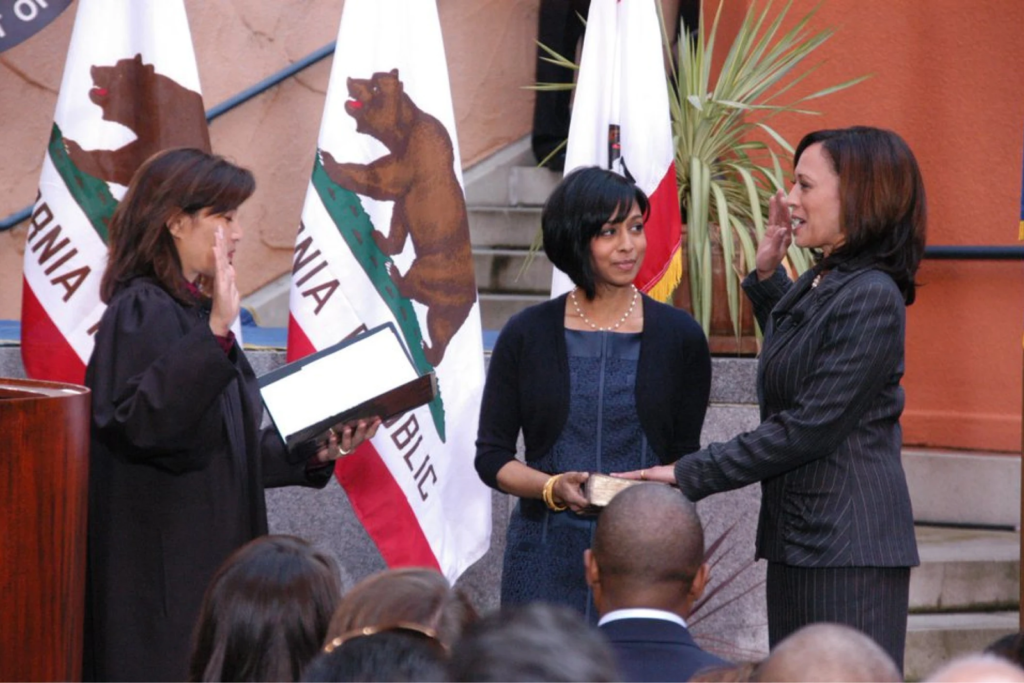
    In 2010, Harris was elected California’s Attorney General, once again becoming the first woman and the first Black person to hold that position. She also used her position as Attorney General to tackle huge issues, including in great part defending the Affordable Care Act, aiding the cause of marriage equality, and working for criminal justice reform. She established herself as a crime hawk, but was also building a reputation for pushing toward more human resolutions to problems such as the need to prevent mass incarceration and how to decrease recidivism. Her innovative efforts, like the Open Justice data initiative that would increase transparency in law enforcement, only added to her national profile.

    Presidential Run and U.S. Senate

    In 2016, Harris was elected to the U.S. Senate, serving California. She is a member of several key committees, including Judiciary Committee, where she was famous for her tough and very thorough questioning during confirmation hearings. She especially spoke out on civil rights, immigration, and criminal justice reform. She made her presence felt in the Senate by pleading for the rights of marginalized communities, by standing up for the DACA program, and by openly criticizing the Trump administration.

    In 2019, Harris launched a campaign for the Democratic nomination for President of the United States. The core issues driving her campaign were reforms in health care, environmental justice, and economic inequality. Although Harris had excellent debate performances, garnering a huge amount of attention for most of the initial period of her campaign, she suspended her campaign in December 2019. However, her candidacy still made her a more formidable star for the Democratic Party.

    Vice Presidency

    During the August 2020, Joe Biden, the Democratic presidential candidate chose Kamala Harris, a person who would go down in history as the first-ever Black woman and South Asian American woman to appear on a major party’s presidential ticket. In November 2020, the Biden-Harris ticket won the election against incumbent President Donald Trump and Vice President Mike Pence. On January 20, 2021, Harris was sworn in as Vice President of the United States, making history as the highest-ranking female official in U.S. history.

    Harris, as Vice President, has been instrumental in matters of critical national importance, whether in COVID-19 responses, voting rights, immigration reform, or the cause of racial justice. She also continued to represent the Biden administration overseas by being part of diplomatic missions and communicating with world leaders. Harris’s vice presidency has attracted much attention on various levels: Not just because of her historical record but possibly because she might herself be interested in running for the office someday.

    Legacy and Impact


    From her days as a California prosecutor to becoming the vice president of the United States, Kamala Harris’s journey epitomizes resilience, intellect, and commitment to public service. She has stood for justice and equality at every step in her career for women and people of color; thus, at the center of American politics, she stands like a beacon of hope to millions of people.

    Now, Kamala Harris is running for President of the United States to continue protecting our freedoms, delivering justice, and expanding opportunity so that every American can not just get by, but get ahead.

  • Zepto: A Rocket-Fast Rise in the Indian Quick Commerce Market

    Zepto: A Rocket-Fast Rise in the Indian Quick Commerce Market

    Convenience is the absolute king in today’s fast-moving world. Consumers are now seeking products and services to be delivered to their doorstep within minutes. One such company that has ridden on this wave is Zepto, a leading quick commerce startup based in India. Zepto has altered the way people shop for groceries and essentials, with ultra-fast delivery services.

    What is Zepto?

    Zepto is an e-commerce platform that specializes in instant delivery for groceries and essentials. Unlike other online grocery shops, which take days or even hours to have the ordered items delivered, Zepto makes shopping next-generation through 10-minute or less delivery. This fast delivery service has earned much popularity among busy consumers valuing convenience and speed.

    Who are the founders of Zepto?

    Aadit Palicha and Kaivalya Vohra, former employees at Flipkart, founded Zepto in 2020. Witnessing firsthand how convenience and speed in online shopping were only becoming increasingly popular, the two sensed that there was space for crafting a platform allowing consumers to get grocery and other essentials delivered to their doorstep in mere minutes. With a background in e-commerce, this duo was well-placed to launch Zepto into the very competitive grocery delivery market.

    How Zepto Began its Journey

    • Early Days and Rapid Expansion (2020-2021): Zepto started in the city of Mumbai in December 2020, focusing on ultra-fast grocery delivery. The company soon took off to spread across cities within India.
    • A Series of Funding Rounds and Aggressive Growth (2022): Zepto invited much-needed interest from investors, resulting in back-to-back funding rounds. On the back of this money, it would now be able to further accelerate its growth, expansion of its product portfolio, and continued investment in technology.
    • The Battle for Quick Commerce Dominance (2023-present): Having seen enormous potential in the success that Zepto had at its core, several other players entered the Indian quick commerce market. Even as competition was increasing, Zepto was able to hold on to its position as a leading player by customer satisfaction, product innovation, and operational efficiency.

    How Zepto delivers in under 10-mins?

    How Zepto delivers in under 10-mins
    How Zepto delivers in under 10-mins

    The infrastructure powering Zepto’s ability to deliver any orders within 10 minutes comes in the form of dark stores, which are simply small, localized warehouses. These dark stores are located near densely populated areas, and in this way, Zepto is able to quickly fill orders and get them to customers in as short a time frame as possible. Besides, Zepto deploys advanced technology and efficient logistics to optimize its delivery operations.

    Future Plans of Zepto

    The future plans of Zepto involve adding more products to its grocery category. It will also enhance the technology infrastructure to get into newer markets. Besides, Zepto has socially committed itself to sustainable environment practices and ensuring a lesser carbon footprint.

    Zepto – Mission and Vision

    It envisions redefining convenience and speed in e-commerce with a mission to be the most trusted and loved instant-delivery brand in India. Zepto seeks to offer customers optimum experiences and a change in the way people shop for essentials.

    Zepto’s Impact on the Indian E-Commerce Space

    It has disrupted the entire e-commerce space in India with its fast growth and success. Setting a benchmark in convenience and speed for online shopping, it set a new standard. On the other hand, Zepto’s success has invited further interest among investors within the quick commerce space, further leading to innovation and competition.

    Challenges and Opportunities

    Notwithstanding the significant success that Zepto has had, there are at least a good number of challenges. The infrastructure, logistics, and human resource-related costs that come with running a quick commerce business are definitely not cheap. Moreover, there will need to be a sailing through regulatory hurdles while ensuring its profitability is sustainable.

    Despite these odds, Zepto’s outlook in the future seems bright. The Indian e-commerce market is on the rise; demand for convenient and speedy delivery is unending. With a strong brand, streamlined operations, and great focus on customer experience, Zepto is well poised to capitalise on this growth.

    Competition and Market Dynamics

    The Zepto operates in a very competitive market with many other players gunning for a share of this quick commerce space. Blinkit earlier known as Grofers, Swiggy Instamart, Dunzo have all rolled out their own quick commerce services that make the competition further fierce.

    The competitive environment has forced Zepto to innovate and change at all times to remain ahead of the wave. In particular, investments have been made in product innovation, enhancement of technology capabilities, and geographic expansion. In addition, strategic partnerships and targeted acquisitions have been one lever to market leadership.

    Sustainability and Social Impact

    Zepto has, throughout these times, been making many socially responsible efforts toward its environmental impact. The company implemented sustainable solutions through its very new-age packaging and took steps to reduce carbon footprint. Besides contributing to social causes, Zepto supported local communities.

    Conclusion

    From the journey of a startup to the top player in the Indian quick commerce market, Zepto has earned a lot of respect and popularity. Its rapid expansion, innovative approach, and focus on customer satisfaction have made it successful. The more competition this space sees, the more Zepto will have to further innovate and adapt to be at the forefront of this industry.

    What is Zepto?

    Zepto is a startup based in Mumbai that offers a 10-minute grocery delivery service.

    When was Zepto founded?

    Zepto was founded in September 2020 and began operations in April 2021.

    Which companies does Zepto compete with?

    Swiggy Instamart, BigBasket, Blinkit, and Dunzo are some of the top competitors of Zepto.

  • Liberty Shoes: A Journey from Sole to Success

    Liberty Shoes: A Journey from Sole to Success

    Liberty Shoes, that spells quality and comfort for Indian feet today, started off on a very modest note way back in 1954 as a shoe manufacturing unit at Karnal in Haryana. The brainchild of Dharam Pal Gupta, Purshotam Das Gupta, and Rajkumar Bansal, this unit began its humble production with just four pairs a day, turning out their shoes with the help of skilled cobblers.

    A Decade of Growth: 1954-1964

    The initial years were slow but steady growth. Liberty Shoes was determined to lay a strong foundation, bring about constant improvements in the manufacturing process, and try to understand the changing needs of the Indian consumer. Gradually, production capacity was increased, and a wider range of footwear started coming out of the factory to cater to varied segments of the market.

    Expanding Horizons: 1965-1975

    The Indian economy expanded in the 1960s, and so did Liberty Shoes. New market territories were conquered as its distribution network spread to almost every nook and corner of the country. Technology and infrastructure saw major investments during this decade as production efficiency and product quality were enhanced manifold.

    Building a Brand 1976-1985

    By the late 1970s, Liberty Shoes was already a known name in the Indian footwear industry. The stage now saw new designs and styles coming in to capture the psyche of the young, fashion-conscious mind. The emphasis now shifted to creating a strong brand that stood for comfort, durability, and value for money.

    Retail Revolution (1986-1995)

    The 1980s emerged as the defining decade for Liberty Shoes. Enter the retail sector, open the first exclusive showroom in Kurukshetra, and there it goes, closer to consumers to develop a more direct relationship. During this decade, many new product lines were introduced, basically in view of different segments of consumer preference.

    Global Expansion, 1996-2005

    By this time, Liberty Shoes was already very well entrenched in the domestic market. It looked for international expansion and entered new markets, setting up units in a number of countries. This was basically a period of intense marketing and strategic tieups to make the brand name very visible.

    Digital Dominance, 2006-2015

    The digital revolution influenced the footwear industry in a big way, and Liberty Shoes had to quickly respond to it. The company thus launched its online store whereby products could reach a greater number of people. Utilize social media platforms for engaging with customers and building an effective online community.

    Innovation and Sustainability 2016-present

    The last two years have seen Liberty Shoes determinedly moving towards the twin objectives of innovation and sustainability. It is introducing eco-friendly materials and processes in its products for addressing the new demand of ethical fashion in consumers. Besides, heavy focus is being laid on research and development to introduce the most innovative designs in footwear.

    A Year-on-Year Success Story

    Basically, Liberty Shoes has shown a clean record in terms of financial performance over the years. The revenue has been trending upwards in view of enhanced sales, diversified products, and geographical presence. The company has very ably managed to hold its market leadership in the shoe industry, which is otherwise gloomy.

    Key Milestones

    • 1954: Foundation of Liberty Shoes
    • 1983: First exclusive showroom
    • 1986: Incorporation as a public limited company
    • 1991: Joint venture in Russia
    • 2001: Adesh Gupta becomes CEO
    • 2004: Launch of company-owned stores
    • Present: Strong focus on innovation, sustainability, and digital presence
  • Fundamental Principles of Managerial Economics

    Fundamental Principles of Managerial Economics

    Managerial Economics is both conceptual and metrical. Before the substantive decision problems which fall within the purview of managerial economics are discussed, it is useful to identify and understand some of the basic concepts underlying the subject.

    Economic theory provides a number of concepts and analytical tools which can be of considerable and immense help to a manager in taking many decisions and business planning. This is not to say that economics has all the solutions. In fact, actual problem solving in business has found that there exists a wide disparity between economic theory of the firm and actual observed practice.

    Therefore, it would be useful to examine the basic tools of managerial economics and the nature and extent of gap between the economic theory of the firm and the managerial theory of the firm. The contribution of economics to managerial economics lies in certain principles which are basic to managerial economics. There are six basic principles of managerial economics. They are:-

    1. The Incremental Principle

    The incremental concept is probably the most important concept in economics and is certainly the most frequently used in Managerial Economics. Incremental concept is closely related to the marginal cost and marginal revenues of economic theory.

    The two major concepts in this analysis are incremental cost and incremental revenue. Incremental cost denotes change in total cost, whereas incremental revenue means change in total revenue resulting from a decision of the firm.

    The incremental principle may be stated as follows:

    A decision is clearly a profitable one if

    (i) It increases revenue more than costs.

    ii) It decreases some cost to a greater extent than it increases others.

    (iii) It increases some revenues more than it decreases others.

    (iv) It reduces costs more than revenues.

    2. Marginal Principle

    Marginal analysis implies judging the impact of a unit change in one variable on the other. Marginal generally refers to small changes. Marginal revenue is change in total revenue per unit change in output sold. Marginal cost refers to change in total costs per unit change in output produced (While incremental cost refers to change in total costs due to change in total output). The decision of a firm to change the price would depend upon the resulting impact/change in marginal revenue and marginal cost. If the marginal revenue is greater than the marginal cost, then the firm should bring about the change in price.

    3. The Opportunity Cost Principle

    Both micro and macro economics make abundant use of the fundamental concept of opportunity cost. In everyday life, we apply the notion of opportunity cost even if we are unable to articulate its significance. In Managerial Economics, the opportunity cost concept is useful in decision involving a choice between different alternative courses of action.

    Resources are scarce, we cannot produce all the commodities. For the production of one commodity, we have to forego the production of another commodity. We cannot have everything we want. We are, therefore, forced to make a choice.

    Opportunity cost of a decision is the sacrifice of alternatives required by that decision. Sacrifice of alternatives is involved when carrying out a decision requires using a resource that is limited in supply with the firm. Opportunity cost, therefore, represents the benefits or revenue forgone by pursuing one course of action rather than another.

    The concept of opportunity cost implies three things:

    (i) The calculation of opportunity cost involves the measurement of sacrifices.

    (i1) Sacrifices may be monetary or real.

    (iii) The opportunity cost is termed as the cost of sacrificed alternatives.

    Opportunity cost is just a notional idea which does not appear in the books of account of the company. If resource has no alternative use, then its opportunity cost is nil.

    In managerial decision making, the concept of opportunity cost occupies an important place. The economic significance of opportunity cost is as follows:

    (i) It helps in determining relative prices of different goods.

    (ii) It helps in determining normal remuneration to a factor of production.

    (iii) It helps in proper allocation of factor resources.

    4. Discounting Principle

    This concept is an extension of the concept of time perspective. Since future is unknown and incalculable, there is lot of risk and uncertainty in future. Everyone knows that a rupee today is worth more than a rupee will be two years from now. This appears similar to the saying that “a bird in hand is more worth than two in the bush.” This judgment is made not on account of the uncertainty surrounding the future or the risk of inflation.

    It is simply that in the intervening period a sum of money can earn a return which is ruled out if the same sum is available only at the end of the period. In technical parlance, it is said that the present value of one rupee available at the end of two years is the present value of one rupee available today. The mathematical technique for adjusting for the time value of money and computing present value is called ‘discounting’.

    5. Concept of Time Perspective Principle

    The time perspective concept states that the decision maker must give due consideration both to the short run and long run effects of his decisions. He must give due emphasis to the various time periods. It was Marshall who introduced time element in economic theory.

    The economic concepts of the long run and the short run have become part of everyday language. Managerial economists are also concerned with the short run and long run effects of decisions on revenues as well as costs. The main problem in decision making is to establish the right balance between long run and short run.

    In the short period, the firm can change its output without changing its size. In the long period, the firm can change its output by changing its size. In the short period, the output of the industry is fixed because the firms cannot change their size of operation and they can vary only variable factors. In the long period, the output of the industry is likely to be more because the firms have enough time to increase their sizes and also use both variable and fixed factors.

    In the short period, the average cost of a firm may be either more or less than its average revenue. In the long period, the average cost of the firm will be equal to its average revenue. A decision may be made on the basis of short run considerations, but may as time elapses have long run repercussions which make it more or less profitable than it at first appeared.

    6. Equi-Marginal Principle

    One of the widest known principles of economics is the equi-marginal principle. The principle states that an input should be allocated so that value added by the last unit is the same in all cases. This generalization is popularly called the equi-marginal.

    Let us assume a case in which the firm has 100 unit of labour at its disposal. And the firm is involved in five activities viz., A, B, C, D and E. The firm can increase any one of these activities by employing more labour but only at the cost i.e., sacrifice of other activities.

    An optimum allocation cannot be achieved if the value of the marginal product is greater in one activity than in another. It would be, therefore, profitable to shift labour from low marginal value activity to high marginal value activity, thus increasing the total value of all products taken together.

  • Managerial Economics Relationship with Other Subjects

    Managerial Economics Relationship with Other Subjects

    Many new subjects have evolved in recent years due to the interaction among basic disciplines. While there are many such new subjects in natural and social sciences, managerial economics can be taken as the best example of such a phenomenon among social sciences. Hence it is necessary to trace its roots and relationship with other disciplines.

    1. Relationship with economics

    The relationship between managerial economics and economics theory may be viewed form the point of view of the two approaches to the subject Viz. Microeconomics and Marco Economics. Microeconomics is the study of the economic behaviour of individuals, firms and other such micro-organization. Managerial economics is rooted in Micro Economic theory. Managerial Economics makes use to several Micro Economic concepts such as marginal cost, marginal revenue, elasticity of demand as well as price theory and theories of market structure to name only a few. Macro theory on the other hand is the study of the economy as a whole. It deals with the analysis of national income, the level of employment, general price level, consumption and investment in the economy and even matters related to international trade, Money, public finance, etc.

    The relationship between managerial economics and economics theory is like that of engineering science to physics or of medicine to biology. Managerial economics has an applied bias and its wider scope lies in applying economic theory to solve real life problems of enterprises. Both managerial economics and economics deal with problems of scarcity and resource allocation.

    2. Management theory and accounting

    Managerial economics has been influenced by the developments in management theory and accounting techniques. Accounting refers to the recording of pecuniary transactions of the firm in certain books. A proper knowledge of accounting techniques is very essential for the success of the firm because profit maximization is the major objective of the firm.

    Managerial Economics requires a proper knowledge of cost and revenue information and their classification. A student of managerial economics should be familiar with the generation, interpretation and use of accounting data. The focus of accounting within the firm is fast changing from the concepts of store keeping to that if managerial decision making, this has resulted in a new specialized area of study called “Managerial Accounting”.

    3. Managerial Economics and mathematics

    The use of mathematics is significant for managerial economics in view of its profit maximization goal long with optional use of resources. The major problem of the firm is how to minimize cost, how to maximize profit or how to optimize sales. Mathematical concepts and techniques are widely used in economic logic to solve these problems. Also mathematical methods help to estimate and predict the economic factors for decision making and forward planning.

    Mathematical symbols are more convenient to handle and understand various concepts like incremental cost, elasticity of demand etc., Geometry, Algebra and calculus are the major branches of mathematics which are of use in managerial economics. The main concepts of mathematics like logarithms, and exponential, vectors and determinants, input-output models etc., are widely used. Besides these usual tools, more advanced techniques designed in the recent years viz. linear programming, inventory models and game theory fine wide application in managerial economics.

    4. Managerial Economics and Statistics

    Managerial Economics needs the tools of statistics in more than one way. A successful businessman must correctly estimate the demand for his product. He should be able to analyses the impact of variations in tastes.

    Fashion and changes in income on demand only then he can adjust his output. Statistical methods provide and sure base for decision-making. Thus, statistical tools are used in collecting data and analyzing them to help in the decision making process.

    Statistical tools like the theory of probability and forecasting techniques help the firm to predict the future course of events. Managerial Economics also make use of correlation and multiple regressions in related variables like price and demand to estimate the extent of dependence of one variable on the other. The theory of probability is very useful in problems involving uncertainty.

    5. Managerial Economics and Operations Research

    Taking effective decisions is the major concern of both managerial economics and operations research. The development of techniques and concepts such as linear programming, inventory models and game theory is due to the development of this new subject of operations research in the postwar years. Operations research is concerned with the complex problems arising out of the management of men, machines, materials and money.

    Operation research provides a scientific model of the system and it helps managerial economists in the field of product development, material management, and inventory control, quality control, marketing and demand analysis. The varied tools of operations Research are helpful to managerial economists in decision-making.

    6. Managerial Economics and the theory of Decision making

    The Theory of decision-making is a new field of knowledge grown in the second half of this century. Most of the economic theories explain a single goal for the consumer i.e., Profit maximization for the firm. But the theory of decision-making is developed to explain multiplicity of goals and lot of uncertainty.

    As such this new branch of knowledge is useful to business firms, which have to take quick decision in the case of multiple goals. Viewed this way the theory of decision making is more practical and application oriented than the economic theories.

    7. Managerial Economics and Computer Science

    Computers have changed the way of the world functions and economic or business activity is no exception.

    Computers are used in data and accounts maintenance, inventory and stock controls and supply and demand predictions. What used to take days and months is done in a few minutes or hours by the computers. In fact computerization of business activities on a large scale has reduced the workload of managerial personnel. In most countries a basic knowledge of computer science, is a compulsory programme for managerial trainees.

    To conclude, managerial economics, which is an offshoot traditional economics, has gained strength to be a separate branch of knowledge. It strength lies in its ability to integrate ideas from various specialized subjects to

    gain a proper perspective for decision-making.

    A successful managerial economist must be a mathematician, a statistician and an economist. He must be also able to combine philosophic methods with historical methods to get the right perspective only then; he will be good at predictions. In short managerial practices with the help of other allied sciences.

  • Nature, Scope and Definition of Business Economics

    Nature, Scope and Definition of Business Economics

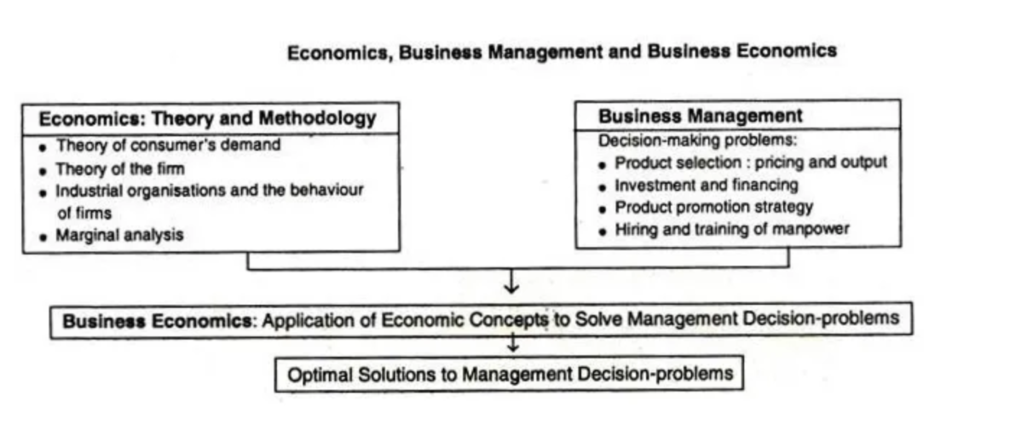
    Business economics is a field of applied economics that studies the financial, organizational, market-related, and environmental issues faced by corporations. Economic theory and quantitative methods form the basis of assessments on factors affecting corporations such as business organization, management, expansion, and strategy. Studies might include how and why corporations expand, the impact of entrepreneurs, the interactions among corporations, and the role of governments in regulation.

    The Basics of Business Economics

    Economics, broadly, refers to the study of the components and functions of a particular marketplace or economy, such as supply and demand, and the effect of the concept of scarcity. Within an economy, production factors, distribution methods, and consumption are important subjects of study. Business economics focuses on the elements and factors within business operations and how they relate to the economy as a whole.

    The field of business economics addresses economic principles, strategies, standard business practices, the acquisition of necessary capital, profit generation, the efficiency of production, and overall management strategy. Business economics also includes the study of external economic factors and their influence on business decisions such as a change in industry regulation or a sudden price shift in raw materials.

    Real World Example of Business Economics

    There are various organizations associated with the field of business economics. In the United States, the National Association for Business Economics (NABE) is the professional association for business economists. The organization’s mission is “to provide leadership in the use and understanding of economics.” In the United Kingdom, the equivalent organization is the Society of Business Economists.

    • Economic theory and quantitative methods form the basis of microeconomic assessments of factors
    • affecting corporations.
    • Business economics encompasses subjects such as the concept of scarcity, product factors, distribution, and consumption.
    • Managerial economics is one important offshoot of business economics.
    • The National Association for Business Economics (NABE) is the professional association for business economists in the United States.

    Nature of Business Economics

    (i) Business Economics is a Science

    What is Science? It is simply a systematic body of knowledge which can establish a relationship between cause and effect.

    Further, Mathematics, Statistics, and Econometrics are decision sciences.

    Business Economics integrates these decision sciences with Economic Theory to arrive at strategies to help businesses achieve their goals. Hence, it follows scientific methods and also tests the validity of the results. This is one aspect of the nature of business economics.

    (ii) It is based on Micro Economics

    We understand the basic difference between micro and macroeconomics. A business manager is certainly more concerned about achieving the objectives of his own organization. After all, this helps him in ensuring profits and long-term survival of the firm.

    Business Economics is more concerned with the decision-making situations of individual establishments. Therefore, it depends on the techniques of Microeconomics.

    (iii) It Incorporates Elements of Macro Analysis

    Even though all businesses focus on their profitability and survival, a firm cannot operate in a vacuum. The external environment of the economy like income and employment levels in the economy, tax policies, etc., affects the firm. All these external factors are components of macro economy.

    Therefore, a business manager has to take all such factors into consideration which may influence his business environment.

    (iv) It is an Art

    Business Economics is an art as it requires the practical application of rules and principle to achieve set objectives.

    (v) Use of Theory of Markets and Private Enterprises

    Business Economics primarily uses the theory of markets and private enterprises. It uses the theory of the firm and resource allocation in a private enterprise economy.

    (vi) Pragmatic in Approach

    Microeconomics is purely theoretical and analyzes economic occurrences under unrealistic assumptions. On the other hand, Business Economics is pragmatic in its approach. It tries to solve the problems which the firms face in the real world.

    (vii) Interdisciplinary

    Business Economics incorporates tools from many other disciplines like mathematics, statistics, accounting, marketing, etc. Therefore, is in interdisciplinary in nature.

    (viii) Normative

    Broadly speaking, Economic Theory has evolved along two lines – Positive and Normative.

    A positive or pure science analyzes the cause and effect relationship between variables in a scientific manner. However, it does not involve any value judgment. In simpler words, it describes the economic behavior of individuals or society without focusing on the desirability of such behavior.

    On the other hand, normative science involves value judgments. It suggests a course of action under the given circumstances.

    Usually, Business Economics is normative in nature. It offers suggestions for the application of economic principles while forming policies, making decisions, and planning for the future. However, firms must understand their environment thoroughly to establish decision rules. This requires the study of positive economic theory.

    Therefore, we can say that Business Economics combines the essentials of both the theories while keeping more emphasis on the normative economic theory.

    The Scope of Business Economics

    1. Microeconomics Applied to Operational Issues

    As the name suggests, internal or operational issues are issues that arise within a firm and are within the control of the management. It is within the scope of business economics to analyze this.

    Further, a few examples of such issues are choice of business, size of business, product designs, pricing, promotion for sales, technology choice, etc. Most firms can deal with these using the following microeconomics theories:

    (i) Analyzing Demand and Forecasting

    Analyzing demand is all about understanding buyer behavior. It studies the preferences of consumers along with the effects of changes in the determinants of demand. Also, these determinants include the price of the good, consumer’s income, tastes/ preferences, etc.

    Forecasting demand is a technique used to predict the future demand for a good and/or service. Further, this prediction is based on the past behavior of factors which affect the demand. This is important for firms as accurate predictions help them produce the required quantities of goods at the right time.

    Further, it gives them enough time to arrange various factors of production in advance like raw materials, labor, equipment, etc. Business Economics offers scientific tools which assist in forecasting demand.

    (ii) Production and Cost Analysis

    A business economist has the following responsibilities with regards to the production:

    • Decide on the optimum size of output based on the objectives of the firm.
    • Also, ensure that the firm does not incur any undue costs.

    By production analysis, the firm can choose the appropriate technology offering a technically efficient way of producing the output. Cost analysis, on the other hand, enables the firm to identify the behavior of costs when factors like output, time period, and the size of plant change. Further, by using both these analyses, a firm can maximize profits by producing optimum output at the least possible cost.

    (iii) Inventory Management

    Firms can use certain rules to reduce costs associated with maintaining inventory in the form of raw materials, work in progress, and finished goods. Further, it is important to understand that the inventory policies affect the profitability of a firm. Hence, economists use methods like the ABC analysis and mathematical models to help the firm in maintaining an optimum stock of inventories.

    (iv) Market Structure and Pricing Policies

    Any firm needs to know about the nature and extent of competition in the market. A thorough analysis of the market structure provides this information. Further, with the help of this, firms command a certain ability to determine prices in the market. Also, this information helps firms create strategies for market management under the given competitive conditions.

    Price theory, on the other hand, helps the firm in understanding how prices are determined under different kinds of market conditions. Also, it assists the firm in creating pricing policies.

    (v) Resource Allocation

    Business Economics uses advanced tools like linear programming to create the best course of action for an optimal utilization of available resources.

    (vi) Theory of Capital and Investment Decisions

    Among other decisions, a firm must carefully evaluate its investment decisions an allocate its capital sensibly. Various theories pertaining to capital and investments offer scientific criteria for choosing investment projects. Further, these theories also help the firm in assessing the efficiency of capital. Business Economics assists the decision-making process when the firm needs to decide between competing uses of funds.

    (vii) Profit Analysis

    Profits depend on many factors like changing prices, market conditions, etc. The profit theories help firms in measuring and managing profits under such uncertain conditions. Further, they also help in planning future profits.

    (viii) Risk and Uncertainty Analysis

    Most businesses operate under a certain amount of risk and uncertainty. Also, analyzing these risks and uncertainties can help firms in making efficient decisions and formulating plans.

    2. Macroeconomics applied to Environmental Issues

    External or environmental factors have a measurable impact on the performance of a business. The major macroeconomic factors are:

    • Type of economic system
    • Stage of the business cycle
    • General trends in national income, employment, prices, saving, and investment.
    • Government’s economic policies
    • Performance of the financial sector and capital market
    • Socio-economic organizations
    • Social and political environment.

    The management of a firm has no control over these factors. Therefore, it is important that the firm fine-tunes its policies to minimize the adverse effects of these factors.

  • 20 Ways to start conversation with strangers

    20 Ways to start conversation with strangers

    Feeling a little shy around new people? Starting a conversation with a stranger can be daunting, but it doesn’t have to be. Here are 20 simple and effective conversation starters to help you break the ice.

    Observation-Based Openers

    • Compliment their style: “I love your [item]. Where did you get it?”
    • Express interest in their belongings: “That’s a cool [book/shirt/etc.]. What’s it about/where’d you get it?”
    • Ask about their surroundings: “Have you tried the [food/drink] here? What do you think?”

    General Questions

    • Be direct and friendly: “Hi, do you mind if I join you?”
    • Show interest in their day: “How’s your day going?”
    • Seek recommendations: “Do you know any good places to eat around here?”
    • Ask for directions or information: “Excuse me, do you know where [place] is?”
    • Share your newness: “Hi, I’m new around here. Do you have any tips?”
    • Ask for opinions: “Excuse me, can I ask your opinion on something?”

    Shared Interests

    • Find common ground: “Hey, do you like [hobby/interest]? I’m really into it.”
    • Discuss current events: “Have you seen the latest [movie/show/etc.]? What did you think?”
    • Engage in light-hearted banter: “What’s your favorite thing about this place?”

    Direct and Simple

    • Classic icebreaker: “Hey, do you come here often?”
    • Show curiosity: “What brings you here today?”
    • Be polite and respectful: “Excuse me, do you have the time?”
    • Seek advice: “Can I get your advice on something?”
    • Find a hangout spot: “Do you have a favorite spot to hang out around here?”

    Remember, the key to a successful conversation is genuine interest and active listening. Don’t be afraid to follow up on their responses and keep the conversation flowing naturally. With a little practice, you’ll be a conversation pro in no time!

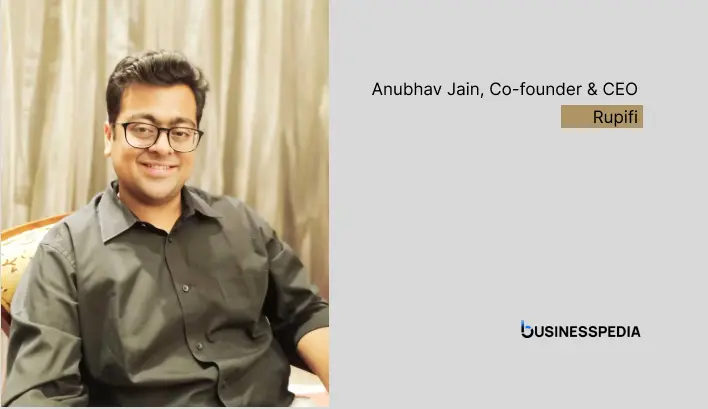
  • Anubhav Jain, Co-founder & CEO, Rupifi

    Anubhav Jain, Co-founder & CEO, Rupifi

    Story of It always pays to dream higher, start up young: Anubhav Jain, Co-founder & CEO, Rupifi. “Anubhav Jain: A Leader in Fintech Innovation”

    Anubhav Jain is a seasoned entrepreneur and a leader in the fintech industry. He is the Co-Founder and CEO of Rupifi, a digital lending platform that aims to revolutionize the traditional lending industry. Under his leadership, Rupifi has grown to become one of the most innovative and user-friendly lending platforms in the market.

    Early Career

    Anubhav Jain started his career as a software engineer in the tech industry. He quickly rose through the ranks, gaining experience in software development, product management, and business development. After several successful projects, he decided to branch out on his own and pursue entrepreneurship.

    The Birth of Rupifi

    Anubhav Jain’s passion for innovation and drive to change the world led him to co-found Rupifi with a group of like-minded individuals. The company was established with the goal of creating a simple, user-friendly digital lending platform that would allow people to access loans in a fast and convenient manner.

    Innovation at Rupifi

    Under Anubhav Jain’s leadership, Rupifi has implemented a number of innovative features that set it apart from its competitors. The platform uses advanced algorithms and machine learning to evaluate loan applications and provide quick loan approvals. Additionally, Rupifi provides a range of loan options, including personal loans, business loans, and even loans for specific purposes, such as home renovation or medical expenses.

    Commitment to Customer Satisfaction

    Anubhav Jain is deeply committed to providing an exceptional customer experience. He believes that customer satisfaction is key to the success of any business, and he works tirelessly to ensure that Rupifi’s users are happy and satisfied with their loan experience. Rupifi’s user-friendly platform, quick loan approvals, and transparent lending process are just a few of the ways that the company demonstrates its commitment to its customers.

    Conclusion

    Anubhav Jain is a true leader in the fintech industry. With his vision and innovative spirit, he has helped to shape Rupifi into one of the most trusted and respected digital lending platforms in the market. He is a true champion of financial innovation and his unwavering commitment to customer satisfaction will ensure that Rupifi continues to grow and thrive for many years to come.

  • Vedant Lamba, Founder, The Mainstreet Marketplace

    Vedant Lamba, Founder, The Mainstreet Marketplace

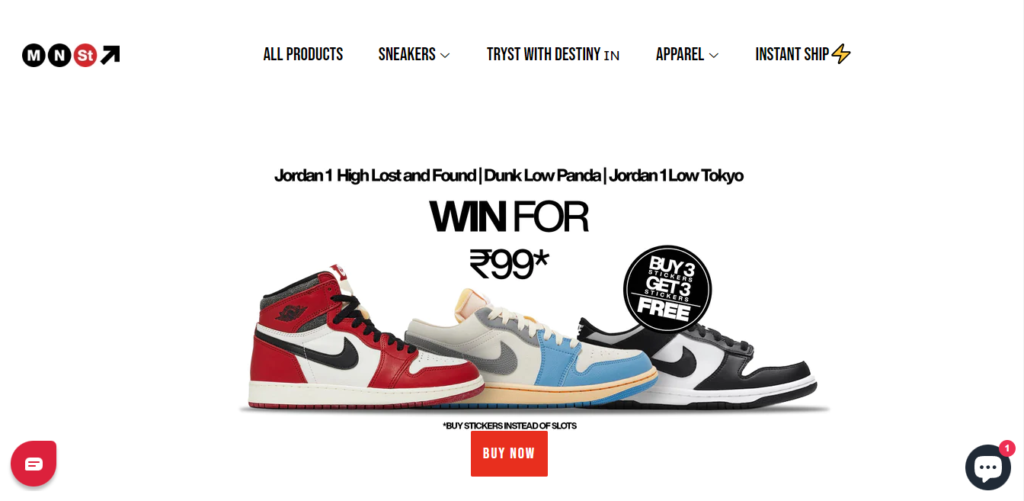
    Story of Giving leg-up to a sneaker reselling biz: Vedant Lamba, Founder, The Mainstreet Marketplace.

    At just 22 years of age, Vedant Lamba made it to the ‘Forbes 30 under 30’ list of 2022. The young businessman is at the forefront of the thriving sneaker culture in India. His venture The Mainstreet Marketplace is one of India’s biggest sneaker reselling platforms that he started in 2017. Initially, he put out videos on his YouTube channel ‘Mainstreet TV’ to share information on the newest sneaker launches. His success led to his first store opening in Pune and eventually in Mumbai and Delhi. He boasts celebrity clientele and his Delhi store is known to be the among largest resale stores in Asia that trades in brands like Jordan, Yeezy, Nike, Adidas, Nike, and so on.

    Vedant Lamba, Founder, The Mainstreet Marketplace

    For many, childhood ambitions pave the way. Mumbai-based Lamba, founder of The Mainstreet Marketplace, wanted to start his business since he was about 12 years old. About ten years later, his dream has come true and how. He says he had no back up plan. Every successful entrepreneur is a great risk taker. For him his strong risk capacity comes from his privileged background.

      Like many parents who ensure their child completes their higher education before they venture into business, Lamba too wanted the same. But seeing his persistence, they came down to him at least completing his 12th grade. “I’ve been far too fortunate with my family’s support,” says Lamba. He gets hundreds of messages from people who have seen him create content and talk about his goals on his social media platforms. “The way I see it, even if one of them is brave enough to take a risk, it will leave me feeling very fulfilled,” he adds.

      Why It’s Time to Use Invoice Generator? – Invoice Generator | Receipt Template | Invoice Maker – Vantazo.com

      Several youngsters like Lamba have the confidence, familial support, talent, ideas and the privilege to follow their own dreams—the recipe for a successful business rather than going the safe job-route.

      Lamba feels that one should make more of an effort to find their own flow rather than doing something conventional or not. He also feels that though the current Indian governmental support needs improvement to nurture start-ups, the underdeveloped nature of the market provides several opportunities for business to flourish.

      © The Financial Express – Subham Mitra

    • Ghazal Alagh, Co-founder, Mamaearth

      Ghazal Alagh, Co-founder, Mamaearth

      Story of Changing India’s beauty landscape: Ghazal Alagh, Co-founder, Mamaearth

      Ghazal Alagh is the Co-Founder of Mamaearth, a popular brand known for its organic and chemical-free products for babies and mothers. Ghazal’s journey with Mamaearth started when she became a mother herself and realized the need for safe and natural products for her child. With a degree in Business Management, Ghazal has always had a passion for entrepreneurship and her experience as a mother gave her the push she needed to start her own business.

      Mamaearth was founded in 2016, with the aim to provide safe, natural and effective products for mothers and babies. The brand has a wide range of products including skincare, hair care, health care and household cleaning items. All the products are made with natural ingredients and are free from harmful chemicals like parabens, sulphates, and mineral oil.

      Ghazal and her husband, Varun Alagh, started Mamaearth from their own home, and within a few years, it has become one of the leading brands in the market. The brand is well-loved by customers for its quality products and its commitment to being environmentally friendly. Mamaearth has received several awards and recognition for its products, including the “Best Natural Baby Care” brand in India in 2019.

      Ghazal’s dedication and hard work have been key to the success of Mamaearth. She has always been hands-on, working closely with the team to ensure that the brand’s vision is upheld and the products are of the highest quality. Ghazal’s experience and expertise have been instrumental in the brand’s success, and she continues to play a crucial role in its growth.

      In conclusion, Ghazal Alagh is a true inspiration to all aspiring entrepreneurs. She has shown that with hard work and dedication, it is possible to turn a passion into a successful business. Her story is a testament to the impact that a mother’s love can have on the world and the importance of creating safe and natural products for our children.