Author: Rashmi Kumari

  • What is Marketing, Definition & Goals

    What is Marketing, Definition & Goals

    In this article, we’ll learn about What is Marketing, the goals of Marketing , Benefits of Marketing, Limitations of Marketing and more.

    Marketing is the process of creating, communicating, delivering, and exchanging offerings that have value for customers, clients, partners, and society at large.

    Marketing Definitions

    1. According to the American Marketing Association (AMA) Board of Directors:

    “Marketing is the activity, set of institutions, and processes for creating, communicating, delivering, and exchanging offerings that have value for customers, clients, partners, and society at large”.

    2. According to Dr. Philip Kotler:

    “The science and art of exploring, creating, and delivering value to satisfy the needs of a target market at a profit. Marketing identifies unfulfilled needs and desires. It defines, measures and quantifies the size of the identified market and the profit potential. It pinpoints which segments the company is capable of serving best and it designs and promotes the appropriate products and services”.

    The Goals of Marketing

    The goals of marketing are to:

    • Create customer value: Marketing should create value for customers by providing products and services that meet their needs and wants.
    • Build strong customer relationships: Marketing should build strong relationships with customers by providing them with excellent customer service and creating a positive customer experience.
    • Generate sales and profit: Marketing should generate sales and profit for the organization.

    Benefits of Marketing

    Benefits of Marketing for Businesses

    1. Increased Brand Awareness and Recognition:
      • Effective marketing enhances visibility and familiarity.
      • Greater recall and consideration when customers need products or services.
      • Establishes legitimacy in the industry and builds trust.
    2. Attracting and Retaining Customers:
      • Reaches new potential customers through targeted messaging.
      • Converts them into paying customers with compelling value propositions.
      • Fosters loyalty and encourages repeat business by understanding customer needs.
    3. Product Development and Innovation:
      • Marketing research provides insights into customer needs and preferences.
      • Enables the development of products and services aligned with audience preferences.
      • Addresses unmet needs, leading to higher customer satisfaction and market differentiation.
    4. Competitive Advantage:
      • Strong marketing differentiates the brand from competitors.
      • Highlights unique value propositions, strengths, and brand personality.
      • Attracts customers seeking specific features, positioning the brand as the preferred choice.
    5. Increased Sales and Revenue:
      • Successful marketing contributes directly to the bottom line.
      • Generates leads, nurtures them through the sales funnel, and converts them into customers.
      • Drives growth in sales and revenue for the business.
    6. Improved Brand Reputation and Perception:
      • Effective marketing builds a positive brand image.
      • Showcases values, mission, and commitment to quality.
      • Strengthens customer trust, attracts talent, and encourages positive word-of-mouth marketing.
    7. Enhanced Customer Experience:
      • Marketing plays a crucial role in creating a positive customer journey.
      • Provides clear communication, relevant content, and personalized interactions.
      • Leads to heightened customer satisfaction and fosters loyalty over time.

    Benefits of Marketing for Customers

    1. Discovery of New Products and Services:
      • Marketing aids customers in finding products and services that address their needs and solve problems.
      • Exposure to various options and highlighting relevant features empowers customers to make informed decisions.
    2. Informed Buying Decisions:
      • Marketing provides customers with essential information for making informed buying decisions.
      • This includes detailed product descriptions, comparisons, testimonials, and educational content.
      • Enables customers to choose the best option aligned with their needs and budget.
    3. Building Trust and Relationships:
      • Effective marketing establishes trust and fosters positive relationships.
      • Achieved through transparency, authenticity, and personalized communication.
      • Creates a sense of connection and loyalty, leading to repeat business and brand advocacy.
    4. Enhanced Value Perception:
      • Marketing effectively communicates the value proposition of a product or service.
      • Highlights benefits and justifies the price point to help customers understand the brand’s unique offering.
      • Increases the perceived value of the product or service, influencing customer choices.

    Limitations of Marketing

    Marketing, while immensely powerful, comes with its own set of limitations. Here are some key points to consider:

    • Oversaturation: With countless brands vying for attention, it can be difficult to stand out and reach your target audience. Consumers are bombarded with messages, leading to banner blindness and decreased effectiveness.
    • Devaluation: Constant exposure can devalue marketing messages. Repetitive promotions or manipulative tactics can erode trust and damage brand image.
    • No Guaranteed Success: Even the most well-crafted campaign cannot guarantee success. Unforeseen circumstances, competitor actions, or shifts in market trends can render even the best plans ineffective.
    • Customer Bias: Consumers are not passive targets. They have their own biases, preferences, and information processing styles. Marketing may not resonate with everyone, and misjudging your audience can lead to wasted resources.
    • Cost: Implementing effective marketing strategies can be expensive, especially for smaller businesses. From research and content creation to advertising and campaign management, costs can quickly add up.
    • Ethical Concerns: Balancing persuasion with transparency and avoiding manipulative tactics is crucial. Malpractices can damage brand reputation and ultimately harm both businesses and consumers.
    • Measuring ROI: Attributing specific results to marketing efforts can be challenging, making it difficult to measure return on investment (ROI) accurately. This can limit resources allocated to marketing and make it harder to justify its value.
    • Dynamic Landscape: Marketing tactics need to adapt constantly to keep pace with evolving technologies, consumer behavior, and social trends. Failure to adapt can leave brands outdated and irrelevant.
    • Limited Control: External factors like economic conditions, government regulations, and competitor actions can significantly impact marketing outcomes, even with the best planning.

    Remember, marketing is an ongoing process, not a one-time fix. Understanding these limitations and continuously refining your strategies are key to maximizing its effectiveness and achieving your marketing goals.

  • Fundamental concepts of Organizational Behaviour

    Fundamental concepts of Organizational Behaviour

    In this article, you’ll learn about fundamental concepts of Organizational Behaviour.

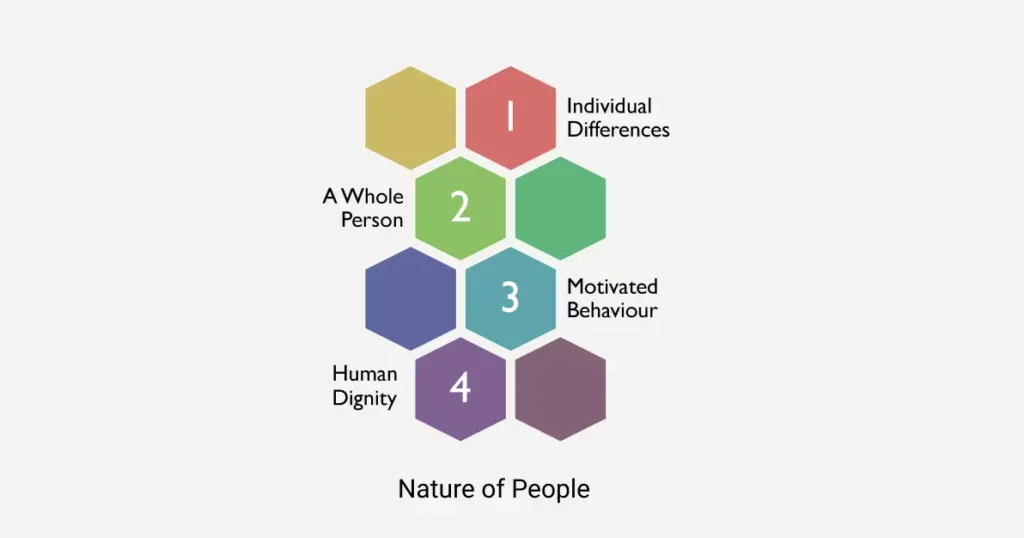
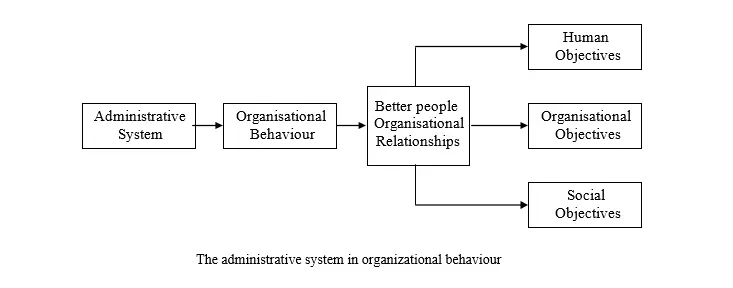
    Organizational Behaviour starts with a set of six fundamental concepts revolving around the nature of people and organizations. They are as follows:

    The Nature of people

    • Individual differences
    • A whole person
    • Motivated Behaviour
    • Value of the person (human dignity)

    The Nature of Organizations

    • Social systems
    • Mutual Interest

    Result

    • Holistic organizational behaviour

    The Nature of people

    The Nature of people
    The Nature of people

    Individual differences

    People have much in common (they become excited, or they are grieved by the loss of loved one), but each person in the world is also individually different. Each one is different from all others, probably in millions of ways, just as each of their fingerprints is different, as a far as we know. And these differences are usually substantial rather than meaningless. All people are different. This is a fact supported by science.

    The idea of individual differences comes originally from psychology. From the day of birth, each person is unique, and individual experiences after birth tend to make people even more different. Individual differences mean that management can get the greatest motivation among employees by treating manager’s approach to employees should be individual, not statistical. This belief that each person is different from all others is typically called the Law of Individual Differences.

    A whole person

    Although some organisations may wish they could employ a person’s skill or brain, they actually employ a whole person, rather than certain characteristics. Different human traits may be separately studied, but in the final analysis they are all part of one system making up a whole person.  Skill does not exist apart from background or knowledge. Human life is not totally separable from work life and emotional conditions are not separate from physical conditions. People function as total human beings.

    Motivated behaviour

    From psychology we learn that normal behaviour has certain causes. These may relate to a person’s needs and / or the consequences that result from acts. In the case of needs, people are motivated not by what we think they ought to have but by what they themselves want. To an outside observer a person’s needs may be unrealistic, but they are still controlling. This act leaves management with two basic ways to motivate people. It can show them how certain actions will increase their need fulfilment, or it can threaten decreased need fulfilment if they follow an undesirable course of action. Clearly a path towards increased need fulfilment is the better approach.

    Value of the person (human dignity)

    This concept is of a different order from the other three because it is more an ethical philosophy than a scientific conclusion. It asserts that people are to be treated differently from other factors of production because they are of a higher order in the universe. It recognizes that because people are of a higher order they want to be treated with respect and dignity – and should be treated this way. The concept of human dignity rejects the old idea of using employees as economic tools.

    The Nature of Organizations

    Social systems

    From sociology we learn that organisations are social systems; consequently activities there-in are governed by social laws as well as psychological laws. Just as people have psychological needs, they also have social roles and status. Their behaviour is influenced by their group as well as by their individual drives. In fact, two types of social systems exist side by side in organisations. One is the formal (official) social system, and the other is the informal social system.

    The existence of a social system implies that the organizational environment is one of dynamic change rather than a static set of relations. All parts of the system are interdependent and subject to influence by any other part.  Everything is related to everything else.  The idea of a social system provides a frame work for analysing organizational behaviour issues. It helps make organizational behaviour problems understandable and manageable.

    Systems Approach

    Mutual interest

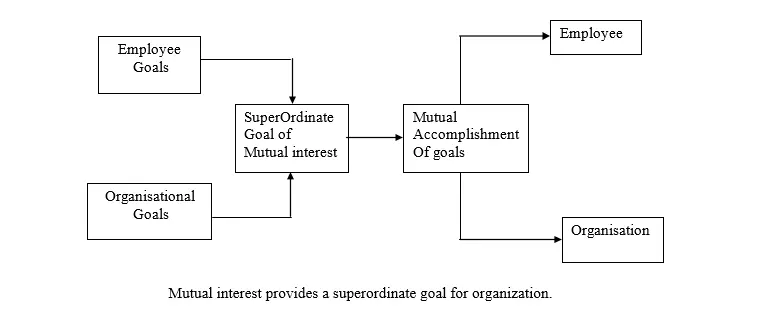
    Mutual interest is represented by the statement ―organisations, need people, and people also need organisations‖. Organisations have a human purpose. They are formed and maintained on the basis of some mutuality of interest among their participants. People see organisations as a means to help them reach their goals, while organisations need people to help reach organizational objectives. As shown in the following figure, mutual interest provides a superordinate goal that integrates the efforts of individuals and groups. The result is that they are encouraged to attack organizational problems rather than each other.

    Mutual interest provides a superordinate goal for organization

    Holistic organizational behaviour

    When the six fundamental concepts of organizational behaviour are considered together, they provide a holistic concept of the subject. Holistic organizational behaviour interprets people-organisation relationships in terms of the whole person, whole group, whole organisation, and whole social system. It takes an across-the board view of people in organisations in an effort to understand as many as possible of the factors that influence their behaviour. Issues are analysed in terms of the total situation affecting them rather than in terms of an isolated event or problem.

  • What Is Emotional Intelligence? Definition, Key Elements and Examples

    What Is Emotional Intelligence? Definition, Key Elements and Examples

    In this article, you’ll learn about What Is Emotional Intelligence? Definition, Importance of Emotional Intelligence , Implications of Emotional Intelligence, Characteristics and Examples.

    Emotional intelligence (EI) is most often defined as the ability to perceive, use, understand, manage, and handle emotions. People with high emotional intelligence can recognize their own emotions and those of others, use emotional information to guide thinking and behavior, discern between different feelings and label them appropriately, and adjust emotions to adapt to environments. Although the term first appeared in 1964, it gained popularity in the 1995 best-selling book Emotional Intelligence, written by science journalist Daniel Goleman. Goleman defined EI as the array of skills and characteristics that drive leadership performance.

    Emotional Intelligence Definition

    According to Daniel Goleman“Emotional intelligence is the capacity for recognizing our own feelings and those of others, for motivating ourselves, and for managing emotions well in our self and in our relationships”

    According to Peter Salovey and John D. Mayer, “Emotional intelligence is the ability to keep an eye on one’s own and others’ feelings and emotions, to discriminate among them and to use this information to guide one’s thinking and actions”.

    Characteristics of Emotional Intelligence 

    Goleman describes five core characteristics of emotional intelligence in organisational behaviour OB, which are as follows:

    1) Self-Awareness: This dimension consists of knowing one’s internal state, resources, preferences,  and intuitions. It is the ability to recognize and interpret feelings as they are happening and to perform accurate self-assessment. This also includes the ability to be at peace with oneself and to have confidence in oneself. Self-awareness is being able to not let social norms get in the way of a personal mindset.

    2) Self-Management/Self-Regulation: It is the ability to keep impulses and emotions in check by exhibiting self-control. It also includes the ability to keep standards of things, like honesty and respect. Self-management involves the ability for one to take responsibility for one’s actions, the ability to adapt to change, and the ability to come up with novel ideas and approaches to situations.

    3) Motivation: It is the ability to guide and facilitate goals, both long-term and short-term. It involves a drive for achievement, the ability to commit and take initiative as well as a sense of confidence about a goal. Motivation usually involves doing things we do not want to do, yet doing them anyway.

    4) Empathy: Another dimension of emotional intelligence is empathy. Emotional intelligence helps to read and understand the emotional make-up of others. It is the ability to understand others’ needs, perspectives, feelings, concerns, and sense their developmental needs.

    Importance of Emotional Intelligence 

    The importance of emotional intelligence in organizational behavior is as follows:

    1) Building Strong Relationships: Emotional intelligence helps build strong relationships emotional intelligence is vitally important when talking about working with colleagues, friendships, or romantic relationships. With the ability to empathize, keep calm in the face of another person, understands the needs and wants of others, to be flexible enough to sustain a relationship, otherwise, things can go badly wrong.

    2) Improves Communication with Others: When persons act with emotional intelligence they can improve their communication with others because they develop a whole set of skills and strategies that allow for more meaningful communications.

    3) Better Empathy Skills: Empathy is understanding another person’s emotional makeup. It is a core emotional intelligence skill in communication. Without the ability to feel how the other person might be feeling, people are unlikely to have a close relationship or influence others effectively. They will always feel that they do not really understand them and they can be right.

    4) Acting with Integrity: Integrity is another core of emotional intelligence ability. Integrity is an act of doing things right through their actions, beliefs, and words even when no one is watching them. It refers to the loyalty, honesty, and honourable behavior of a person in such a way that is consistent with his core beliefs, being true to himself and being honest with others. When a person acts with emotional intelligence and a high degree of integrity at work, this means that the person is trustworthy and reliable and therefore other people respect and trust him. 

    6) Improved Career Prospects: All managers want to employ someone who is emotionally intelligent. They will not necessarily call it that though. Clued-up managers know that they can train people in technical skills much more quickly than they can train them in emotional intelligence.

    7) Manage Change more Confidently: People with low emotional intelligence often find change difficult. They do not feel confident enough in themselves to bend and adapt to the wind of change. This means they often turn their face against change, denying the need for it, and eventually lose out as progress happens around them. Instead of adopting change and growing with it, they change only when forced to, even then reluctantly with poor grace.

    Limitations of Emotional Intelligence 

    For all its benefits, emotional intelligence has just as many limitations. These limitations are as follows:

    1) Emotional intelligence is too Vague a Concept: Too many researchers, and it is not clear what emotional intelligence is. Is it a form of intelligence? Most of us would not think that being self-aware or self-motivated or having empathy is a matter of understanding. So, is Emotional intelligence a misnomer? Moreover, many times different researchers focus on different skills, making it difficult to get a definition of emotional intelligence. One researcher may study self-discipline. Another may study empathy. Another may look at self-awareness. The concept of Emotional intelligence has now become so broad and the components so variegated that, it is no longer even an intelligible concept.

    2) Emotional intelligence cannot be Measured: Many critics have raised questions about measuring emotional intelligence. Because emotional intelligence is a form of intelligence, for instance, then there must be right and wrong answers about it on tests, they argue. Some tests do have right and wrong answers, although the validity of some of the questions on these measures is questionable. For example, one measure asks us to associate particular feelings with specific colours, as if purple always makes us feel cool, not warm. Other measures are self-reported, which means there is no right or wrong answer. For example, an emotional intelligence  test question might ask to respond to the statement, “I am good at ‘reading’ other people.” In general, the measures of Emotional intelligence are diverse, and researchers have not subjected them to as much meticulous study as they have measures of personality and general intelligence.

    3) Validity of Emotional intelligence is Suspect: Some critics argue that because Emotional intelligence is so closely related to intelligence and personality, once you control for these factors, emotional intelligence has nothing unique to offer. There is some foundation to this argument. Emotional intelligence appears to be highly correlated with measures of personality, especially emotional stability. But there has not been enough research on whether emotional intelligence adds insight beyond measures of personality and general intelligence in predicting job performance. Still, among consulting firms and in the popular press, emotional intelligence is wildly popular. For example, one company’s promotional materials for an emotional intelligence measure claimed, “Emotional intelligence accounts for more than 85 per cent of star performance in top leaders.” To say the least, it is hard to validate this statement with the research literature.

    Implications of Emotional Intelligence 

    Emotional intelligence has several implications in organizations, both business and non-business. Emotional intelligence can be applied in the following areas:

    Some of the implications of Emotional Intelligence are as follows:

    • Filling Organisational Positions
    • Credibility of Managers
    • Effective Communication
    • Stress Management
    • Work Life
    • Leadership Effectiveness
    • Handling Frustration
    • Conflict Resolution

    1) Filling Organisational Positions: In any organization, various types of positions are created. These positions are at different levels and in different functional areas of the organization. An organization that is likely to succeed in these positions are occupied by those employees who can meet the requirement of these positions. Thus, while filling the various organizational positions, an attempt is made to match jobs and individuals. In this matching process, various characteristics of individuals are taken into account such as age, educational background, experience, personality, emotional maturity, etc. While all these characteristics may be important for performing jobs well, recent emphasis in the recruitment and selection process is being put on emotional intelligence because of its contribution to professional success. Because of this reason, many psychologists have made attempts to find out the level of emotional intelligence required for different types of jobs so that there is a match between employees and their jobs.

    2) Work Life: Work life is concerned with the impact of work on people as well as on organizational effectiveness and the idea of participation in organizational problem solving and decision making. High emotional intelligence is very applicable in improving the quality of work life. Emotional intelligence stimulates motivation, eases, change, reduces stress, improves communication, and enhances rational decisions making. It develops positive thinking towards oneself and others. It protects people from threats of psychological nature generated by criticism.

    3) Credibility of Managers: Credibility of managers is a prerequisite for managerial success, credibility is built by what one says and does. When there is a difference between what one says and does, a credibility gap exists. The credibility of a person is reflected in the features such as trustworthiness, integrity, honesty, informativeness, and dynamism. Through high emotional intelligence, all these features can be enhanced in a person because it stimulates consistency in behavior making the behavior highly predictable by others. Further, since high emotional intelligence leads to high self-esteem, the person adjusts his behavior according to the situation to protect his self-esteem. Thus, it can be safely concluded that high emotional intelligence enables a person to develop credibility.

    4) Leadership Effectiveness: Leadership is a process of supporting and influencing others to work enthusiastically towards achieving the desired result. If a person influences his followers (in an organizational context, subordinates) for productivity on a long-term basis, he is an effective leader. High emotional intelligence on the part of the person leads to his effectiveness. 

    According to Goleman, “Various resource person in leadership development offer their advice based on inference, experience, and instinct and not based on scientific data. With a result, leadership qualities are not developed appropriately”.

    Goleman says that emotional intelligence, especially at the higher level of an organization, is the sine qua non for leadership. Data documenting the links between the emotional intelligence of leaders and the performance of organizations indicate a very high positive correlation.

    5) Effective Communication: Emotional intelligence helps in perceiving the meaning of any message in its correct perspective. Similar is the case with sending the message. Often, in interpersonal face-to-face communication, body language, that is, the movement of various parts of the body of the message sender plays an important role. If the sender does not have emotional maturity, he is likely to communicate something different through his body language even though he may use correct words in phrasing his message. Emotional intelligence helps in avoiding such deformation in communication, thereby making communication effective. In general, emotional intelligence helps in making communication effective.

    6) Handling Frustration: Frustration is the accumulated tension generated through the non-satisfaction of needs. Through the person may make repeated efforts for satisfying his needs, there may be many external factors that hamper need satisfaction and frustration goes on. This frustration is dysfunctional for a healthy personality and, therefore, must be overcome.

    7) Stress Management: Since stress beyond the optimum level is dysfunctional, it must be managed effectively. Emotional intelligence helps in managing stress effectively. In fact, stress management largely depends on striking an emotional balance between a potential stress condition and one’s reaction to it. Any event has two aspects-positive and negative. If a positive aspect of the event is emphasized, it becomes less stressful because stress is a psychological phenomenon and depends on how one interprets an event.

    Emotional intelligence stimulates for interpretation of an event in its right perspective by: 

    • The event at work and in life and what cognitions it elicits.
    • Becoming aware of the effects of such cognitions on the physical and emotional responses.
    • Systematically evaluating the objective consequences of the event and 
    • Replacing self-defeating cognitions that unnecessarily arouse stress.

    8) Conflict Resolution: Emotional intelligence not only helps in resolving conflicts but also helps in creating situations for non-arousal of conflicts. If one analyses the real cause of a conflict, one may find that it takes place because of the incompatibility of attitudinal and emotional sets of the parties involved in it rather than any major issue. Thus, if attitudinal and emotional sets are managed properly, there is every possibility that conflict will not arise. Emotional intelligence helps in managing these sets by making people aware of why a person is taking a particular stand on an issue. This awareness helps in bringing the two parties involved in a conflict to the real issue breaking down the emotional vulnerability. When the parties to the conflict do not bring their emotion into the conflict, they are in a position to understand the real issues in the conflict and the conflict is resolved cordially.


  • Oral Report: Characteristics, Structure, and Types

    Oral Report: Characteristics, Structure, and Types

    Effective communication is a vital skill in today’s fast-paced world, and oral reports play a crucial role in conveying information, presenting findings, or sharing ideas in a concise and engaging manner. Whether in academic, business, or professional settings, mastering the art of oral report writing is essential for success. In this article, we will explore the characteristics, structure, and types of oral reports to help you deliver impactful presentations with clarity and confidence.

    Characteristics of Oral Reports

    1. Clarity: Clear communication is the hallmark of an effective oral report. Presenters should use simple language, avoid jargon or technical terms, and express ideas in a way that is easily understandable to the audience.
    2. Conciseness: Oral reports require brevity and the ability to present information succinctly. Presenters should focus on the main points, omitting unnecessary details, and keeping the presentation concise yet informative.
    3. Organization: Structure and organization are crucial in oral reports. Presenters should follow a logical sequence, presenting ideas in a coherent and well-structured manner. This allows the audience to follow the flow of information easily.
    4. Engaging Delivery: Engaging the audience is a key characteristic of an effective oral report. Presenters should use appropriate tone, voice modulation, gestures, and eye contact to capture and maintain the audience’s attention throughout the presentation.

    Structure of Oral Reports

    1. Introduction: Begin the oral report with a compelling introduction that grabs the audience’s attention. Clearly state the purpose of the report, provide an overview of the topic, and establish its relevance and significance.
    2. Background Information: Provide necessary background information to set the context for the report. This helps the audience understand the subject matter and its importance.
    3. Main Body: Present the main points, findings, or ideas in a structured manner. Divide the content into logical sections or subtopics, and use clear transitions between them. Support each point with relevant evidence, examples, or data.
    4. Visual Aids: Incorporate visual aids such as slides, charts, graphs, or multimedia elements to enhance the presentation. Visuals should be clear, visually appealing, and used strategically to reinforce key points or illustrate complex concepts.
    5. Conclusion: Summarize the main findings, ideas, or recommendations in a concise manner. Reinforce the key takeaways from the report and leave the audience with a clear understanding of the main message.

    Types of Oral Reports

    1. Informative Reports: These reports aim to provide factual information or share knowledge on a specific topic. Examples include research presentations, educational lectures, or informative updates on a subject.
    2. Persuasive Reports: Persuasive oral reports seek to influence the audience’s opinions, attitudes, or actions. They present arguments, support them with evidence, and aim to convince the audience to adopt a particular viewpoint or take specific actions.
    3. Progress Reports: Progress reports track the progress of a project, task, or initiative. They provide updates on achievements, challenges, and future plans, ensuring stakeholders are informed about the project’s status.
    4. Problem-Solution Reports: These reports identify a problem or challenge and propose effective solutions or recommendations. They present a clear analysis of the problem, explore possible solutions, and outline the advantages of the proposed approach.
    5. Executive Summaries: Executive summaries are concise overviews of longer reports. They provide a high-level summary of the main points, findings, or recommendations, allowing busy executives to grasp the essence of the report quickly.

    In conclusion, oral reports are an essential component of effective communication. By understanding the characteristics of oral reports, structuring presentations effectively, and recognizing the different types of oral reports, presenters can deliver engaging and impactful presentations. Mastering the art of oral report writing will not only enhance your communication skills but also make you a more effective presenter and communicator. By incorporating the characteristics of clarity, conciseness, organization, and engaging delivery into your oral reports, you can capture the audience’s attention and deliver your message effectively.

  • What Is Communication? Definition, Components, and Model

    What Is Communication? Definition, Components, and Model

    Many theories have been proposed to describe, predict, and understand the behaviors and phenomena of which communication consists. When it comes to communicating in business, we are often less interested in theory than in making sure our communications generate the desired results. But in order to achieve results, it can be valuable to understand what communication is and how it works.

    Definitions of Communication

    Schramm defines communication as “a tool that makes societies possible and distinguish human from other societies”.

    Berelson and Steiner define communication as the transmission of information, ideas, emotions and skills through the use of symbols, words, pictures, figures, and graph.

    Rogers says, “Communication is the process of transmitting ideas, information, and attitudes from the source to a receiver for the purpose of influencing with intent”.

    Kar defines communication as “all those planned or unplanned processes through which one person influences behaviour of others.”

    A more comprehensive suggested definition to define communication would be: “a process of transmitting ideas, information, attitudes (images which we have formulated for ourselves) by the use of symbols, words, pictures, figures from the source (who is the originator of the message) to a receiver, for the purpose of influencing with intent”. So, communication is considered as a process through which senders and receivers of messages interact in a given social context. The concept of communication simply relies on four basic components.

    what is Communication ?
    Communication

    Communication Components

    Depending on the previous definitions, we can conclude that communication is a process used to timely and properly exchange information between a sender and a receiver to achieve a desired goal.

    Factors in the Definition

    1. Process: It suggests that the components of interaction are dynamic in nature. They cannot be regarded as unchanging elements in time and space. This simply means that no single aspect of communication can be meaningfully understood apart from the other elements.
    2. Interaction: It is the process of linking between senders and receivers of the message. The process specifies interaction or linkages between or among countless factors, so that the changes in any set of forces affect the operation of all other processes to produce a total effect. Communication is an attempt to bridge the gap between two individuals through producing and receiving messages which have meaning for both.
    3. Social Context: Human communication is, to a great extent, influenced by the social context in which it occurs. The context or the situation that consists of a set of rules which govern the origin, flow and effect of the messages.

    Communication Model

    It describes what is necessary for an act of communication to take place. A model represents the major features and eliminates the unnecessary details of communication.

    Functions of Communication Models

    • To clarify the scope of human interaction showing it to be a circular, complex, continuous, dynamic, or a coding process.
    • To point out where to book and under what conditions to analyse different responses.
    • To show the variables in human communication.
    • Used as a frame work in researches.

    Elements of communication model

    Communication is a process of exchanging verbal and non-verbal messages. It is a continuous process. Pre-requisite of communication is a message. This message must be conveyed through some medium to the recipient.

    It is essential that this message must be understood by the recipient in same terms as intended by the sender. He must respond within a time frame. Thus, communication is a two way process and is incomplete without a feedback from the recipient to the sender on how well the message is understood by him.

  • Story of Delhivery -‘Small world’

    Story of Delhivery -‘Small world’

    Delhivery is an Indian logistics and supply chain services company founded in 2011 by Sahil Barua, Mohit Tandon, Bhavesh Manglani, Suraj Saharan, and Kapil Bharati. The company started with a mission to simplify e-commerce logistics and provide reliable and efficient supply chain services to businesses of all sizes.

    The idea for Delhivery originated when the founders noticed the difficulties faced by e-commerce companies in India in managing their logistics and supply chain operations. They realized that there was a gap in the market for a technology-enabled logistics company that could provide end-to-end solutions for e-commerce companies, from warehousing and order management to last-mile delivery.

    To get started, the founders pooled their savings and raised funding from friends and family. They then set up a small warehouse in Delhi and began building their technology platform. The early days were tough, with the founders juggling multiple roles and working long hours to get the business off the ground.

    However, their hard work paid off, and Delhivery soon began to attract the attention of investors. In 2013, the company raised its first funding round of $5 million from Nexus Venture Partners. This was followed by several more funding rounds, with investors including Carlyle Group, Tiger Global, and Fosun International.

    As the company grew, it expanded its operations across India and invested in building a robust technology platform that could handle the complex logistics and supply chain operations required for e-commerce companies. Delhivery now offers a wide range of services, including warehousing, order management, fulfillment, and last-mile delivery.

    Today, Delhivery is one of the largest logistics and supply chain services companies in India, with a network of more than 2,500 cities and towns across the country. The company has also expanded into international markets, with operations in Nepal, Bhutan, Bangladesh, and Sri Lanka.

    Despite the challenges posed by the COVID-19 pandemic, Delhivery has continued to grow rapidly, driven by the surge in e-commerce sales in India. The company is now valued at over $3 billion and is considered one of the most successful startups in India’s e-commerce ecosystem.

  • Difference Between Verbal and Nonverbal Communication

    Difference Between Verbal and Nonverbal Communication

    Verbal communication consists of getting your message across using sounds, words, and languages, while nonverbal communication involves unsaid things like eye movement, body language, and tone.

    BASIS FOR COMPARISONVERBAL COMMUNICATIONNON-VERBAL COMMUNICATION
    MeaningThe communication in which the sender uses words to transmit the message to the receiver is known as verbal communication.The communication that takes place between sender and receiver with the use of signs is known as non-verbal communication.
    TypesFormal and InformalChronemics, Vocalics, Haptics, Kinesics, Proxemics, Artifacts.
    Time ConsumingNoYes
    Chances of transmission of wrong messageRarely happens.Happens most of the time.
    Documentary EvidenceYes, in case of written communication.No
    AdvantageThe Message can be clearly understood and immediate feedback is possible.Helpful in understanding emotions, status, lifestyle and feelings of the sender.
    PresenceThe message can be transmitted through letters, phone calls, etc. so the personal presence of the parties, doesn’t make any change.The personal presence of both the parties to communication is a must.
  • Characteristics of Effective Teamwork

    Characteristics of Effective Teamwork

    Effective teamwork creates its own set of characteristics that makes it possible to see the cohesion in a group. When an efficient team gets to work, the structure that has been put into place helps the group obtain productive results. In order to create a productive team, you first need to be able to identify the characteristics of effective teamwork.

    Pillars of Effective Teamwork

    Pillars of Effective Teamwork are as follows

    1. Unified Commitment to a Goal
    2. Participation
    3. Open Communication
    4. Decision Making
    5. Efficient use of Ideas

    Unified Commitment to a Goal

    A team is created to complete the goals it is given. An effective team is committed to completing its goal by using the team’s resources. It does not mean that as individuals the people that make up the team share the same point of view or are all in agreement on what is best for the group. It means that when the team is presented with a goal, they can come together and work as a single unit to complete the task.

    Participation

    In order for a team to act as a team everyone must be participating in the creation of a solution. A team does not have extra members. Each member of a team is essential to the team’s success, and when the group is given a task, each member knows what their job is and sets out to put in their fair share of the effort.

    Open Communication

    A team is able to communicate effectively and there is a feeling of open communication between all members of the group. Issues within a team are handled by face-to-face communication. Team members do not talk behind each other’s back as there is a respect developed among team members that necessitates direct and open communication on all issues.

    Decision-Making

    A team has a hierarchy and a built-in decision-making system that helps it to react quickly and effectively to all situations. The members of the group are respected for their various areas of expertise, and the leader of the group has developed the ability to obtain the group members’ opinions to formulate the group’s response. This applies to decisions made within the group ranging from resolving internal conflict to a potential change in group leadership.

    Efficient Use of Ideas

    Brainstorming is one way that groups come up with the solution to a problem. An effective team is able to gather information from each member and formulate that information into a response. The team becomes adept at dismissing ideas that will not work, and including effective ideas into what would become the team’s solution to an issue.

  • Traits of an Effective Leader

    Traits of an Effective Leader

    In this article, you’ll learn about Traits of an Effective Leader and more.

    The traits of an effective leader

    • Emotional stability. Good leaders must be able to tolerate frustration and stress. Overall, they must be well-adjusted and have the psychological maturity to deal with anything they are required to face.
    • Dominance. Leaders are often times competitive and decisive and usually enjoy overcoming obstacles. Overall, they are assertive in their thinking style as well as their attitude in dealing with others.
    • Enthusiasm. Leaders are usually seen as active, expressive, and energetic. They are often very optimistic and open to change. Overall, they are generally quick and alert and tend to be uninhibited.
    • Conscientiousness. Leaders are often dominated by a sense of duty and tend to be very exacting in character. They usually have a very high standard of excellence and an inward desire to do one’s best. They also have a need for order and tend to be very self-disciplined.
    • Social boldness. Leaders tend to be spontaneous risk-takers. They are usually socially aggressive and generally thick-skinned. Overall, they are responsive to others and tend to be high in emotional stamina.
    • Tough-mindedness. Good leaders are practical, logical, and to-the-point. They tend to be low in sentimental attachments and comfortable with criticism. They are usually insensitive to hardship and overall, are very poised.
    • Self-assurance. Self-confidence and resiliency are common traits among leaders. They tend to be free of guilt and have little or no need for approval. They are generally secure and free from guilt and are usually unaffected by prior mistakes or failures.
    • Compulsiveness. Leaders were found to be controlled and very precise in their social interactions. Overall, they were very protective of their integrity and reputation and consequently tended to be socially aware and careful, abundant in foresight, and very careful when making decisions or determining specific actions. 

    Beyond these basic traits, leaders of today must also possess traits which will help them motivate others and lead them in new directions. Leaders of the future must be able to envision the future and convince others that their vision is worth following. To do this, they must have the following personality traits:

    • High energy. Long hours and some travel are usually a prerequisite for leadership positions, especially as your company grows. Remaining alert and staying focused are two of the greatest obstacles you will have to face as a leader.
    • Intuitiveness. Rapid changes in the world today combined with information overload result in an inability to “know” everything. In other words, reasoning and logic will not get you through all situations. In fact, more and more leaders are learning to the value of using their intuition and trusting their “gut” when making decisions.
    • Maturity. To be a good leader, personal power and recognition must be secondary to the development of your employees. In other words, maturity is based on recognizing that more can be accomplished by empowering others than can be by ruling others.
    • Team orientation. Business leaders today put a strong emphasis on team work. Instead of promoting an adult/child relationship with their employees, leaders create an adult/adult relationship which fosters team cohesiveness.
    • Empathy. Being able to “put yourself in the other person’s shoes” is a key trait of leaders today. Without empathy, you can’t build trust. And without trust, you will never be able to get the best effort from your employees.
    • Charisma. People usually perceive leaders as larger than life. Charisma plays a large part in this perception. Leaders who have charisma are able to arouse strong emotions in their employees by defining a vision which unites and captivates them. Using this vision, leaders motivate employees to reach toward a future goal by tying the goal to substantial personal rewards and values.

    Overall, leaders are larger than life in many ways. Personal traits play a major role in determining who will and who will not be comfortable leading others. However, it’s important to remember that people are forever learning and changing. 

  • Attitude: Definition, Characteristics and ABC Model

    Attitude: Definition, Characteristics and ABC Model

    “I like her attitude,” “He has a good attitude,” etc. Actually, it is characterized by the tendency to feel and behave in a particular way toward some object.

    What is Attitude?

    A predisposition or a tendency to respond positively or negatively towards a certain idea, object, person, or situation.

    Attitude influences an individual’s choice of action, and responses to challenges, incentives, and rewards (together called stimuli). An attitude can be a positive or negative evaluation of people, objects, events, activities, and ideas. It could be concrete, abstract or just about anything in your environment. 

    Attitude Definition

    Attitudes are evaluation statements either favourable or unfavourable or unfavourable concerning objects, people or events. They reflect how one feels about something.

    Robbins

     Attitude as an enduring organization of motivational, emotional, perceptual and cognitive processes with respect to some aspect of the individual’s world.

    Krech and Crutchfield

    Attitude is a tendency or predisposition to evaluate an object or symbol of that object in a certain way.

    Katz and Scotland

    Attitude is a mental and neutral state of readiness organized through experience, exerting a directive or dynamic influence upon individual’s response to all objects and situations with which it is related.

    G.W. Allport

    ABC Model of attitude

    Every attitude has three components that are represented in what is called the ABC model of attitudes:

    • A for affective,
    • B for behavioral, and
    • C for cognitive. 
    ABC Model of attitude
    ABC Model of attitude

    ABC Model of attitude formation

    1.Affective Component

    First, the affective component refers to the emotional reaction one has toward an attitude object. Think of someone – we’ll name her Alice – who has ophidiophobia (a phobia of snakes). A snake is an attitude object. Whenever Alice is exposed to a snake – whether she sees one or thinks about one – she feels extreme anxiety and fear. This is only one component of this specific attitude, though; we will discuss the other two components a little later in this lesson.

    Now, an attitude that is stemmed from or originally created by an emotion is called an affectively-based attitude. Attitudes about hot-button issues – such as politics, sex, and

    religion – tend to be affectively-based, as they usually come from a person’s values. This type of attitude is used to express and validate our moral belief or value systems.

    2.Behavioral Component

    The next component of an attitude is the behavioral component, and it refers to the way one behaves when exposed to an attitude object. Think about Alice and her snake phobia again. We already identified the affective component of her attitude towards snakes – fear and anxiety. How do you think she behaves when it comes to snakes? Most likely, she avoids them whenever possible. If she does see one, she probably screams or cries. This behavior is the second component of that particular attitude.

    3.Cognitive Component

    The third and final component of an attitude is the cognitive component, and it refers to the thoughts and beliefs one has about an attitude object. We’ve already determined that Alice avoids snakes and is scared when she is exposed to them. But, what does she think about snakes? It’s likely she believes that all snakes are dangerous and gross. Beyond the physical and emotional reactions of her phobia, there is also this cognitive component of her attitude.

    Characteristics of Attitude

    1. Attitudes are the complex combination of things we call personality, beliefs, values, behaviors, and motivations.
    2. It can fall anywhere along a continuum from very favorable to very unfavorable.
    3. All people, irrespective of their status or intelligence, hold attitudes.
    4. An attitude exists in every person’s mind. It helps to define our identity, guide our actions, and influence how we judge people.
    5. Although the feeling and belief components of attitude are internal to a person, we can view a person’s attitude from their resulting behavior.
    6. Attitude helps us define how we see situations and define how we behave toward the situation or object.
    7. It provides us with internal cognitions or beliefs and thoughts about people and objects.
    8. It can also be explicit and implicit. Explicit attitude is those that we are consciously aware of an implicit attitude is unconscious, but still, affect our behaviors.
    9. Attitudes cause us to behave in a particular way toward an object or person.
    10. An attitude is a summary of a person’s experience; thus, an attitude is grounded in direct experience predicts future behavior more accurately.
    11. It includes certain aspects of personality as interests, appreciation, and social conduct.
    12. It indicates the total of a man’s inclinations and feelings.
    13. An attitude is a point of view, substantiated or otherwise, true or false, which one holds towards an idea, object, or person.
    14. It has aspects such as direction, intensity, generality, or specificity.
    15. It refers to one’s readiness for doing Work.
    16. It may be positive or negative and may be affected by age, position, and education.